

The meaning of light and shadow: create depth and atmosphere in spaces
TL;DR:
- Light forms the basic structure of a space, but shadow adds depth, atmosphere, and visibility to shapes. In design, it's crucial to control the direction of light and contrast, which significantly impact the vibrancy and experience of a space. Layered lighting and intentional shadows create visual hierarchy and atmosphere in restaurants and galleries.
Light is the foundation of a space, but shadow is its soul. Many designers illuminate a space so that every corner is bright and uniform, resulting in a bland, anonymous space devoid of character. In reality, light makes shapes and materials visible, and only the play of shadows brings depth, rhythm, and atmosphere. In restaurants and galleries, this interplay determines whether a customer perceives the space as lively and memorable or as a flat, unremarkable thoroughfare.
Table of Contents
- Why Light Alone Isn't Enough: Shadow as a Source of Depth and Atmosphere
- Layered Lighting and Shadow Management in Restaurants and Galleries
- Light Direction and Shadow Quality: A Multi-Layered Interpretation of Art and Atmosphere
- Innovative Solutions and Practical Applications: Utilizing Light and Shadow in Space Design
- The Surprising Lesson of Light and Shadow: Fear of Contrast Deprives Spaces of Character
- Take Space Design to the Next Level with Dekoja.net
- Frequently Asked Questions about the Use of Light and Shadow
Key Takeaways
| Aspect | Details |
|---|---|
| Shadow creates depth | Managing shadow makes a space multi-dimensional and atmospheric. |
| Layered lighting | Combine ambient, task, and accent lighting for a varied and clear spatial experience. |
| Balance of light and shadow | Bold use of contrast brings character to a space without making it unpleasant. |
| Direction and testing | The direction of light and testing of shadows transform art and atmosphere into unique interpretations. |
Why Light Alone Isn't Enough: Shadow as a Source of Depth and Atmosphere
In design, one often encounters the idea that lighting means brightness. More lamps, more lux, more ceiling lights. This is a misleading premise. Light without shadow creates a two-dimensional, flat surface, lacking all the visual information that makes a space interesting.
Shadow gives meaning to light and makes a space multi-dimensional. When light hits a surface at an angle, differences in darkness emerge, revealing texture, shape, and depth. Uniform diffused lighting removes these differences, resulting in a so-called "flat" room where everything looks equally important and equally insignificant.
"The relationship between light and shadow is the most important tool in spatial design. Without contrast, a space becomes visually empty, even if it is physically full of details."
This is especially true in restaurants and galleries. In a restaurant, a customer wants to feel like they are in a special place, not a cafeteria or an office. In a gallery, a work of art needs shadows to bring out its form and surface.
Key functions of the interplay of light and shadow:
- Light reveals shapes, textures, and colors
- Shadow brings depth, contrast, and visual hierarchy
- Contrast guides the eye and indicates what is important
- Deliberate shadow creates intimacy and a sense of place
- Uniform brightness removes depth and makes a space dull
The way light and shadow settle into a space can and should be deliberately designed. It is not an accident or a technical error. Shadow is as much a design element as material or color.
Pro tip: Don't eliminate all shadowed areas. Controlled contrast, where part of the space remains distinctly darker, creates a deep atmosphere and guides the customer's gaze where you want it to go. Try turning off one ceiling light at a time and see what shadows are created in the space. Often the result is better than with full illumination.
Once you understand that shadow is as important as light, the next step is to learn to control both in layers.
Layered Lighting and Shadow Management in Restaurants and Galleries
Layered lighting is the basic structure of space design. Lighting design emphasizes the layered and directional principle, where a space is built from several different lighting levels, rather than with one uniform general illumination. This principle works in both restaurants and galleries, although the objectives are slightly different.
Three levels of layered lighting:
- Ambient light is the basic illumination of a space, ensuring basic functionality and safety. It is often dim and uniform, and alone it is not enough to create atmosphere.
- Task light is directed at a specific activity, such as above a table in a restaurant or on a work of art in a gallery. It is brighter and more precise than ambient light.
- Accent light is atmospheric lighting that highlights architectural details, materials, or artworks. It intentionally creates shadows and builds visual hierarchy.
| Feature | Single-level lighting | Layered lighting |
|---|---|---|
| Atmosphere | Uniform, impersonal | Varied, lively |
| Shadow management | No control | Precise control |
| Visual hierarchy | Absent | Clear |
| Flexibility | Low | High |
| Energy efficiency | Often poor | Better targeting |
| Suitability for restaurants | Functionally sufficient | Atmospherically optimal |
| Suitability for galleries | Not recommended | Essential |
Layering is a fundamental structure of space design, and its application varies according to the purpose of the space. In a restaurant, the goal is to create intimacy and comfort, while in a gallery, the priority is the proper presentation of artworks without harmful reflections or distorted colors.
Restaurant: Ambient light is kept low, at around 50–200 lux, to make the space feel intimate. Table-specific pendant lights or candle lanterns serve as task lighting. Accent lights highlight wall surfaces, paintings, or architectural details. The result is layered lighting, where the customer sits in an illuminated spot but is surrounded by atmospheric shadowed areas.
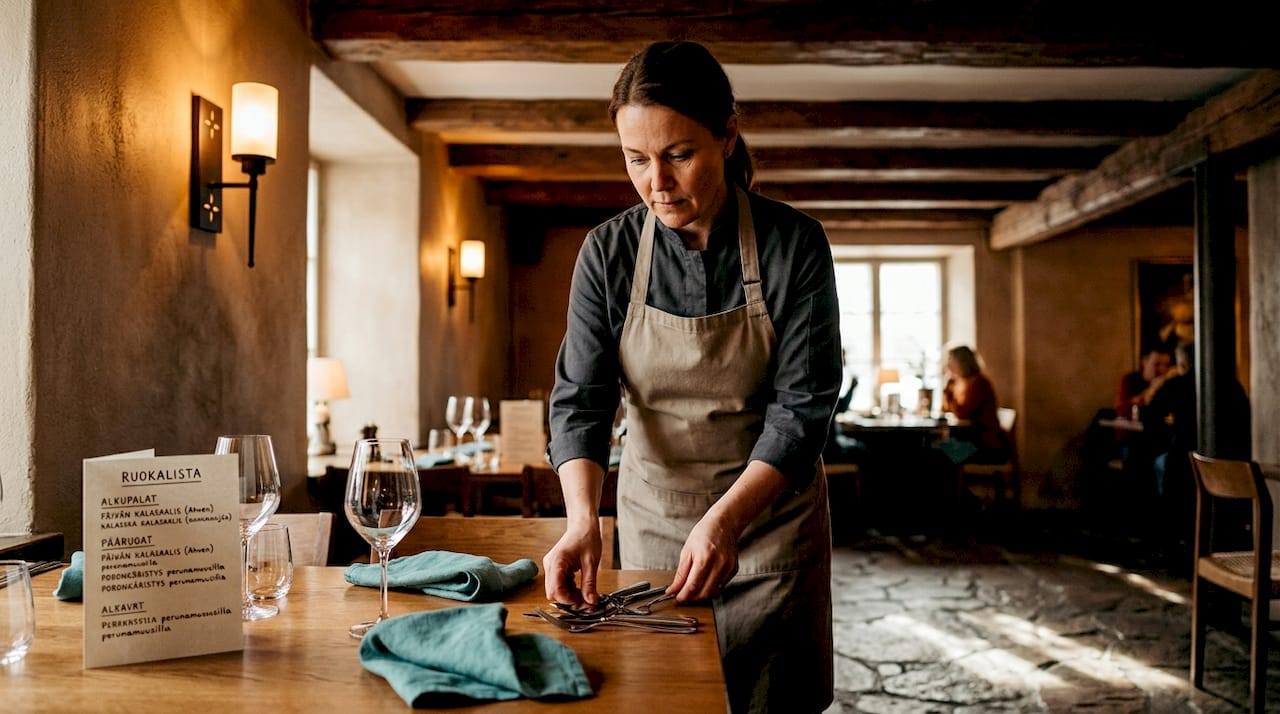
Gallery: Ambient light should be neutral and not compete with the artwork lighting. Artwork lights are precisely aimed, color-rendering luminaires with adjustable angles. Accent lighting can highlight the architecture of the space, but it must not interfere with viewing the artworks.
Pro tip: Use an “ambient base + accent pools” strategy, where the base lighting is uniformly dim and the brightest points are spotlights. This works for both safety and ambiance. The customer moves safely through the space, but their gaze is automatically drawn to the illuminated spots.
Restaurant lighting design tips explain how these principles are implemented in practice in a restaurant environment. The next level is to understand how the direction of light itself changes the nature of shadow and the interpretation of a work.
Light Direction and Shadow Quality: A Multi-Layered Interpretation of Art and Atmosphere
The direction of light is one of the most underestimated variables in space design. Many think that the color temperature and brightness of light are the most important factors, but direction largely determines what kind of shadows are created in a space and how three-dimensional shapes are perceived.
In art galleries, shadow is directly linked to the perception of form and surface as well as the depth of the space. The same artwork looks completely different depending on whether the light comes from above, from the side, or opposite.
Effects of light direction on shadow quality:
| Light Direction | Shadow Type | Effect on artwork or space |
|---|---|---|
| Top-angle light (45°) | Soft cast shadow downwards | Natural, neutral, does not interfere with interpretation |
| Side light | Highlighting side and surface shadow | Textures are emphasized, form emerges strongly |
| Backlight | Silhouette, rim shadow | Dramatic, form stands out dark against light |
| Directly overhead | Harsh, sharp cast shadow | Unnatural, emphasizes top surfaces, deepens recesses |
| From below | Reverse shadow | Confusing, rarely used, strong dramatic effect |
Shadow darkness levels and their use:
- Partial shadow occurs when light is diffused or reflected. It is soft and faint, suitable for background lighting.
- Cast shadow is a sharp-edged shadow created by spotlights. It precisely conveys form and depth.
- Deep shadow refers to an area where light barely penetrates. It creates intensity and intimacy but requires control.
In practice, this means that a spotlight placed in front of an artwork in a gallery should be positioned at an angle of about 30–45 degrees relative to the plane of the artwork. This creates a natural cast shadow that emphasizes relief surfaces and gives the artwork depth without excessively distorting colors or forms.
Factors affecting the readability and atmosphere of an artwork:
- Angle of light relative to the artwork's surface
- Beam width (narrow vs. wide spot)
- Color temperature (warm 2700K vs. neutral 3000K vs. cool 4000K)
- Reflectivity of surrounding surfaces
- Distance from the artwork
- Combined effect of multiple light sources
The best ways to highlight light in restaurant interiors provide concrete examples of how directing light changes the entire character of a space.
In practice, testing shadows should be done before final installation. Move the light source to different locations and angles, photograph the space with a phone from various directions, and compare the images. The photograph reveals the shadow structure much more clearly than the eye perceives in real time.
Innovative Solutions and Practical Applications: Utilizing Light and Shadow in Space Design
Theory only becomes valuable when it translates into practical solutions. Light guides the eye, and the contrast of shadows emphasizes the shape of a space, a principle that can be applied in a phased process.
Step-by-step guide to successful light and shadow design:
- Map the current lighting of the space. Visit the space at different times of day and note where unintentional shadows are created, where the light is too uniform, and where the customer's gaze does not naturally go.
- Identify the most important features of the space. In a restaurant, these might be individual table groups, the bar area, or an architectural detail. In a gallery, they are the placement points of artworks.
- Build layered lighting from bottom to top. Start with ambient light, add task lighting to necessary points, and finish with accent lighting. Do not try to solve everything with a single luminaire.
- Test shadow formation before permanent installation. Use portable luminaires or mobile lamp stands and photograph the result from multiple angles.
- Adjust light directions and angles based on test images. Small changes in angle can completely alter the nature of the shadow.
- Evaluate the result through the customer's eyes. Sit in a customer's seat, stand in front of an artwork in a gallery. The experience matters, not technical perfection.
- Document the final choices. Record the luminaire models, locations, angles, and color temperatures so that the setup can be reproduced later.
Example of a modern restaurant: One of the most effective methods is to use accent lighting in the entrance area, creating a welcoming cast shadow on a door frame or wall element. This acts as a visual draw even before the customer steps inside. The cast shadow makes the architectural form three-dimensional and appealing.
Another effective example is indirect lighting used in dining areas, where light is reflected through the ceiling or wall. This produces a soft, broad partial shadow that surrounds the table and creates its own microcosm without clear boundaries.
Pro tip: Test shadows at different times of day. The most distinctive shadows often arise when light and space interact under changing conditions, for example, the combined effect of afternoon sunlight and indoor lighting. If the restaurant is open both during the day and in the evening, ensure that the designed layered lighting works in both situations.
Also consider the movement of people in the space. Light and shadow are not static elements when the space is filled with people. As a customer moves, they change the shadow arrangements, and the design should take this into account. For example, too narrow light strips can create uncomfortable dark areas where a person stands while talking. Lighting design tips for restaurants provide practical examples for managing precisely such situations.
Innovative material solutions complement lighting design. Surfaces with very low reflectance, such as super-black effect surfaces, absorb light in a way that makes shadows deeper and contrast stronger. Such surfaces can serve as a contrasting element on a wall or as a background for an artwork, making the spotlight appear even brighter compared to the surrounding surface.
The Surprising Lesson of Light and Shadow: Fear of Contrast Deprives Spaces of Character
Years of experience in spatial design repeatedly reveal the same mistake: designers fear shadows. This fear is not entirely irrational, as a dark corner or poorly lit step is a safety hazard. But this justified concern has evolved into a broader overcautiousness that destroys the atmosphere even before a customer steps into the space.
Shadow should not be seen as an automatic error, as contrast is a prerequisite for depth and meaning. This is a simple but revolutionary idea. When a designer accepts that part of a space can be darker, everything changes. Bright areas feel brighter when contrasted against dark. Textures emerge. The space gains character.
The biggest single mistake is the pursuit of uniform, contrast-less light. This often happens when a client demands "more light" without anyone asking for what and how. An electrician installs more spotlights, an architect approves, and the result is an office-like space that no one remembers.
The impact of layering on atmosphere can be directly measured in customer experience. Studies in restaurant psychology show that in dimly lit environments, customers stay longer, order more, and rate food quality higher. This is not because people want to eat in the dark, but because controlled contrast creates a sense of uniqueness and the place's own identity.
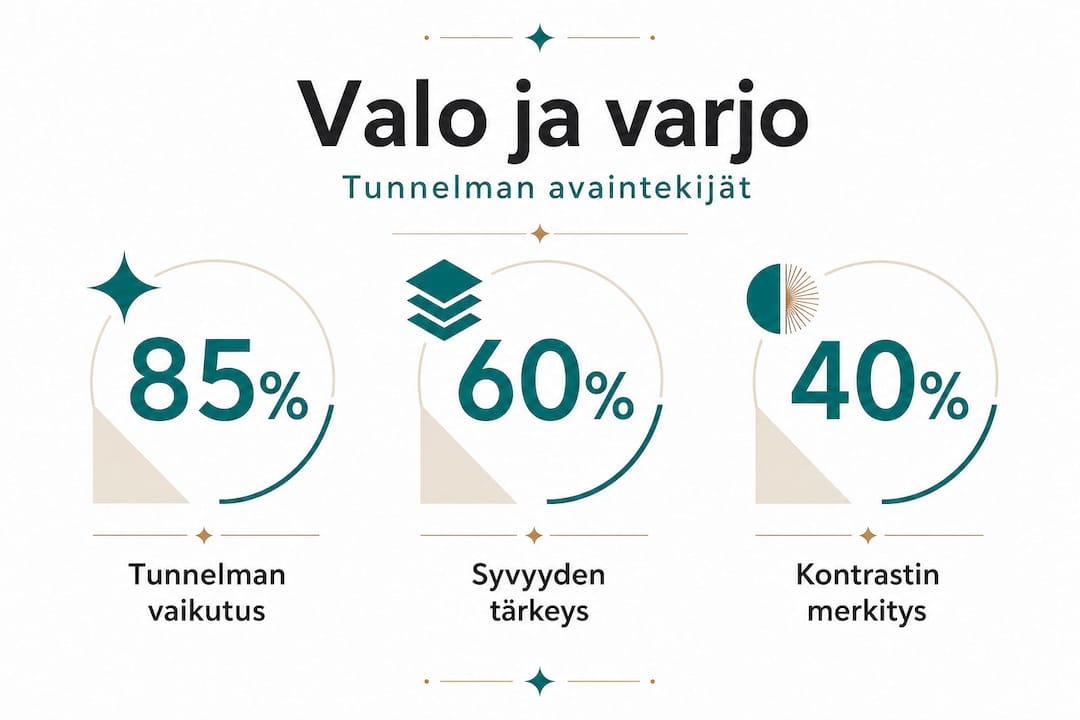
In galleries, the story is the same. Artworks do not shine if everything is equally bright. An artwork needs a contrast, a dark background, or at least a dimmer environment for a spotlight to do its job. This is the paradox that many designers do not understand: an artwork looks better when there is less light around it, not more.
The courage to use shadows intentionally is a skill that sets creators apart. It is not enough to know how to choose the right luminaires or calculate the correct lux values. One must dare to leave part of a space darker than building regulations would require. One must dare to tell a client that this dark corner is intentional and it makes the space better.
Boldly experiment with different light-shadow ratios. Change the contrast ratio in small steps and observe how the space reacts. Often, the optimal solution is found where intuition starts to feel a little uncomfortable, just on the other side of that boundary.
Take Space Design to the Next Level with Dekoja.net
Controlling light and shadow begins with material choices. When the groundwork is done with the right surfaces, lighting design produces results that cannot be achieved with lamps alone.

Dekoja.net supplies specialized materials from a domestic warehouse in Finland that restaurant and gallery designers need to create contrast surfaces and effect walls. The selection includes Musou Black paint and fabrics, super black surfaces, anti-reflective materials, and visual effect surfaces that others do not offer. Fast 1-3 business day deliveries and B2B service for projects make collaboration smooth. Contact us and tell us about your project; we will help you through it from start to finish.
Frequently Asked Questions About the Use of Light and Shadow
Why should shadows be utilized in restaurant design?
Shadows bring depth and hierarchy to a space and make lighting multidimensional and atmospheric. Shadow gives meaning to light and transforms a space from a two-dimensional to a three-dimensional experience.
When should layered lighting be used?
Layering is advisable whenever one wants to emphasize the shapes of a space and create varied atmospheres. The layer principle is emphasized in lighting design, and it is especially important in restaurants and galleries where atmosphere is a key part of the customer experience.
How do I test the relationship between light and shadow in a gallery?
Experiment with the placement of luminaires and adjust the directions of light to test the quality of shadows at different points. Different light directions create different shadow and darkness ratios, so even small changes in angles can completely alter the mood of an artwork.
Does strong contrast make a space too harsh or unpleasant?
Stable contrast gives a space character and depth, as long as it is controlled and not too sharp. Contrast and controlled dark areas are prerequisites for depth, and when properly implemented, they make a space memorable rather than oppressive.