

Emphasizing lighting in interior design: Create an impressive result
Lighting design in restaurants and design accommodation in Central Europe requires a careful analysis of the intended use of each space and the expectations of the customers. Lighting requirements are defined in the SFS-EN 12464-1 standard, and the flexibility of lighting is an essential part of successful design. Here you will learn how to create a whole by combining the needs of the space, sustainable materials and creative solutions to take the customer experience to the next level.
Table of contents
- Step 1: analyze the lighting needs and goals of the space
- Step 2: choose suitable materials and effect surfaces
- Step 3: Plan lighting placement and contrasts
- Step 4: implement the integration of lighting and surfaces
- Step 5: Test and adjust the final lighting effect
Quick Summary
| Key Point | Explanation |
|---|---|
| 1. Analyze the space needs carefully | Lighting design should be based on the use of the space and the expectations of the users. Different spaces require different lighting solutions. |
| 2. Choose the right materials | Material choices have a major impact on the efficiency and aesthetics of lighting. The right surfaces support the functionality of lighting. |
| 3. Plan the placement of lighting | By placing the lights, you can create pleasant contrasts and accents that affect the atmosphere of the space. |
| 4. Test the lighting in practice | Use the lighting in real-world conditions to see its effect. Make any necessary adjustments to ensure functionality. |
| 5. Document the process carefully | It is a good idea to record all adjustments and observations. This will facilitate maintenance and future changes, allowing for improvements. |
Step 1: Analyze the lighting needs and goals of the space
Before you start lighting design, you need to understand what is expected of the space in terms of lighting. This analysis is the foundation of lighting design and determines how all your other decisions will shape up. A restaurant, designer accommodation or other spaces require different lighting solutions, and it is not a random choice but a careful analysis.
Start by identifying the main purpose of the space. Is it a restaurant hall where customers dine, or a bar area where socializing and ambiance are a priority? Or perhaps it is a reception or lounge area in a hotel. All of these spaces have different lighting requirements that are standardized . Consider what users will be doing in the space and what role the lighting plays in their experience. For example, a restaurant that aims for an intimate atmosphere will need a completely different level of lighting than a conference room where visual tasks require higher levels of lighting.
Also remember that the flexibility of your lighting is critical. Customers will arrive at different times of the day and under different circumstances. Going from an afternoon atmosphere to a dinner party requires lighting solutions that you can adjust as needed. This doesn’t mean you have to play with every light individually, but rather create systems that allow for quick changes without the space becoming a church or a basement.
Write down your specific goals. Do you want to emphasize certain architectural elements? Are you aiming for drama, warmth, or a professional impression? These answers will guide every subsequent choice you make. In Central European restaurants and design accommodations, customers expect visual consistency that supports the brand identity.
Also consider energy savings and sustainability. Modern lighting design is not only about aesthetics but also about sustainability. Choose technology and materials that will last over time and reduce operational costs.
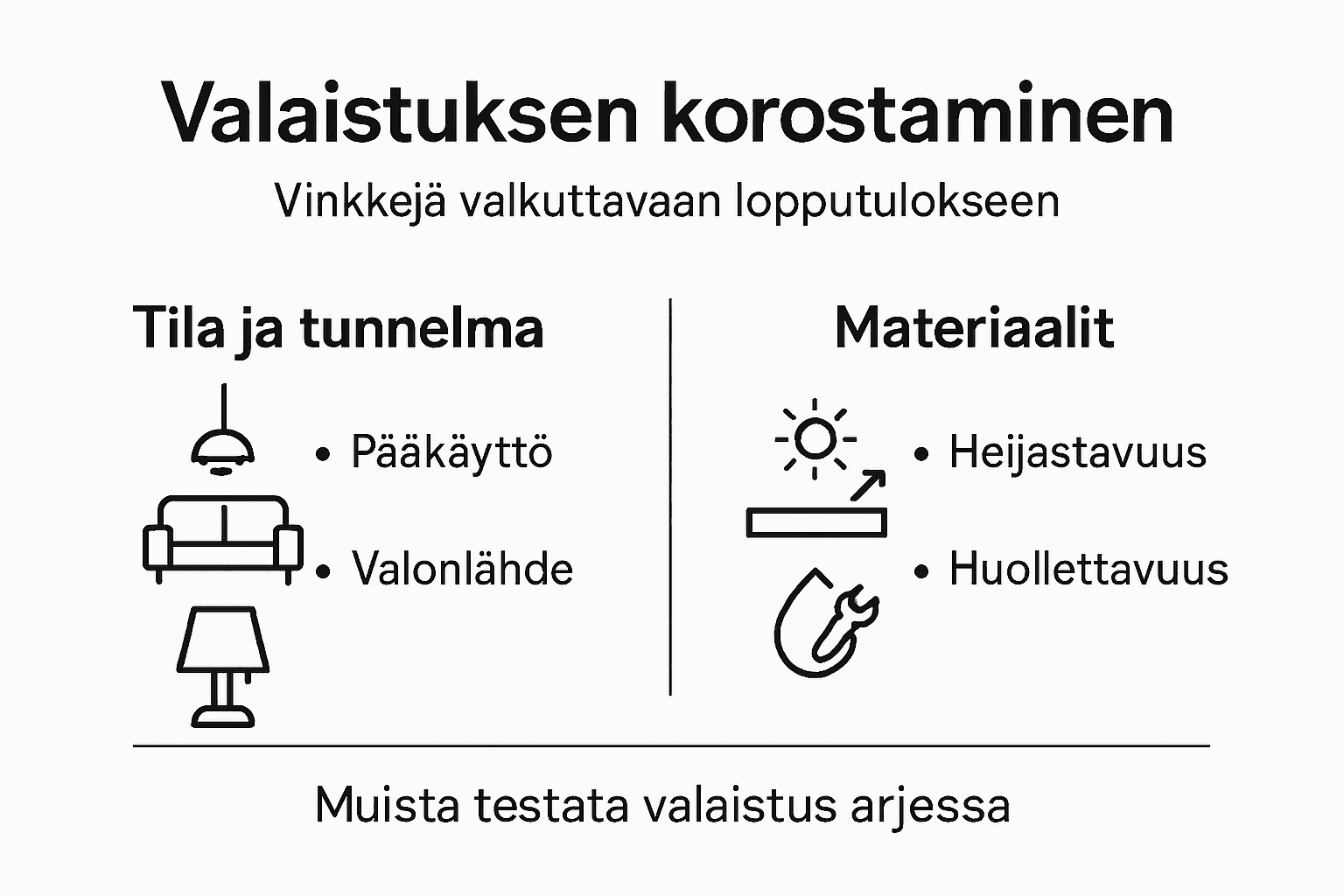
Pro Tip Document the lighting needs of each space in writing and take photos during the day, evening, and night to see how natural and ambient light affect your space. This will dramatically change your understanding.
Step 2: Choose suitable materials and effect surfaces
Material choices determine how lighting interacts with your space. The right materials not only look good, but they also work with the lighting to create the visual effect you were aiming for in the analysis phase. Lighting that hits a matte surface behaves completely differently than lighting that hits a reflective surface. This is crucial.
Start by exploring how different materials react to light. Accent lighting often requires a combination of reflective or semi-reflective surfaces and deep, light-absorbing surfaces. Lighting needs contrast to work. If a space has only matte surfaces or only reflective surfaces, the lighting will either be lacking or false. Mixing is key. You can use durable materials like bamboo and cork , which have a natural texture that works with the lighting. These materials are not only environmentally friendly, but they also create depth that the lighting can highlight. Solid wood and natural stone are classic choices that will stand the test of time and retain their appeal year after year.
Effect surfaces are where interior design and lighting really meet. These are surfaces that are designed specifically with lighting in mind. This can mean matt finishes that absorb light to create contrast, or finishes with special optical properties. In a restaurant or designer accommodation, effect surfaces are not a luxury but a strategic investment. They form the foundation on which the lighting builds. Consider whether you want the surfaces to be neutral or active. Neutral surfaces like light grey or white give the lighting the lead role. Active surfaces like dark or textured surfaces create depth and drama.
Also consider how the materials will be maintained. Materials suitable for lighting can be sensitive to dirt or use. In restaurants and accommodations, durability is critical. Choose materials that will retain their appearance after months and years. This often means making practical choices that serve both aesthetics and functionality.
Once you have the materials and effect surfaces in mind in your drawing, you will then combine them with the right lighting design. But first you need to have a foundation that supports everything you are going to do. Materials are the canvas on which the lighting paints.
Pro tip: Order samples of any materials you are considering and test them under different lighting in the same space where they will be used before making a final decision. Samples will look completely different in exhibition lighting compared to real-life use.
Below is a summary of the properties of materials and effect surfaces from a lighting perspective:
| Material | Behavior of light | Visual impact | Resistance |
|---|---|---|---|
| Matte finish | Absorbs light | Calm, soft | Good wear resistance |
| Reflective surface | Reflects light | Vibrant, bright | Prone to scratching |
| Rough surface | Highlights shadows | Depth, texture | Difficult to clean |
| Natural material | Converts color warmth | Natural, warm | Usually long-lived |
Step 3: Plan lighting placement and contrasts
Now that you have your materials selected, it’s time to plan where the lighting will be placed and how it will create contrast. This step will transform the experience of your space from ordinary to extraordinary. Lighting placement is a precise combination of technique and artistic vision, and it requires thinking in all three dimensions.
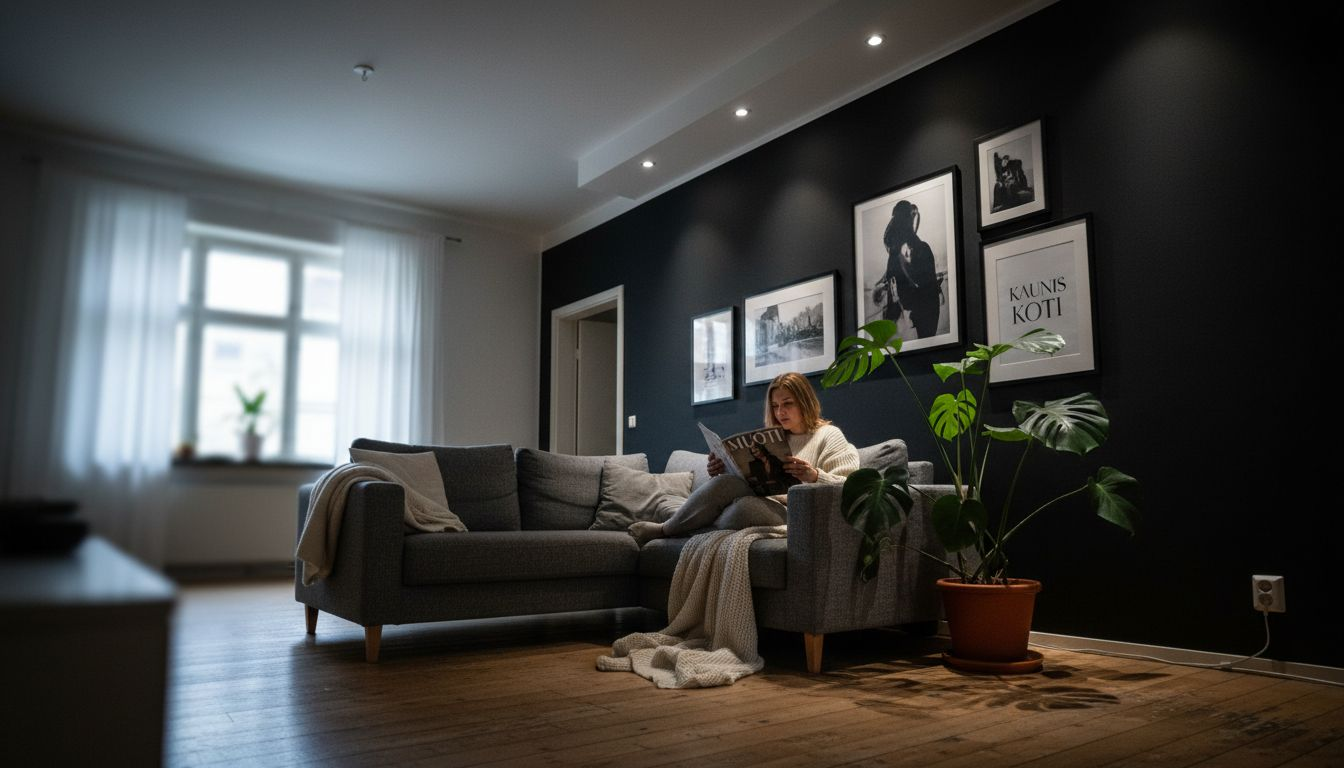
Start by mapping out the architectural features and design elements in the space that you want to highlight. Do you want the eye to stop at the main wall of the restaurant? Or perhaps the bar counter or the ceiling? Lighting can help you highlight the architecture and design elements of the space by creating strategic contrasts. This is done on three levels. General lighting provides basic lighting, spotlights highlight specific areas or objects, and mood lighting creates emotional depth. They are not competitors but rather working together. In a restaurant at night, spotlights and mood lighting can highlight what general lighting dominates during the day.
Next, consider glare and shadows. Glare is the enemy of lighting design. It tires customers and makes a space uncomfortable. Shadows, on the other hand, can be artistic when used correctly, but in the wrong place they can make a space feel oppressive. Proper placement of lighting is essential to avoid glare and create contrast . This means that the location of the lamp should not be directly at the customer’s eye level, and the lighting should be connected to the materials you have chosen. Matte surfaces absorb light and limit reflections, while active surfaces reflect light and create depth.
Contrast is the essence of lighting. Without contrast, lighting has no effect. You can create contrast in three ways. First, with color temperature contrast, where warm light (2700 Kelvin) contrasts with cool light (4000 Kelvin or more). Second, with intensity contrast, where bright light stands alongside soft or slightly dimmer light. Third, with material contrast, where dark surfaces contrast with lighter surfaces and the light emphasizes these differences. In design accommodations, you can use contrast to create different spaces in the same square meters. The bedroom is soft and warm, the living room is dynamic and contrasting.
With the right placement, the lighting becomes invisible. Customers don’t see bulbs or wires, they only see a space that feels personally designed for them. They experience a depth that they can’t name but that makes the space memorable. Next, you install the lighting and test how it works.
The following table summarizes different lighting solutions and their effects on the atmosphere of the space:
| Lighting type | Intended use | Mood effect | Maintenance challenges |
|---|---|---|---|
| General lighting | Basic operations | Neutral, flat | Easy, long-lasting |
| Spotlight | Highlights | Dynamic, precise | Micro-targeting, maintenance |
| Mood lighting | Emotional depth | Intimate, warm | Need for adjustment, changes |
| Indirect light | Soft contrasts | Cozy, harmonious | Structural installation |
Pro tip _Use three different scenarios for your main lighting design: bright daytime functional lighting, moody ambient lighting, and dramatic nighttime lighting. Test each scenario with the right materials and colors at different times of day to see how natural light and interior lighting interact.
Step 4: Implement lighting and surface integration
This is where theory becomes practice. Combining lighting and materials is not a coincidence but a meticulous process that requires testing and fine-tuning. This is the stage where you really see how all the elements of the previous decisions work together.
Start by testing the lighting with the materials in the conditions they will be in. If you chose a matte black surface, it will look completely different under bright halogen light than under warm LED lighting. If you chose light wood, its grains and texture will appear completely different depending on which direction the light comes from. Light affects the perception of colors, and therefore when choosing materials and surfaces, you should consider the effect of lighting on colors and the appearance of the space . This is not a philosophical question, but a practical reality, understanding which will dramatically change the final result.
Next, consider how direct and indirect light interact with surfaces. Direct light creates strong shadows and highlights structure. Indirect light softens and evens out. In a restaurant or design accommodation, you will often use both. Direct spotlights can reflect off architectural detail, while indirect light softens its surroundings. Indirect light softens surfaces and highlights their texture, creating a sense of coziness and depth to the space . This is especially important if you are using a material palette that has both smooth and rough surfaces.
Now experiment with your lighting at different times. Test it during the day when natural light is strong. Test it in the evening when natural light is weak. Test it at night when the lighting is the only light in the space. Each of these situations reveals different things. During the day you can see how your lighting complements or competes with the natural light. At night you can see the transition, which for many users of the space is a critical moment. At night you can see the true impact of your lighting.
The colors of your materials change depending on the lighting. Dark wood can look dead under cold lighting but alive and warm under warm LED lighting. Matte surfaces can look streaky if the lighting is not uniform. Mirrored surfaces can visibly reflect the lights, which is not desirable. Each of these observations is a learning opportunity. Adjust the position of the lights, use diffusers, change the color temperature or the power of the light. Materials and lighting are a constant negotiation until they find an adaptation.
Once you are done testing and are satisfied with the results, document each setup. Take photos, write down the color temperature, wattage, and light type for each area. This documentation will be useful for maintenance and any future changes.
Pro Tip: Use professional photography equipment or your smartphone's camera's manual mode when testing. Your smartphone's automatic compensation often distorts the actual lighting, so manual control shows the space as the eye sees it.
Step 5: Test and adjust the final lighting effect
You’re now nearing the end. The lighting is installed, the materials are in place, and it’s time to see how everything actually works. Testing and adjusting are the final steps that turn good lighting into great lighting. This is not a quick process, but one that requires patience and careful observation.
Start by testing the lighting in conditions where the space will actually be used. If this is a restaurant, test it during opening hours for customers. If it is a design accommodation, test it with guests staying. Test lighting helps you see how the light behaves in the space, and whether the materials and surfaces are reacting as you expected. This is a critical point because practical use reveals things that the design cannot predict. How do people moving around affect the shape of shadows? How do diners see their food illuminated? How do guests’ faces look with this lighting?
By taking advantage of the control options available with different lighting devices, you can create variable moods and optimize lighting for different times of day and situations . This means you should have the means to adjust the lighting. Dimmers are a basic feature, but adjusting the color temperature is also valuable. Warmer light in the evening creates a different mood than more neutral light during the day. Also consider whether you want some areas that can be switched off or changed independently. In a restaurant, the lighting at the bar counter could operate independently of the main light.
Next, test your lighting at different times of the day. Test it at sunrise, noon, evening, and night. Each time reveals different things. Sunrise can bring unexpected reflections from a reflective surface. Midday can make interior lighting useless. Evening is a critical transition time. Nighttime reveals the true potential of your lighting. As you test, write down what works and what doesn’t. Is any area too dark? Is any area too bright? Is glare a problem? Is the shape of the shadow unusual?
Now adjust the problem areas. Adjusting the placement and intensity of the lights can create the desired ambiance and ensure comfort. This could mean physically moving the lights, adding diffusers, changing the color temperature, or adjusting the efficiency. Each change should be retested. Adjustment is an iterative process. Small changes can have big effects. Moving lights just a few inches can eliminate glare completely.
Once you are happy with the results, test the lighting one last time under perfect conditions. The space is now fully utilized, the materials are correct, and the lighting is optimized. This is the moment when you can see if the parasite you wanted to create is real. This is the final confirmation that the lighting enhancement has been successful.
Pro Tip Document each adjustment with photos and written notes: what the adjustments were, what you changed, and why. This memo is gold when clients want changes later or when you have a new project of the same type.
Emphasize the uniqueness and depth of your space with lighting
The most important thing in lighting design is to get the right contrast from the materials and surfaces of the space and create light experiences that make the space memorable and functional. This article emphasized the connection between lighting and materials and the need to test different lighting conditions. If you want to take the lighting of your restaurant or design accommodation to the next level, our range of lighting products offers solutions that will create both atmosphere and functionality.

Dekoja.net's specialty is Musou Black – the world's blackest paint and material family that absorbs almost all visible light. It helps create visual contrast that maximizes the depth of a space and makes lighting even more impressive. Also check out our selection of Lemus audio and lighting to complement the experience of your space. Act now and find the tools to create lighting that evokes emotions and stays in the minds of customers. Visit our website Dekoja.net and start revolutionizing your visual impression today.
Frequently asked questions
How do I analyze the lighting needs of a space?
Start by identifying the main purpose of the space and think about what mood you want to create with the lighting. Write down specific goals, such as the lighting requirements of the space at different times of the day or highlighting specific architectural elements.
Which materials are best suited for lighting?
Choose materials that work well with light, such as matte surfaces or reflective surfaces that create beautiful contrasts. Test different materials and keep a selection of long-lasting options so they stay beautiful for years.
How do I plan the placement of lighting?
Design lighting to highlight important architectural features and design elements. Determine the placement of fixtures to avoid glare and use three different lighting options, such as general lighting, spotlighting, and mood lighting.
How do I test and adjust the lighting effect?
Test your lighting in real-world conditions, such as during restaurant hours or in a residential space, and adjust the placement and intensity of your lights as needed. Document all your observations so you can replicate successful setups in future projects.
What is the effect of lighting on the atmosphere of a space?
Lighting creates emotions and moods that can significantly impact the customer experience. Experiment with different lighting solutions at different times of the day and determine what combinations produce the best results.
How to ensure that lighting remains aesthetic in the long term?
Choose durable materials and maintain lighting solutions regularly to ensure their long lifespan. Develop maintenance guidelines and test lighting regularly to ensure its functionality.
Recommendation
- 7 smart interior design ideas for restaurant spaces and design – Dekoja.net
- 7 smart interior design ideas for restaurant spaces and design – Dekoja.net
- 7 smart interior design ideas for restaurant spaces and design – Dekoja.net
- 7 smart interior design ideas for restaurant spaces and design – Dekoja.net