

Outdoor aesthetic solutions for restaurants and accommodations
TL;DR:
- The aesthetic solutions of an outdoor space determine whether a customer stays or walks by. Good design combines visual appeal, safety, and usability sustainably year-round.
The aesthetic solutions of an outdoor space determine whether a customer stays or walks by. A restaurant's terrace or a design accommodation's courtyard is the first point of contact that communicates the brand before anyone has even opened the door. Functional outdoor solutions combine visual appeal, safety, and usability so that none compromises the other. In this article, we'll go through the most important factors for building an outdoor space that is not only beautiful but also functional all year round.
Table of Contents
- Aesthetic Selection Criteria for Outdoor Spaces in Restaurants and Design Accommodations
- Modular Outdoor Furniture – Flexibility and Individuality in Outdoor Space Appearance
- Outdoor Lighting: Layering and Controllability as Enhancers of Space Appearance
- Durable and Multi-Purpose Material Solutions for Outdoor Choices
- Year-Round Greenery: Plant and Structural Solutions in Outdoor Spaces
- Safe Aesthetics: Slip Management and Pathway Design
- Comparison Table of Aesthetic Outdoor Solutions and Their Suitability
- What Does Aesthetics Truly Mean in an Outdoor Space? Designer's Insights
- Enhance Your Outdoor Space's Aesthetics – Explore Dekoja.net's Solutions
- Frequently Asked Questions About Aesthetic Outdoor Solutions
Aesthetic Selection Criteria for Outdoor Spaces in Restaurants and Design Accommodations
Aesthetics in an outdoor space means more than just superficial beauty. It means a space that functions from morning coffee to evening events, from rain to sunshine, from the first customer to the last.
Good outdoor space design starts with four basic criteria:
- Visual Cohesion: Materials, color palettes, and furniture form a clear whole that tells the same story as the interior space.
- Usability: The space must function smoothly regardless of customer numbers or weather conditions. Furniture placement, pathways, and seating arrangements determine daily practicality.
- Safety: Risk of slipping, adequate lighting, and accessible pathways are non-negotiable requirements. Accessibility design guidelines include practical clarifications that can be directly applied to restaurant and accommodation design.
- Longevity: Materials and structures must withstand the Finnish climate without constant maintenance.
Assessing aesthetics based solely on first impressions is misleading. The best way to evaluate a space is to observe how customers move within it. Do pathways become cramped? How quickly does furniture start to look worn after rain? These questions guide better choices than a single promotional image.
Next, we will go through six key aesthetic solutions that will make your space stand out from competitors and function in daily use.
Modular Outdoor Furniture – Flexibility and Individuality in Outdoor Space Appearance
Modular furniture is one of the best-managed practical solutions for outdoor space design. It looks like design, but functions like a tool.
Modular furnishing allows for flexible arrangement of seating areas according to the space's size and usage needs. In a restaurant, this means that the same furniture set serves lunch, evening events, and weekend brunches without new purchases.
Key benefits:
- Seasonal Flexibility: Elements can be rearranged for winter or for the peak summer season.
- Cost-effectiveness: New elements are added as needed, instead of replacing all furniture at once.
- Customer Flow Management: Large groups, intimate couple tables, and lounge areas can all be accommodated with the same furniture.
- Easily Changeable Upholstery: Color and ambiance change with new covers, updating the entire space's look affordably.
The weakness of modular furniture is maintaining cohesion. If elements from different manufacturers are mixed without a plan, the result is cluttered and does not support the brand. Choose one basic series and expand from there.
Professional tip: Choose a modular sofa series with at least eight different configurations where seat cushions are easily removable. This saves storage space in winter and significantly extends product life. Also, see material choices for 2026 to support furniture decisions.
After modularity, we will examine the aesthetic and functional solutions of outdoor lighting.
Outdoor Lighting: Layering and Controllability as Enhancers of Space Appearance
Lighting is the most important atmospheric factor in an outdoor space, rarely planned with sufficient precision. One strong overhead light is not enough. It makes the space feel like a parking garage.
Layering means that an outdoor space has three levels of light: general lighting, ambient lighting (ground lights, plant lighting, candles), and functional spot lighting (dining, stairs, pathways). When these three are in balance, the space looks designed regardless of the time of day.
Controllability is what makes lighting an investment rather than just an expense. Dimmable outdoor lighting options support atmosphere adjustment in restaurants and accommodation environments, so the same space suits afternoon coffee and late-night dinner without physical changes.
Practical considerations for lighting design:
- Warm color temperatures (2700K–3000K) are suitable for restaurants and lounges. Cold light detracts from the diner's mood.
- IP65 rating is the minimum for outdoor use. In Finland's rainy climate, aiming for IP67 is advisable for stairs and near water features.
- Smart lighting and remote control allow managing lighting with a phone without having to physically enter the space.
- Upward plant lighting creates dramatic depth, especially in the evenings, and is one of the most cost-effective ways to elevate the visual level of an outdoor space.
Professional tip: Design lighting layers so that general light can be dimmed to 30 percent without compromising the safety of pathways. This requires that the layering of lighting is designed so that functional light is its own controllable circuit.
Next, we delve into material choices that affect the durability and elegance of an outdoor space.
Durable and Multi-Purpose Material Solutions for Outdoor Choices
The material determines how long a space looks as intended. Poor material begins to deteriorate after the first winter, good material lasts ten years without significant maintenance.
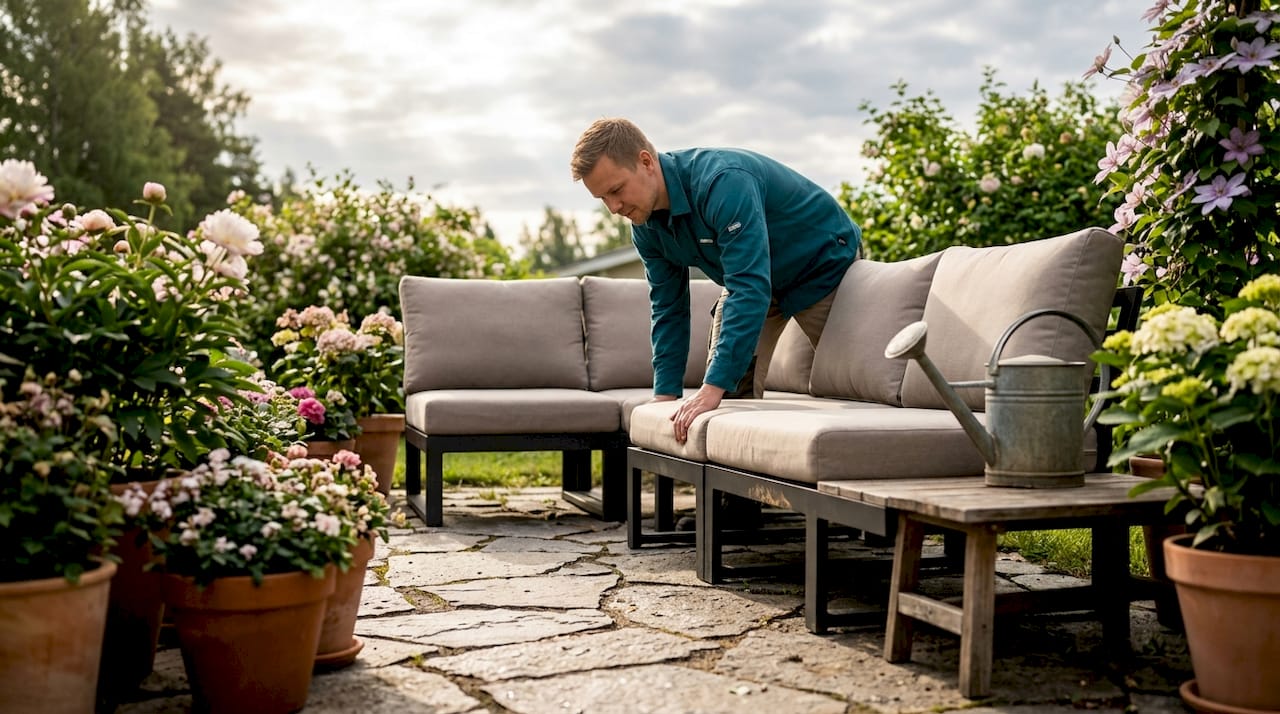
Terrace rug and furniture trends for 2026 point towards natural fibers and technological innovations that support versatility and longevity. This is evident in design projects: more and more clients want materials that don't need to be replaced every spring.
Most popular material categories for outdoor spaces in 2026:
- Artificial Turf Surfaces: Current artificial turfs are UV-stabilized and look almost natural. Suitable for areas where natural grass does not thrive or would wear out quickly.
- Composite Decking: Combines the visual warmth of wood with the durability of plastic. Does not crack, paint, or require oil treatment.
- Polyrattan Furniture: Resistant to moisture, frost, and UV radiation. Easy to maintain and a wide range of colors.
- Natural Fiber Outdoor Rugs: Jute, sisal, and bamboo add warmth and texture, but require a protective coating for outdoor use.
When choosing materials, it's advisable to proceed in order:
- Define the stress level of the space: is the surface exposed to rain, sun, traffic?
- Choose materials based on durability class, not just appearance.
- Check care instructions and assess whether annual maintenance is realistic given resources.
- Test color and texture retention: request a material sample and expose it to sun and moisture for a week.
Creative material solutions combine durability with visual distinctiveness, which is key in competitive markets.
From materials, we move on to plant and structural solutions that support year-round aesthetics.
Year-Round Greenery: Plant and Structural Solutions in Outdoor Spaces
Vegetation is the cheapest way to add depth, structure, and atmosphere to an outdoor space. The problem is that many spaces look lush in summer and desolate in winter. This is a clear design flaw that can be corrected.
Conifers, such as thujas, junipers, and dwarf mountain pines, provide structure and greenery year-round, even in winter months. They are the most reliable elements of an outdoor space: easy to care for, long-lasting, and visually strong.
Layering is created from three vegetational levels:
- Low groundcover plants (sedum, juniper groundcover): fill the base, prevent weed growth, and create cohesion.
- Shrub level (honeysuckle, boxwood, lavender): defines the space's boundaries and acts as a space divider.
- Tall anchor plants or trees: provide scale, shade, and drama.
| Plant | Year-Round | Care Needs | Purpose |
|---|---|---|---|
| Thuja (Thuja) | Yes | Low | Space divider, background plant |
| Juniper (Juniperus) | Yes | Very low | Low areas, groundcover |
| Boxwood (Buxus) | Yes | Moderate | Shaping, edging |
| Lavender (Lavandula) | Partially | Low | Sensory experience, ambiance |
| Dwarf Mountain Pine | Yes | Low | Low structure, winter hardy |
Shrubs can also be used as acoustic solutions for outdoor spaces. A dense hedge row dampens street noise and creates privacy for customers, significantly improving the perceived spatial experience. More inspiration for outdoor plant and structural solutions can be found in specialized design guides.
Next, we will examine the significance of stairs and pathways in safe aesthetics.
Safe Aesthetics: Slip Management and Pathway Design
Safety is the one thing where aesthetics must not win. A beautiful, slippery paved surface is a hazard, not a design masterpiece.
Slippery surfaces on stairs have caused serious fall accidents, which concretely demonstrates that the safety of surfaces cannot be overlooked in the name of aesthetics. This is especially critical in restaurants and accommodations where customers move in unfamiliar environments and often in dim light.
Key principles for a safe outdoor space:
- Clear width of pathways is at least 1200 mm for wheelchair users and strollers. This is not a recommendation but a practical measure for functionality.
- The coefficient of friction for surfaces must meet at least R10 classification in rainy outdoor areas. Dark stones may look stylish, but are often more slippery than lighter and rougher surfaces.
- Stair edge markings do not detract from aesthetics if integrated into the design, for example, by embedding a contrasting strip into the front edge of the step.
- LED strip lights in pathways are both safe and visually striking, and they double as guides for customers to move naturally through the space.
“Safety in an outdoor space is not an obstacle to aesthetics. It is a design task for which a visually functional solution can always be found when it is incorporated into the process early.”
Managing slipperiness in the Finnish climate also means frost-resistant surface materials. Natural stone can crack due to frost heave, so it must be tested before use. See the materials and slip management guide for more detailed recommendations on surface materials.
After this, we will summarize the different solutions by comparing their key features.
Comparison Table of Aesthetic Outdoor Solutions and Their Suitability
The following table summarizes the discussed solutions and helps prioritize investments according to the needs of your space.
| Solution | Visual Impact | Flexibility | Safety Impact | Cost Level | Best Use Case |
|---|---|---|---|---|---|
| Modular furniture | High | Very High | Neutral | Moderate | Restaurant terraces, variable events |
| Layered outdoor lighting | Very High | High | Positive | Moderate–High | Dinners, events, spot lighting |
| Composite decking | High | Low | Positive | Moderate | Permanent terrace structures |
| Conifers and shrubs | Moderate–High | Low | Neutral | Low | Year-round green areas |
| Anti-slip surfaces on stairs | Low | Low | Very Positive | Low | All stairs and wet surfaces |
| Natural fiber rug | Moderate | Moderate | Moderate | Low–Moderate | Lounge and seating areas |
The table clearly shows that the best results are achieved by combining several solutions rather than focusing on a single element. The aesthetic solutions for outdoor spaces work best as a whole, where lighting, materials, furniture, and vegetation support each other.
After the summary table, I will elaborate on my views and practical experiences regarding the aesthetics of outdoor spaces.
What does aesthetics truly mean in an outdoor space? A designer's perspective
In outdoor space design, the same mistake is repeatedly encountered: the client wants a space that looks good in pictures. Not a space that works.
These are different things.
A picture captures only one angle. The client moves throughout the entire space. They sit down, stand up, walk from one end of the terrace to the other, wait for a rain shower to pass. A space designed only from a visual perspective quickly reveals its weaknesses. Tables that are too close to each other, slippery stone surfaces, inadequate lighting on walkways. These detract from the aesthetics and usability of outdoor spaces as much as poor material choices.
Another common misconception is that aesthetics is a one-time project. The space is completed, photographed, and then moved on from. In reality, a high-quality outdoor space requires a maintenance plan. Vegetation changes with the seasons, materials need care, and lighting technology evolves. A space that doesn't live visibly ages.
Modularity is an underestimated answer to this problem. When furniture is adaptable, the space can update its look without major investments. This is a significant long-term competitive advantage, especially for restaurants whose clientele expects something new every season.
The best outdoor space design begins with mapping the user journey. How does the customer arrive at the space? Where do they sit down? What direction do they look in? These questions guide the placement of lighting, furniture, and vegetation better than any single trend solution.
Outdoor space trends for 2026 emphasize sustainability, adaptability, and year-round usability. Landscape design is increasingly integrated with architecture, and outdoor area interior solutions are approaching the level of indoor spaces. This is the right direction, as it means outdoor space is taken seriously and not treated as a mere add-on.
Improve the aesthetics of your outdoor space – explore Dekoja.net's solutions
A visually distinctive outdoor space starts with material options that others don't offer. Dekoja.net specializes in solutions that make a space memorable: super black surfaces, non-reflective materials, and effect surfaces that create contrast and depth even in outdoor areas.

Dekoja.net's materials are suitable for both indoor and outdoor visual solutions, and the expert team provides support throughout the entire project. Material recommendations from Dekoja.net help you choose the right surfaces for your space. Deliveries leave the Finnish warehouse within 1–3 business days, and the B2B service supports project packages for design agencies and restaurants.
Frequently asked questions about outdoor aesthetic solutions
How do aesthetics and safety combine in outdoor space design?
Aesthetic solutions must be designed to support users' safe movement. Slippery stair surfaces have led to serious accidents, emphasizing that safety must be included in the design process from the outset, not added later.
Why is modular furniture popular in restaurant outdoor spaces?
They offer flexibility and allow the space to be adapted according to customer flow and usage needs. Modular furnishing allows elements to be combined in different ways according to the size and purpose of the space, improving the versatility of the outdoor area without constant new purchases.
How does dimmable lighting help in shaping the outdoor space's appearance?
Dimmable lighting allows adjustments for various uses, from lunch dining to late evening events. Remote control options for outdoor lighting support flexible mood setting without physically visiting the space.
What plants should be chosen to keep a garden looking green all year round?
Conifers such as thujas, junipers, and dwarf mountain pines provide structure and greenery even in winter. Conifers maintain greenery year-round and reinforce the space's structure with minimal maintenance, making them ideal for outdoor areas of restaurants and accommodations.