

Invisible Surfaces: Innovative Solutions for Space Design
TL;DR:
- Invisible surfaces control the dynamics of light, shadows, and reflections. They enable specific spatial atmospheres and visual lightness. Technologies such as ALD and biomimetics offer versatile solutions for interior and architectural design.
A space can be shaped so that the material itself disappears, leaving only the dynamics of light, shadows, and reflections. This is the core idea of invisible surfaces, and it is rapidly changing the way restaurants, galleries, and creative studios design their spaces. It's not just about aesthetics: a correctly chosen surface can guide the visitor's gaze, eliminate distracting reflections, and create an atmosphere that cannot be achieved by other means. In this article, we will go through what invisible surfaces mean, how different technologies work, and how to choose the right solution for your project.
Table of Contents
- What are invisible surfaces – concept and solutions
- Light control and thin-film technologies
- Macro-level structures and biomimetics: light guidance through geometry
- Transparent, light-guiding surfaces and immersion: acrylic, PC, and installations
- What most people overlook in the design of invisible surfaces
- Innovative surfaces to support your design project
- Frequently Asked Questions
Key Takeaways
| Point | Details |
|---|---|
| Technologies are becoming more diverse | ALD, biomimetics, and transparent materials offer various solutions for invisibility and light management needs. |
| Design is both aesthetic and functional | Correctly chosen invisible surfaces serve the space's atmosphere and efficiency both technically and visually. |
| Material selection according to the object | It is important to select a method based on experience and usability, for example, acrylic for immersion or ALD for precise light control. |
| Applications are wide-ranging | In restaurants, galleries, and studios, invisible surfaces enable new and impressive spatial experiences. |
What are invisible surfaces – concept and solutions
An invisible surface does not mean that the material literally disappears. It means that the surface behaves with light in such a way that it no longer draws attention to itself. The result can be perfect light absorption, perfect transparency, or the complete elimination of reflections. All three effects can make a material "invisible" in different ways.
In modern space design, invisibility is achieved through four main methods. The first is thin-film technology, where atomic-level coatings change the optical properties of the material. The second is macro-level structures, where the geometry of the surface guides light in multiple directions so that reflection disappears. The third is transparent materials such as acrylic and polycarbonate, which can bend light or blend into their surroundings. The fourth is fiber-based solutions, where the material structure itself absorbs light.
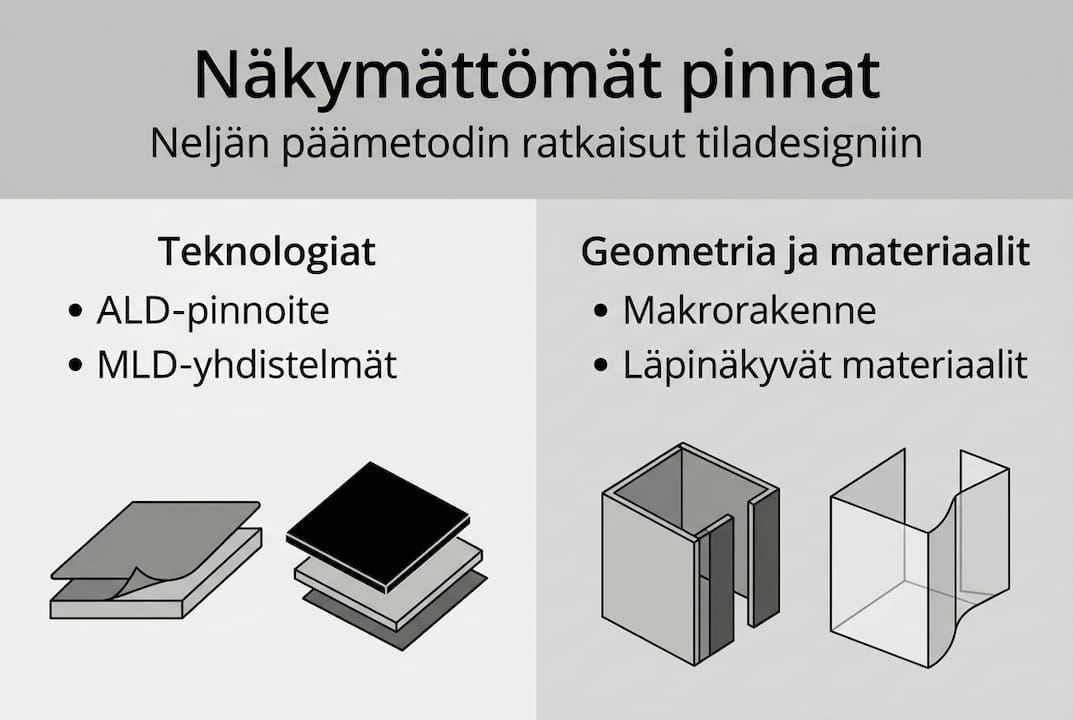
ALD technology (Atomic Layer Deposition), developed in Finland, is one of the most important advances in this field. ALD enables the production of atomic-level thin films, which make surfaces practically invisible through light management. The technology was developed in Finland and is now a globally used method in semiconductor manufacturing, solar cells, and increasingly in architecture.
Stealth materials, such as coatings developed by Lainisalo, also use acrylic and polycarbonate (PC) to create surfaces that blend into the environment or eliminate reflections in architectural objects. These materials work particularly well on facades and interiors where traditional surfaces would shine or be distracting.
| Method | Principle of operation | Typical applications |
|---|---|---|
| ALD thin film | Atomic-level coating | Galleries, studios, presentation technology |
| Macrostructure | Geometric light guidance | Wall surfaces, installations |
| Acrylic/PC | Transparency and light bending | Partitions, artworks |
| Fiber-based | Absorption through structure | Acoustic surfaces, studios |
On a practical level, light absorption in space design means that a designer can remove unwanted reflections, enhance contrasts, and precisely guide a visitor's attention to their desired object. In a gallery, this can mean an artwork stands out from the wall as if floating. In a restaurant, it can create an intimate atmosphere without heavy curtains or partitions.
- Thin films are suitable for objects requiring precise light control in a small space
- Macrostructures work best on larger wall surfaces and in installations
- Transparent materials are suitable for space dividers and immersive elements
- Fiber-based solutions integrate naturally with acoustics
“An invisible surface is not a lack of material, but its highest quality: it serves the space and does not demand attention to itself.”
Light control and thin-film technologies
The core idea of ALD technology is simple: material is grown layer by layer, one atomic layer at a time. This enables a coating that is uniform at the nanometer level and can be adapted to almost any shape. ALD can grow thin films with an accuracy of less than 1 nm and coat complex surfaces, making it unique compared to traditional coating methods.
In practice, this means that a curved wall surface in a restaurant or an irregular sculpture in a gallery can be coated as evenly as a flat plate. The result is a surface that does not reflect light undesirably or create distracting glares.
ALD/MLD combinations enable flexible, poorly heat-conducting, and light-absorbing coatings. MLD (Molecular Layer Deposition) adds flexibility, which is important for surfaces exposed to temperature fluctuations or mechanical stress. The combination is particularly well-suited for applications where the surface has both functional and aesthetic requirements.
| Method | Accuracy | Flexibility | Heat resistance | Application |
|---|---|---|---|---|
| ALD | < 1 nm | Low | High | Galleries, studios |
| MLD | 1-5 nm | High | Moderate | Restaurants, facades |
| Traditional coating | 10-100 µm | High | Varies | General use |
In project planning, ALD technology should be considered early on:
- Define what light behavior you want to change: absorption, reflection, or transmission
- Determine the shape and material of the surface to be coated
- Assess the operating conditions of the space: temperature, humidity, mechanical stress
- Choose ALD, MLD, or a combination as needed
- Consider cleanability and maintenance intervals already in the design phase
Professional tip: Light absorption in construction is not just an aesthetic issue. A correctly chosen thin film can also reduce the thermal load of a space by reducing the heat absorption or emission of surfaces, which is particularly important in large galleries and restaurants with intensive lighting. Also, consider smart home material choices combined with thin-film solutions when designing spaces where lighting is automated.
Practical examples can already be found in several Finnish locations. In presentation technology, ALD-coated reflectors are used to precisely direct light without distracting reflections. In galleries, coated wall surfaces are used to create a neutral background that does not compete with artworks. In studios, matte ALD surfaces eliminate unwanted reflections in camera work.
Macro-level structures and biomimetics: light guidance through geometry
Alongside thin films, there is another, more visually impactful approach: the macrostructure of the surface. In this approach, light absorption or guidance is not based on a chemical coating but on the geometry of the surface. Nature is the best teacher here.
The gyroid is a mathematical surface found in the structure of butterfly wings and the bones of some sea cucumbers. It is a curved surface shape that divides space into two interweaving but separate regions. When this structure is implemented in a wall surface, light reflects multiple times within the structure before exiting, and each reflection reduces the intensity. Macroscopic structures use gyroid and Schwarz D shapes to trap light, reducing reflection by over 35%, without altering the materials.
| Structure | Inspiration | Reflection reduction | Additional feature |
|---|---|---|---|
| Gyroid | Butterfly wing | 35 %+ | Lightness, heat transfer |
| Schwarz D | Sea cucumber | 30 %+ | Strength, durability |
| Honeycomb | Beehive | 20-25 % | Acoustics |
| Pillar array | Silkworm silk | 25-30 % | Flexibility |
Biomimetic structures offer several advantages simultaneously:
- Minimizing reflections without chemical coatings
- Lightness: lattice structures can be up to 80% lighter than solid surfaces
- Improved heat transfer, reducing the thermal load of the space
- Possibility to combine acoustic properties into the same structure
However, practical limitations should be noted. Complex geometric structures are challenging to clean. Dust, grease, and other impurities accumulate inside the structure, and ordinary cleaning methods do not always reach all surfaces. This is particularly important in restaurants, where hygiene standards are strict.
Professional tip: Design cleanability into the structure's geometry from the start. Choose a structure with sufficiently large openings for pressure washing or brush cleaning. Request a cleaning test report from the supplier before making the final material selection. Layered lighting and the combination of macrostructures work best when both are designed to be compatible from the outset.
Abrasion, or surface wear, is another factor to consider. Lattice structures are thin-walled and can wear out faster than solid surfaces in areas with high mechanical stress. In public spaces, such as restaurants, this means that the structure should be placed in areas that are not directly touched.
Transparent, light-guiding surfaces and immersion: acrylic, PC, and installations
Technical and structural solutions are not the only ways to create invisibility. Transparent materials, especially acrylic and polycarbonate, can do the same through a different mechanism: they do not absorb light but allow it to pass through or bend it so that the material itself disappears from view.
Heated clear acrylic allows 90% transparency and the material to almost disappear into light phenomena. This means that an acrylic partition or installation can be practically invisible when the lighting is adjusted correctly. The result is a space where boundaries exist functionally but disappear visually.
The possibilities of using acrylic and polycarbonate in space design are extensive:
- Space dividers: Transparent partitions functionally divide space without visual mass
- Installations: Light installations within acrylic create three-dimensional effects
- Ceiling surfaces: Transparent ceiling elements bring natural light deeper into the space
- Artworks: Acrylic sculptures can change their appearance according to lighting
- Reflective surfaces: Partially mirrored acrylic creates a sense of depth in small spaces
Polycarbonate is a more durable alternative to acrylic for applications with more mechanical stress. It is also more malleable with heat, allowing for curved shapes without joints. Acrylic, on the other hand, offers better optical clarity and is easier to polish if the surface gets scratched.
“When the material disappears and only light remains, the space begins to feel larger than it is. This is the true power of transparent surfaces.”
Immersion occurs when the viewer can no longer distinguish where the space ends and where the installation begins. This is achieved by combining transparent surfaces, thoughtful lighting, and the placement of surfaces so that reflections and permeability create depth. In a restaurant, this can mean that the diner sits in a seemingly floating space. In a gallery, the artwork can feel like it is suspended in the air.
What most people overlook in the design of invisible surfaces
The most common mistake in designing invisible surfaces is to approach them merely as technical solutions. The best ALD coating or the most durable macrostructure is chosen, but how the surface affects the overall experience of the space from a human perspective is forgotten.
Invisibility is always relative. A surface that is invisible in one lighting condition may be very visible in another. This means that light absorption and spatial experience must be designed together, not separately. The lighting designer and the surface material selector must sit at the same table from the very beginning.
Another often overlooked aspect is that the bold combination of different invisibility technologies yields the best result. An ALD-coated wall combined with a transparent acrylic installation and a macrostructured ceiling element creates an experience that no single technology alone can produce. The dynamics of the overall experience are more than the sum of their parts, and it is precisely this dynamic that is too often missed when comparing only technical data.
Innovative surfaces to support your design project
If you want to take your next project to the next level, the right materials and expert support are crucial. Invisible surfaces, light absorption, and visual effect solutions require precise material selection and project-specific expertise.
Dekoja.net supplies Musou Black and other super black effect surfaces directly from domestic stock, quickly within 1-3 business days. In our selection, you will find non-reflective materials, optical illusion surfaces, and all necessary solutions for restaurants, galleries, and creative studios. B2B service for projects and design offices is available, and our expert will help you through the project from start to finish. Contact us and tell us about your project.
Frequently Asked Questions
How do invisible surfaces work in practice in a gallery or restaurant space?
They eliminate light reflections and make the space visually lighter by directing or absorbing light using various techniques, such as thin films or macro-lattice structures. Surfaces coated with ALD technology manage light in such a way that the material disappears from view.
```Are invisible surfaces durable and easy to maintain?
Most technologies, such as ALD, advanced structures, and stealth coatings, combine easy cleanability and wear resistance, but the individual choice should be made according to the use of the space. Complex geometric structures require special attention when cleaning.
Can invisible surfaces be combined with acoustics or lighting technology?
Yes, many solutions such as fibrous acoustic surfaces and transparent or absorbent materials can be designed to work in conjunction with lighting and acoustics. ALD and macro-level solutions can be utilized in both lighting and acoustic control in space design.
How does the combination of lighting and invisible surfaces affect the ambiance?
The combined effect of lighting and optically guiding surfaces allows for changing the look of the space, enhancing contrasts, and subtly modifying the ambiance without heavy structures. With light-guiding structures and transparent acrylic walls, the entire visual dynamics of the space change.