

Light Absorption in Spatial Design – Maximum Contrast and Aesthetics
Every interior designer in Central Europe knows how crucial light control is to the atmosphere of a space. In restaurants and art installations, the absorption or reflectivity of a surface can change the direction of the entire experience. Musou Black offers the opportunity to take contrast and depth to a new level, as it absorbs a staggering 99.4 percent of the light that hits it, creating a strong visual impact without disturbing reflections. This article explains how absorption technology and the right materials determine the atmosphere and functionality of a space.
Table of contents
- Light absorption and its scientific basis
- Difference in absorption and reflectivity of surfaces
- Musou black and other special materials
- The impact of visual appearance on spatial experience
- Common mistakes when using absorption surfaces
Key assembly points
| Paragraph | Detail |
|---|---|
| Light absorption and reflection are key to the visual appearance of a space | The behavior of light on a surface determines how a space is perceived and how it affects its mood. |
| Dark color improves absorption | Dark colors absorb more light, creating dramatic visual effects, especially on background surfaces. |
| The right lighting is crucial | The effectiveness of absorption surfaces is only visible in the right lighting; lighting should be considered in the design. |
| Wrong decisions can ruin the look of the space | Poor material choices and uneven application can be visible in the lighting and weaken the content. |
Light absorption and its scientific basis
Light is energy that travels through space in the form of waves. When light encounters a material, something happens: some is reflected, some is transmitted, and some is absorbed. Absorption is the process by which light loses its energy in the medium.
Understanding begins with the concept of photons. Light is made up of tiny packets of energy called photons . When a photon hits an atom or molecule, it can transfer energy to an electron, causing the electron to move to a higher energy level.
How light is absorbed by materials
As light passes through a medium, it is gradually attenuated. This attenuation is measured by two factors:
- Transmittance – how much light passes through the material
- Absorbance – how much light a material absorbs
The Beer-Lambert law explains this mathematically: absorption depends on the thickness of the material and its coupling strength.
It's simple: thicker material absorbs more light. Strongly colored materials absorb more than weakly colored ones.
Energy and color relationship
Different colors are absorbed differently. Blue light is the most energetic, red light is the least energetic. High-energy light penetrates deeper, while weaker light stays near the surface.
Black materials are master absorbers. They absorb up to 99 percent of visible light instead of reflecting it. This is completely different from regular black paint.
When light is absorbed by a material, it turns into heat, which we cannot see with our eyes. Visible light disappears.
Practical application in interior design
In restaurants and art spaces, absorption creates dramatic effects:
- Museat surface absorbs reflected light
- The contrast between the intermediate stages intensifies
- Lighting guides the viewer's eye precisely
- Depth and three-dimensionality increase
When the background wall absorbs light well, any illuminated element in the foreground stands out. This is a visual exploitation of the law and physics.
Pro tip : Choose materials by testing: install a sample piece, illuminate it the same way as the final space and evaluate how it changes the contrast. The right absorption solution makes the biggest difference.
Difference in absorption and reflectivity of surfaces
Two surfaces can have completely different effects on light, even though they look the same. The difference is fundamental: absorption sucks up light energy and turns it into heat, while reflectivity sends light back.
By understanding these two concepts, you will master the visual appearance of a space. They are not opposites – they are complete opposing forces.
What happens when light hits a surface?
When a beam of light falls on a surface, three things can happen:
- Light is reflected back into our eyes
- Light is absorbed by the material and converted into energy
- Light penetrates through the material
Light and reflective surfaces reflect sunlight, while dark surfaces absorb it. These properties differ dramatically in their effect on a space.
Absorptive surfaces
Absorptive surfaces absorb light and hold it in. The light does not escape the surface, but disappears. The energy is converted into heat and invisible radiation.
Black paint is a good example. Regular black absorbs about 80–90 percent of light. Exceptionally absorptive materials like Musou Black absorb 99.4 percent.
Why is this important in restaurants? When the background wall is highly absorbent, the elements in the foreground are emphasized. Contrast is created by separation.
Reflective surfaces
Reflective surfaces reflect light back. Like mirrors, they send light back where it came from. Light surfaces reflect, shiny surfaces reflect strongly.
The reflective surface remains light and looks pale. It diffuses the light, making the space feel more open and larger. The light “splashes” around.
Reflectivity is useful for smaller spaces where more light and openness are desired.
The table below summarizes the key physical factors affecting light absorption and reflectivity in interior design:
| Factor | Effect on absorption | Effect on reflectivity |
|---|---|---|
| Material color | Dark enhances absorption | Light increases recovery |
| Finish | Matte surface enhances absorption | The shiny surface reflects effectively |
| Material structure | Porous absorbs more light | Compact returns light more efficiently |
| Thickness | Thick absorbs more | Thin partially transmits light |
Practical difference in restaurants
| Feature | Absorbent surface | Reflective surface |
|---|---|---|
| Behavior of light | Sucks and suffocates | Repatriate |
| Contrast | Maximal | Impaired |
| Sense of space | Intimate, dramatic | Open, light |
| Light control | Accurate and efficient | Scattered |
Absorption creates depth and definition. Reflection distributes light evenly throughout.
Absorptive surfaces are theatrical. They make the lighting the hero . Reflective surfaces are democratic – the light is shared equally for everyone.
Pro tip : Combine both: an absorptive background wall makes illuminated elements dramatic, while white ceiling heights reflect overhead lighting. Contrast creates dynamics.
Musou Black and other special materials
Just ordinary paints are not enough when you want to create a truly unforgettable space. Special materials are the tools that turn physics into art. Musou Black is almost legendary among them.
Musou Black is a water-based acrylic model that absorbs 99.4 percent of the light that hits it. It is as close to black as humans can see without special equipment. The effect is hypnotic.
What makes Musou Black different?
Musou Black absorbs 99.4 percent of light , making the surface look like a three-dimensional hole instead of a flat surface. No light reflection, no glare, no reduced reflection – nothing.
Regular black paint absorbs about 80 percent. The remaining 20 percent is reflected back to our eyes. There's a little bit of shine, a little bit of reflection. Musou Black eliminates that completely.
Why is this important? Because reflection is a trick of the eye. It makes a surface look like a surface. Musou Black makes it appear black, like the color of a dead body .
Applications in restaurants and galleries
Musou Black is particularly suitable for:
- Background walls that must be invisible
- Tools you want to disappear into the darkness
- Frames where paintings float
- High ceilings that waste on lighting
- Nested zooms of temporary exhibitions
In restaurants, painting the back wall with Musou Black allows you to direct the eye exactly where you want it. Paintings, lighting, people's faces – everything stands out due to the contrast.
When the background wall disappears into light, everything illuminated in the foreground becomes spectacular.
Other special materials
Musou Black is king, but it's not alone. Other non-reflective materials include:
- Special-grade lighting materials
- Velvet-coated polymers
- Carbon-coated absorption plates
- Detailed optimized matte surfaces
They don't all reach Musou Black's 99.4 percent, but they are reasonably priced and work for many applications.
The following comparison illustrates the properties of Musou Black and other black materials used in interior design:
| Material | Light absorption (%) | Usage context |
|---|---|---|
| Musou Black | 99.4 | Top-level contrast, background walls |
| Plain black paint | 80–90 | General surfaces, dark effects |
| Velvet polymer | 95 | Acoustic walls, exhibitions |
| Carbon surface | 92 | Laboratories, technical facilities |
Pro tip: Always test on a small area before the entire wall – Musou Black requires the right lighting to look its best. The wrong lighting will just make it look black.
The impact of visual appearance on spatial experience
A space is not just square meters and walls. It is an experience that starts with the eyes and ends with emotions. The visual expression determines how a person experiences a space – before they say a word.
When you step into a restaurant, your eyes take in information in milliseconds. Colors, lights, contrasts, shapes. These elements create a feeling. You either feel welcome or you feel alienated. Either the space draws you forward or it repels you.
How colors and contrast affect
Visual elements like colors and contrasts have a significant impact on first impressions . They are not decoration – they are the language of the space.
A black background and light elements in the foreground create a dramatic contrast . The eye is drawn to the light. The dark areas make the lights shine brighter. The lighting becomes spectacular.
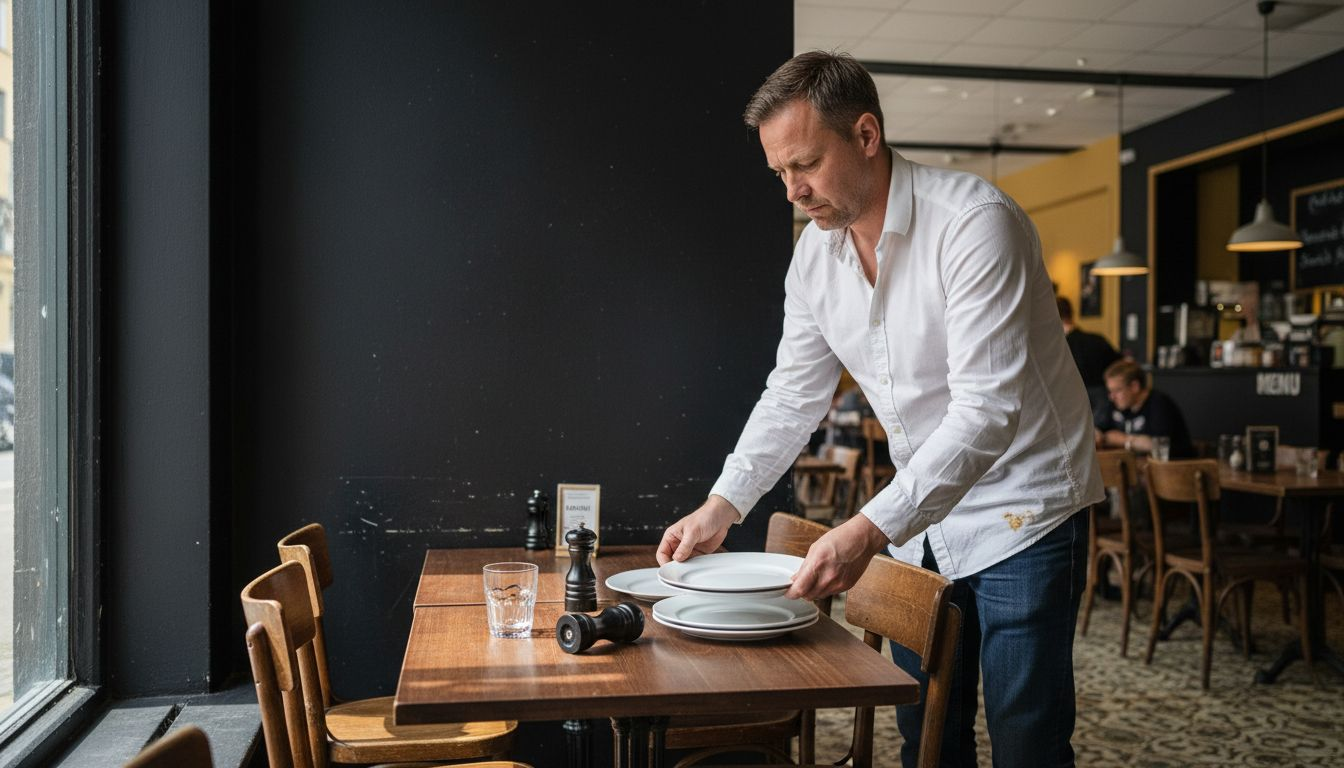
On the other hand, if everything is on the same level – the same light, the same color – the space feels flat, dull. The eye can't find any point of fixation.
Feeling and trust in the space
Visual identity builds trust. When a space is well-designed and cohesive, customers trust it. This is reflected in their behavior: they stay longer, order more, and come back again.
A poorly designed space creates uncertainty. “Is this place professionally run? Can I trust the food?”
In restaurants and art spaces, your visual identity is the first message customers receive. It tells you whether you are a cultural establishment or a fast food establishment .
Depth and three-dimensionality
Absorptive surfaces create the illusion of depth. When the background fades to black, the object in the foreground appears to float. It's not flat—it's three-dimensional, weightless.
Reflective surfaces make the same space appear flat and two-dimensional. Everything appears to be on the same level.
Depth is a psychological effect that makes a space appear larger and more interesting:
- The space feels larger than it actually is.
- The eye can “travel” further in space
- The experience becomes more immersive and impactful
A visual identity is not just a pretty sight. It is a strategic tool that determines what people feel and think.
Practical application
In restaurants and galleries, the visual appearance is crucial to success:
- Choose colors that create the desired mood
- Use contrast to direct attention
- Create depth with absorptive surfaces
- A unified look throughout the entire space
Pro tip _Test your visual appearance in the evening with the lighting on – the right contrast is especially visible in the dark. Daylight hides many secrets of visual design.
Common mistakes when using absorption surfaces
Installing absorption surfaces seems simple – but mistakes are often costly. One wrong decision can ruin the look of the entire space. Professional designers know what pitfalls lie in wait.
Many interior designers and architects make the same mistakes over and over again. These are not small details – they change the entire outcome.
Neglect of preparation
The first mistake is to skip surface preparation . The wall is not cleaned properly, old paint or dust remains. The material does not adhere well, or the absorption becomes uneven.
Absorbent paint requires a clean, even surface. Even the smallest irregularities will show in the final result. Inadequate surface preparation will lead to poor adhesion and future problems.
Time to use it correctly: cleanse, exfoliate, smooth.
Uneven distribution
Another common mistake is uneven painting . Some places are thicker, some are thinner. Absorption varies: some look black, some dark gray.
Black paint is brutally honest – it reveals every imperfection in the application. A wide brush, a steady hand, three coats. This requires patience and precision .
This kind of error is visible in the lighting. When the lights hit the surface, the unevenness jumps out at the eyes.
Wrong lighting expectations
Many designers expect Musou Black or other absorptive materials to look the same in any lighting. This is not the case.
Absorptive surfaces require the right lighting to look right. The wrong lighting angle will just make the surface look black – not dramatic.
Plan the lighting at the same time as the surface. Fixtures, angles, power – everything has an impact.
Poor choice of material in context
In some spaces, Musou Black is perfect. In others, it is the wrong solution. For example, in small restaurants where openness is desired, an absorptive background makes the space too cramped.
We always investigate what the space needs:
- Do you want a dramatic or open feeling?
- How big is the space in reality?
- What time does the space open and what kind of lighting will be used?
- How long do customers stay?
The wrong material in the right place ruins the design. The right material in the wrong place does the same.
Forgetting about maintenance and upkeep
The black surface collects dust visibly. It looks dirty more easily than light surfaces. Regular cleaning is essential .
Many projects fail because maintenance is not planned. In restaurants or galleries, the surface needs to be cleaned regularly.
Pro tip: Test materials and lighting on a full scale before committing – request a sample piece, light it the same way you would the final space, and wait a few days to see how it looks in different lighting and times of day.
Take your space design to the next level with light absorption and contrast
The central challenge of the article is the control of light in a space, especially in creating dramatic aesthetics through absorption and contrast. Often, the visual appearance of restaurants and art spaces is incomplete when light absorption in materials is not utilized effectively. Special materials like Musou Black enable a light absorption value of up to 99.4 percent, which deepens the sense of space and maximizes contrast in a way that ordinary matte surfaces cannot offer. This is crucial when you want to emphasize important elements and precisely direct the viewer's attention.
Don't settle for the ordinary, make your space unique and experiential by choosing Musou Black and other special materials that support light absorption and aesthetic balance. Learn more about how our materials help enhance visual contrast and create impressive depth in your spaces at Dekoja.net. Create a space design solution that will be remembered and take your customer experience to the next level today.
Frequently asked questions
What is light absorption?
Light absorption is the process by which light loses its energy in a material and turns into heat. This means that some of the light is not reflected but is absorbed by the material.
How do absorptive surfaces affect the atmosphere of a space?
Absorptive surfaces create depth and contrast. When the background surface absorbs light, foreground elements stand out more, creating a dramatic visual effect.
How do different colors affect light absorption?
Different colors absorb light in different ways. Dark colors, such as black, absorb the most light, while light colors reflect more light and absorb less.
Why is Musou Black a special absorbent material?
Musou Black is unique because it absorbs up to 99.4 percent of visible light. It creates a three-dimensional effect and makes the surface almost invisible, which can highlight illuminated elements around it.