

Your Role in Exhibition Design: A Guide 2026
TL;DR:
- An exhibition designer transforms an abstract vision into a space, story, and experience, collaborating with multidisciplinary professionals. The process progresses in stages from strategic planning to production, with clear roles and coordination being key to success. Physical spaces and visual elements, such as lighting and materials, greatly influence the exhibition's atmosphere and visitor experience.
An exhibition designer is an interpreter who transforms an abstract vision into a space, story, and experience. The role in exhibition design covers everything from strategic conceptualization to technical execution, and it is divided among several professionals: curators, museographers, architects, graphic designers, and artists. The holistic process combines space, content, visual identity, and technology into one seamless whole. This article outlines the stages of the process, role responsibilities, and practical tips for a successful exhibition in 2026.
What are the key roles in exhibition design?
The structure of an exhibition team determines the success of a project as much as an individual artistic vision. A multidisciplinary expert team is essential for large exhibitions: Good Kombo Oy's team for the new Aviation Museum's core exhibition included an architect, a graphic designer, a technology expert, and other specialists. This shows that no single role is sufficient on its own; different areas of expertise must work together.
The key roles in an exhibition team are:
- Curator is responsible for content selection and the thematic direction of the exhibition. They decide which works or objects are presented and how they relate to each other.
- Museographer designs the overall structure of the exhibition: the visitor path, spatial division, and method of presenting content. They act as a bridge between content and space.
- Exhibition architect is responsible for physical spatial design, structural dimensioning, and material choices.
- Graphic designer creates the visual identity: texts, signage, area markings in exhibitions, and printed materials.
- Technical expert handles AV equipment, lighting, and digital solutions.
- Artist provides the works and often a strong vision of how they should be presented.
Dialogue between roles is the core of the process. When a curator, architect, and graphic designer work separately, conflicts easily arise regarding space usage, text placement, and technical solutions. Regular joint reviews and clear division of responsibilities prevent these problems. Successful museographic design requires continuous coordination between all parties throughout the entire process.
How does the exhibition design process progress in 2026?

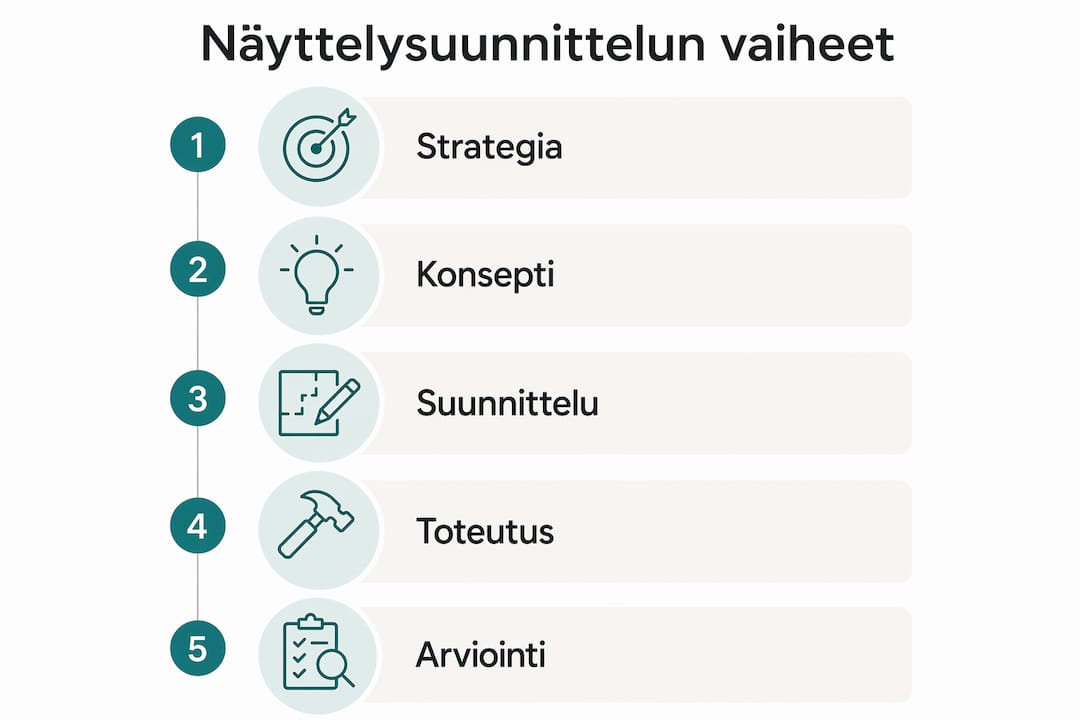
The exhibition design process is a phased whole, where each stage builds upon the previous one. EVE Museos emphasizes the importance of synthesis: content, space, and technology are designed together, not separately. Fragmentation of the process is the most common reason why exhibitions remain disjointed entities.
The exhibition design process typically proceeds as follows:
- Strategy phase. Defines the exhibition's goals, target audience, and budget. Visitor understanding in exhibitions begins at this stage: for whom is the exhibition created, and what should it leave in their memory.
- Conceptualization phase. Develops the exhibition's thematic and visual concept. Conceptualizing exhibitions practically means transforming an abstract idea into a concrete spatial and content-based solution.
- Narrative phase. Builds the visitor path and storytelling. In what order does the visitor encounter content? Which moments are turning points?
- Spatial design phase. The architect and museographer adapt the narrative to the physical space. The Kemppi Experience Center is an example of a modular solution where visitor paths and digital solutions have been integrated into the physical space from the outset.
- Technology phase. AV solutions, lighting, and digital elements are designed. Equipment procurement and compatibility tests are also conducted at this stage.
- Documentation phase. All plans, materials, and technical specifications are documented for production.
- Production phase. Construction, installation, and finishing. Iteration is strongest at this stage.
Following the process does not mean rigidity. It means that changes are made consciously, and their effects on other stages are understood. In 2026, digital design tools such as Revit, SketchUp, and Matterport allow virtual testing of spaces even before construction.
What challenges do different roles face in exhibition design?
Exhibition projects repeatedly encounter the same challenges, regardless of whether it's a small gallery or a large museum. Identifying challenges in advance is the most effective way to manage them.
The most common challenges are:
- Technical compatibility. AV equipment, lighting, and structures do not always work together as planned. The mapping of presentation technology for the Type3 exhibition began as early as summer 2022, over a year before the opening. This shows that technical design requires more time than most teams anticipate.
- Budget and schedule. The creative process easily extends beyond the original framework. A clear budget and schedule help manage the exhibition project without compromising artistic freedom.
- Iteration and changes. The Type3 exhibition was created partly in advance and partly evolving on-site. The artist made finishing touches still in the exhibition space. This is normal, but it requires the team to be flexible and that time and resources are allocated for changes.
- Role ambiguity. When responsibilities are unclear, decisions are delayed, and quality suffers.
Professional tip: At the beginning of the project, draw up a written division of responsibilities, where every role, decision-making authority, and communication channel is named. This simple measure prevents most of the common conflicts in exhibition projects.
An artist's project management and communication skills are as important as artistic expertise. This is a new idea for many artists, but in practice, it means that the ability to communicate clearly with the team and manage the whole is directly linked to the success of the exhibition. The courage to experiment and openness to change are strengths, but they work best within a clear structure.
How do spatial design, lighting, and visual appearance support the overall exhibition?
The physical space is the exhibition's first message to the visitor. Before a single text is read or a work is encountered, the space has already conveyed something. Spatial design, lighting, and visual identity are not separate elements; they collectively build the exhibition's atmosphere and guidance.
Layered lighting significantly improves the functionality of spaces in exhibitions. Lighting creates atmosphere, highlights objects, and directly affects how the visitor experiences the space. Well-designed lighting guides the gaze, slows down or speeds up movement, and makes individual works memorable.
The comparison below illustrates how different visual elements affect the overall exhibition:
| Element | Impact on exhibition experience |
|---|---|
| General lighting | Creates the basic atmosphere and enables safe movement in the space |
| Spotlighting | Highlights individual works or objects and directs the gaze |
| Contrast surfaces | Add depth, differentiate areas, and strengthen visual identity |
| Area markings | Guide the visitor path and make navigation intuitive |
| Color palette | Strengthens thematic unity and supports the content message |
Material choices, alongside lighting, are one of the most effective ways to build atmosphere. Matte, non-reflective materials are suitable for spaces where works or objects are intended to be the main focus. Glossy surfaces, on the other hand, create dynamism and can serve as an effect at certain points. The means of emphasizing light and visuals are directly applicable to exhibition space design as well.
Visual design for exhibitions practically means that the graphic identity, typography, and colors are consistent throughout the space. Area markings in exhibitions are part of this whole: well-designed signage not only tells where you are but also reinforces the exhibition's visual story. When spatial design, lighting, and graphic design are coordinated, the visitor does not notice individual elements. They experience the whole.
Key learnings from exhibition design
The success of exhibitions is based on clear roles, a coordinated process, and the conscious design of physical elements.
| Point | Details |
|---|---|
| Clarity of roles | Assign responsibilities in writing at the start of the project to ensure quick decision-making. |
| Phased process | Follow the order of strategy, conceptualization, narrative, space, technology, and production. |
| Technical foresight | Start AV and lighting mapping at least a year before the opening. |
| Visual unity | Coordinate spatial design, lighting, and graphic appearance into a cohesive whole. |
| Iterativeness | Allocate time and resources for changes, as the exhibition also takes shape during the construction phase. |
Exhibition design requires courage to let go of control
I have closely followed several exhibition projects, and one thing recurs: the best results come from teams where roles are clear but the hierarchy is flat. When the curator, architect, and artist communicate directly, without intermediaries, ideas develop faster, and conflicts are resolved before they escalate into problems.
Multidisciplinary collaboration is the most important competitive advantage for future exhibitions. Technology evolves rapidly, but it does not replace human interaction. Digital tools such as Revit or Matterport are useful, but they are tools, not solutions.
Reconciling artistic freedom and project management is a challenge that cannot be solved at once. I have noticed that artists who approach project management as their own art succeed better. A clear budget and schedule do not stifle creativity. They provide a framework within which bold risks can be taken.
An experimental approach is worthwhile. An exhibition is not a finished product but a living process where experimentation and community are central. This does not mean lack of planning. It means that the plan is so well made that one can consciously deviate from it.
— Mikko
Dekoja supports the visual design of exhibition spaces
The visual impact of an exhibition arises from details: surfaces, lighting, and contrast. Dekoja supplies special materials from Finland, such as Musou Black paint and anti-reflective effect surfaces, suitable for galleries, museums, and design exhibitions.

When you want to create a sense of depth in a space or completely isolate a work from its background, super black surfaces do what ordinary paint cannot. Dekoja serves architects, artists, and design agencies in projects where visual precision is paramount. Deliveries in 1-3 business days from domestic warehouse. Explore Dekoja.net's materials and request a quote for your B2B project.
FAQ
What does a role in an exhibition team mean?
A role in an exhibition team refers to a specific area of responsibility, such as curation, spatial design, or technical implementation. Clear roles speed up decision-making and improve the quality of the end result.
Where should the exhibition design process begin?
The process begins with the strategy phase, where goals, target audience, and budget are defined. Visitor understanding and a clear concept form the foundation for all subsequent stages.
How long before the opening should technical planning begin?
Technical mapping should ideally begin at least a year before the opening. In the case of the Type3 exhibition, presentation technology investigations began in summer 2022, allowing problems to be resolved in time.
How does lighting affect the exhibition experience?
Lighting guides the eye, creates atmosphere, and highlights individual works. Layered lighting, combining general and spot lighting, improves both the functionality of the space and the visitor experience.
Can an artist manage an exhibition project themselves?
Yes, but it requires project management and communication skills alongside artistic expertise. Clear goals, budget, and roles are prerequisites for the artistic process to remain open and flexible throughout the project.