

How to choose the right materials when renovating
TL;DR:
- Material choices are crucial for project success and affect schedules and costs.
- Good preparation and a clear process reduce errors and improve the end result.
- Documentation and clear division of responsibilities are key to sustainable and responsible material choices.
Material selection during changes is one of those decisions that can determine the success or failure of an entire project. Wrong choices made at the wrong point in the schedule cause chain reactions: deliveries are delayed, contractors wait, and the budget is exceeded. A well-made choice, on the other hand, brings both visual clarity and long-lasting functionality. This article is a practical guide that explains step by step how to build a sustainable and controlled material selection process, whether it's a new build, a renovation, or an individual space modification.
Table of Contents
- What is material selection in changes and why is it a critical phase
- Preparation: What to consider before making choices
- Steps: How to make successful material choices in changes
- Evaluation and assurance: How to know you've made the right decisions
- Perspective: What makes material selection genuinely meaningful in changes
- Do you need more inspiration and tools for material selection?
- Frequently Asked Questions about Material Selection in Changes
Key Takeaways
| Point | Details |
|---|---|
| Careful preparation | Scheduling and the right tools prevent surprises in material choices. |
| Documentation for future changes | Utilizing recorded material data facilitates maintenance and adds value. |
| Visual and technical balance | Innovation combined with durability creates both attractiveness and longevity in projects. |
| New obligations from 2026 | Creating a digital construction product catalog will be mandatory. |
What is material selection in changes and why is it a critical phase
The concept isn't always immediately clear. Material selection in changes refers to the selection and management of surface materials and interior design elements in construction and interior design projects during construction phase modifications or individual changes requested by residents. This covers everything from flooring materials to cabinet door surfaces, and applies to both developers and designers.
Why is this phase so critical? Because material decisions are tied to schedules and procurement chains early on. If a decision is delayed or changed late, it can halt the entire construction site.
The most common risks relate to three things:
- Schedule delays: Materials are often ordered with long lead times, and last-minute changes can mean weeks or even months added to the schedule.
- Execution errors: When material information is unclear or insufficient, contractors make interpretations that do not match the designer's intent.
- Value detriment: Incorrectly chosen material can decrease the resale value of the property or require expensive repairs in a short period.
“A well-made material choice is not just an aesthetic decision. It is a technical, logistical, and economic entity that has a direct impact on the project's final valuation.”
A well-made choice, on the other hand, means a clear process where each material has its place, schedule, and responsible person. This results in an outcome that meets both the designer's vision and the developer's requirements. When you learn more about the practical material selection options, you will quickly notice that the range of choices is wide and requires a structured approach.
Material selection in changes is not a single decision point. It is a process that begins with collecting project baseline data and ends with documentation after handover. This process perspective is what distinguishes a professionally managed project from improvisation.
Preparation: What to consider before making choices
Once you understand why material selection is crucial in changes, it's time to figure out how to prepare for the process. Preparation does not mean long waits or making lists for their own sake. It means acquiring the right baseline data at the right time.
One concrete change affecting all professionals is the mandatory construction product catalog. The construction product catalog is mandatory from 1.1.2026, and the Product Information management service helps in its digital creation, supporting low-carbon design and chemical hazard assessment. This practically means that every material chosen for a project must be systematically documented already in the design phase.
Below is a table of typical preparation phase tasks and their timing at different stages of the project:
| Task | Phase | Responsible Person | Priority |
|---|---|---|---|
| Gathering baseline data | Before design | Project Manager | High |
| Building the product catalog | Design phase | Designer | High |
| Material scheduling | Before frame phase | Procurement Department | High |
| Documenting alternatives | Design phase | Designer | Medium |
| Chemical hazard assessment | Before procurement | Developer | High |
| Approvals and signatures | Before orders | Client and Designer | High |
Proven practices before making actual choices:
- Identify critical points in the schedule before you start examining individual materials. Different decisions are needed for the frame phase than for the interior work phase.
- Use digital tools for gathering and sharing material information with the team. A fragmented email thread is not sufficient for professional documentation.
- Systematically map out the client's wishes. Individual changes increase project complexity and must be managed with clear processes.
- Consider material solutions that support sustainability already in the preparation phase, as making changes to the sustainability perspective afterwards significantly increases costs.
The role of documentation is especially important. Every piece of material information that goes unrecorded is a potential problem later on. This applies to international mega-projects as well as small renovation sites.

Professional tip: Build a project-specific material bank right in the first kickoff meeting. Use a shared platform, such as a cloud service, accessible to all stakeholders. This avoids situations where the designer, contractor, and client operate with different versions of the same plan.
When the groundwork is done thoroughly, making the actual selections speeds up significantly. Preparation does not slow down the process; rather, it makes the implementation phase smoother. Good materials for experiential spaces require this foundation to function as intended.
Steps: How to make successful material choices in changes
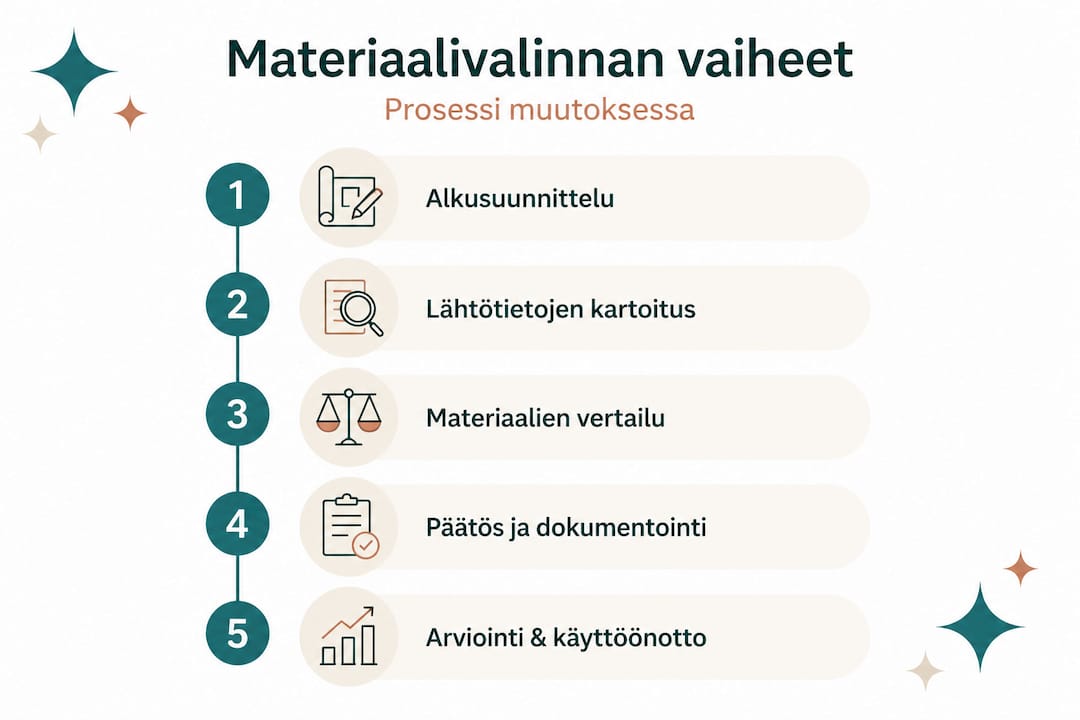
Once the basic information and starting points are in order, it's time to move on to making the choices themselves. The process is clear when divided into four main stages.
Modification services cover interior collection design, coordination of buyer material selections, and controlled handling of resident modification requests, reducing errors and keeping the project on schedule. This same logic applies to all project types, not just new constructions.
Process model in stages:
-
Survey: Gather information on the client's wishes, intended use, budget, and schedule. At this stage, no decisions are made, only data is collected. Using room cards is recommended: each space gets its own card, on which requirements and constraints are noted.
-
Evaluation of alternatives: Present three to five alternatives per material group to the client. Too many options paralyze decision-making. Compare alternatives based on durability, price, delivery time, and visual suitability. Use comparison tables.
-
Decision and approval: The client approves the choices in writing or electronically. This phase is critical for clarifying responsibilities. Without an approved document, procurement cannot proceed.
-
Documentation and monitoring: All selected materials are recorded in the product catalog. Delivery times are actively monitored, and deviations are reported immediately.
In new constructions, material selections are made according to the schedule: structural materials in the frame phase, surface materials in the interior work phase. The same division should also be applied in renovation projects, although scheduling pressures may differ.
Below is a comparison between two different approaches:
| Criterion | Reactive approach | Proactive approach |
|---|---|---|
| Time of decision-making | Last minute | Well in advance of the schedule |
| Documentation | Fragmented or incomplete | Systematic, digital |
| Error risks | High | Low |
| Cost impact | Expensive changes | Managed changes |
| Customer satisfaction | Variable | Consistent |
| Schedule risk | High | Low |
Professional tip: Use room cards even in smaller projects. A simple table with each space on its own row and materials in their own columns is more effective than long email threads. It also speeds up the approval process, as the client can see the entire package at once.
Roles and responsibilities are especially important in change situations. One person coordinates, and another approves. Without a clear division of responsibilities, situations arise where no one knows whose decision it is to select a particular material. In the worst case, this leads to duplicate orders or a situation where a material is changed on the fly without proper approvals.
Architects and interior designers must keep in mind that the visual entirety is built from the sum of individual material decisions. See how materials for aesthetic spaces can support this entirety alongside technical requirements. Technical and aesthetic are not opposites, but at their best, they reinforce each other.
Evaluation and assurance: How to know you've made the right decisions
After a successful material selection, it's important to ensure that the end result meets requirements and adds value. Evaluation is not just a checklist. It is a continuous process that begins with making the choices and continues after handover.
Changing surface materials after purchasing an apartment is possible in owner-occupied and right-of-occupancy apartments, but requires notification or permission in rental apartments. New materials must not diminish the value. This principle should also be kept in mind during the design phase: selected materials must withstand time and maintain the property's value.
In the evaluation phase, the following are checked:
- Compatibility: Does the selected material work with other surface materials, structures, and technical systems? For example, underfloor heating places its own demands on flooring material.
- Durability: Is the material dimensioned for the actual wear and tear of the space? Public spaces require a different durability class than private residences.
- Value retention: Will the material remain attractive and functional for decades, or is it a fleeting trend that will quickly become outdated?
- Maintainability: How easy is the material to clean and maintain? This question is especially important in restaurants, galleries, and other public spaces.
“In renovation material selection, durability, ease of maintenance, and compatibility are balanced. Peculiar edge cases, such as slippery surfaces or thermal expansion, can cause problems that are not obvious in the design phase.”
The most common pitfalls to avoid:
- Selecting material based solely on appearance without checking technical specifications. A beautiful material that doesn't withstand use is a poor choice.
- Underestimating delivery time. Special and unusual materials can require several months of delivery time. This must be considered during the procurement phase.
- Incomplete documentation. If material information is only stored in one person's email, it will be lost when they leave the project.
- Skipping suitability assessment. For example, thermal expansion can be a problem with large continuous surface materials if the joint structures are incorrectly dimensioned.
The importance of documentation cannot be overstated. Tips for sustainable construction can be found from various sources, but common to all of them is the importance of a written record. Every material decision clearly recorded is valuable information later for maintenance, renovation, and sales situations.
Evaluation should also be done before and after installation. Before installation, it is checked that the delivered material matches the order. After installation, it is ensured that the end result matches the plan. This double-check prevents situations where an error is only discovered when the space is already in use.
Long-term value arises from the fact that the selected materials will serve their purpose for years to come. For this reason, it is also useful to familiarize yourself with the principles extending to material selection for garden and outdoor spaces, as the concept of durability applies equally to indoor and outdoor spaces.
Perspective: What makes material selection genuinely meaningful in changes
Once the technical aspect of material selection is under control, one can stop and consider the deeper meaning of choices in projects. At this point, many professionals notice that the quality of the process determines the outcome more than a single material decision.
```There's one thing industry publications rarely state directly: new materials don't always yield the best results. Patina, reuse, and the restoration of old materials can elevate a space's appearance to a whole new level. A carefully ground and protected old concrete floor can be visually more impactful than a new vinyl tile. This doesn't mean new materials should be avoided, but rather that the best outcome is achieved by considering both possibilities side-by-side.
Visual distinctiveness is a balance between minimalism and personality. A choice that is too subdued makes a space forgettable. A choice that is too bold without coordination makes it chaotic. The best projects find a point where a space is remembered precisely for its uniqueness, but not because it's distracting.
This is an area where the visual aspect of experiential spaces becomes central. When a material is chosen both technically correctly and visually justified, the space works and feels right.
Digital tools and material data documentation support genuine responsibility. This doesn't just mean environmental responsibility, though that is also an important part. It means responsibility towards the client, responsibility towards other project parties, and responsibility towards future users. When material data is systematically recorded, every subsequent change or maintenance task can be performed with the correct materials. This is a value that doesn't directly show in the budget but is undeniable.
In practice, the most successful professionals are those who combine technical precision with aesthetic courage. They don't settle for the first option, but they also don't drown in a flood of alternatives. They know when a simple solution is enough and when something that truly stops you in your tracks is needed.
Need more inspiration and tools for material selection?
Once you have a basic understanding of the material selection process, you can delve deeper by leveraging professional solutions. Dekoja.net is designed specifically for the needs of interior designers, architects, and creative professionals who are looking for materials outside the standard selection.
Dekoja.net offers specialty materials not found elsewhere in domestic stock. The selection includes super-black Musou Black surfaces, non-reflective materials, and visual effect surfaces for galleries, restaurants, and studios. Every delivery ships from Finland within 1 to 3 business days. You can find more material inspiration and expert support for your projects directly on the site. The B2B service is available for projects and design offices.
Frequently asked questions about changes in material selection
Can surface materials be changed freely in a rental apartment?
Changing materials in a rental apartment often requires the landlord's permission, and the new materials must not decrease the apartment's value. In owner-occupied apartments, the resident has the decision-making power.
What are the most important criteria for successful material selection?
The most important are durability, ease of maintenance, and compatibility with the space's use. In renovation material selection, durability, low maintenance, and compatibility are balanced.
How should material selection documentation be handled?
Record the selected materials, manufacturers, and technical specifications for future changes and maintenance. Document material information systematically in digital form immediately upon selection.
What new obligations related to material choices will apply from 2026 onwards?
The construction product list will be mandatory in the future and must be prepared digitally. The construction product list will be mandatory from January 1, 2026, and the Product Information management service provides a suitable digital tool for it.