

Material Selection Guidelines for Professionals 2026
TL;DR:
- Material choices affect a space's durability, appearance, and usability, making careful planning essential. Incorrectly chosen or poorly documented materials can lead to costly repairs and long-term problems, especially in wet rooms. The most important thing is to define the space's purpose, criteria, and life-cycle costs before comparing and selecting materials.
Material selection guidelines are sought by experienced architects and first-time renovators alike, because materials ultimately define a space's final appearance, durability, and usability. A wrong choice will come back to haunt you years later: surfaces wear out, wet rooms suffer damage, and repair costs can easily become many times the original budget. This guide provides a clear and practical comprehensive set of instructions for implementing material choices, from sustainable design to technical requirements and the documentation of final selections.
Table of Contents
- Key Considerations
- Material Selection Guidelines: Preparation Phase
- Material Properties for Different Uses
- Implementing Material Selection in Practice
- Quality Control and Monitoring
- My Perspective on Material Choices
- Dekoja Helps with Material Choices
- FAQ
Key Considerations
| Aspect | Details |
|---|---|
| Define criteria first | Document the purpose of use, durability requirements, and budget before comparing materials. |
| Life-cycle thinking saves money | In addition to the acquisition cost, maintenance and energy costs determine the total cost. |
| Technical requirements first in wet rooms | Waterproofing is mandatory before surface material installation, not an optional extra. |
| Document all selections | A well-justified material document facilitates maintenance, warranty issues, and future renovations. |
| Test before final decision | Order samples and install a test area before ordering materials for the entire project. |
Material Selection Guidelines: Preparation Phase
All successful material choices begin with one question: what does the space truly require? The purpose of use determines everything else. A public space floor will withstand harder wear than a residential room floor. A bathroom wall is exposed to moisture that a living room wall never sees.
Purpose of Use and Overall Space
Start by mapping out the space's usage intensity, target group, and technical stresses. A restaurant lobby needs flooring that can withstand hundreds of people a day and is easy to clean. A home living room can settle for a softer and more aesthetic solution. A material works best when chosen specifically for the environment in question, rather than as a generally "good" material.
Understanding the overall space helps avoid visual conflicts. If flooring, wall surfaces, and furniture are chosen independently, the result can be chaotic. Create a mood board or assemble a physical material collage during the design phase.
Durability, Maintainability, and Life Cycle
A sustainable material is a solution where maintainability, availability of spare parts, and partial renewability have been planned in advance. In practice, this means that the material can sometimes be repaired without replacing the entire surface.
Maintenance and energy costs can be the most significant part of the total cost. A cheap floor that wears out in three years will ultimately be more expensive than a quality alternative that lasts thirty.
Environmental and Ethical Considerations
Responsible designers favor local production and consider the entire supply chain and the material's estimated lifespan. Certifications such as FSC for wood, PEFC for forest products, or EPD environmental declarations help compare materials transparently.
Professional tip: Always ask the supplier for the material's EPD declaration or similar environmental document. If the supplier cannot provide it, that in itself is a sign of supply chain opacity.
Building a list of criteria before comparing materials saves considerable time. Document at least the following:
- Space's purpose and estimated number of users
- Moisture stress and temperature fluctuations
- Ease of cleaning and allowed cleaning agents
- Budget for acquisition and estimated annual maintenance costs
- Environmental and certification requirements
- Partners: developer, contractor, installer
Material Properties for Different Uses
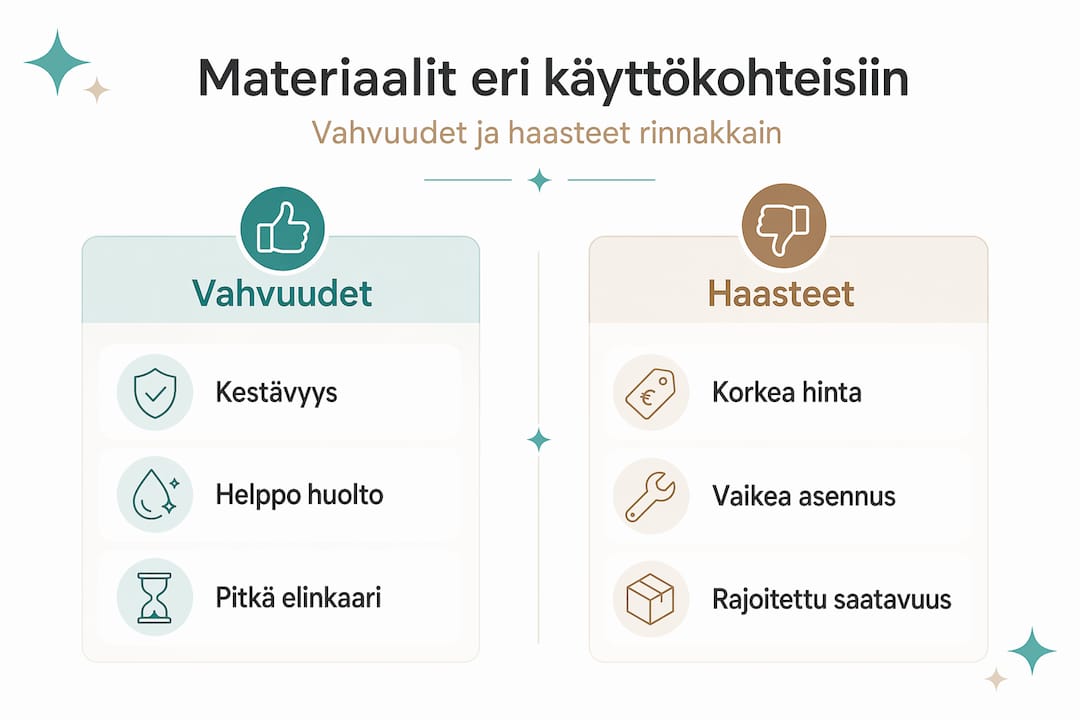
The strengths and challenges of different materials vary significantly depending on the use environment. The comparison below helps quickly grasp the most common options.
| Material | Durability | Maintenance | Price Range | Best Suited For |
|---|---|---|---|---|
| Wood (solid) | Moderate, sandable | Requires oiling or varnishing | 30–80 €/m² | Living room, bedroom |
| Ceramic tiles | Excellent | Easy, grouting needs checking | 10–120 €/m² | Bathroom, kitchen |
| Quartz composite | Very hard, impact resistant | Very easy | 400–800 €/m | Kitchen countertops |
| Granite | Durable, natural | Requires sealing against acids | 500–900 €/m | Countertops, stairs |
| Microcement | Seamless, modern look | Requires protection | 60–150 €/m² | Bathroom, floor |
Bathroom tile prices vary widely: basic tiles cost 10–30 €/m² and large premium tiles 60–120 €/m². The right choice affects both safety and long-term maintenance.
Stone countertop prices vary significantly by material. Laminate costs 50–200 €/m, quartz composite 400–800 €/m, and marble up to 600–1200 €/m, plus installation costs of 300–700 €.
Special Requirements for Wet Rooms
Wet rooms are the most challenging environment for material choices. Moisture stress, temperature fluctuations, and chemicals wear down materials faster than in dry rooms. Technical management of material selection is critical to avoid corrosion and moisture damage.
Natural stone has its advantages in wet rooms. The durability of natural stone and its long life cycle make it a responsible choice when the material is sourced ethically and installed correctly.
Rugs and Textiles
Sisal and jute are suitable for heavy traffic, while wool is better for living rooms. Matching the material to the space's usage greatly extends the rug's lifespan. A wool pile rug in an entryway is a mistake, while a jute rug in a living room feels uncomfortable underfoot.
Professional tip: Always order a sample to see it in real lighting and environmental conditions. A material looks very different in a sample in a store than in the final space.
Implementing Material Selection in Practice
Once the criteria are defined and materials selected, the implementation phase determines the final quality. A good plan is useless if logistics, installation, or documentation fail.
- Material order planning. Calculate the required quantity with a 10–15% buffer for waste and potential repairs. Order everything from the same batch to avoid color variations.
- Supplier collaboration. Confirm delivery time and stock status before finalizing the project schedule. Missing material at a construction site costs money daily.
- Technical requirement check. Waterproofing, substrates, and adhesives must be chosen according to the surface material. The wrong adhesive can void the material's warranty.
- Test area before the entire surface. Install a small test area and allow it to dry or settle before proceeding with the entire project.
- Documentation. Record the material name, supplier, batch number, installation date, and care instructions. This information is invaluable for repairs and warranty claims.
Waterproofing in Wet Rooms
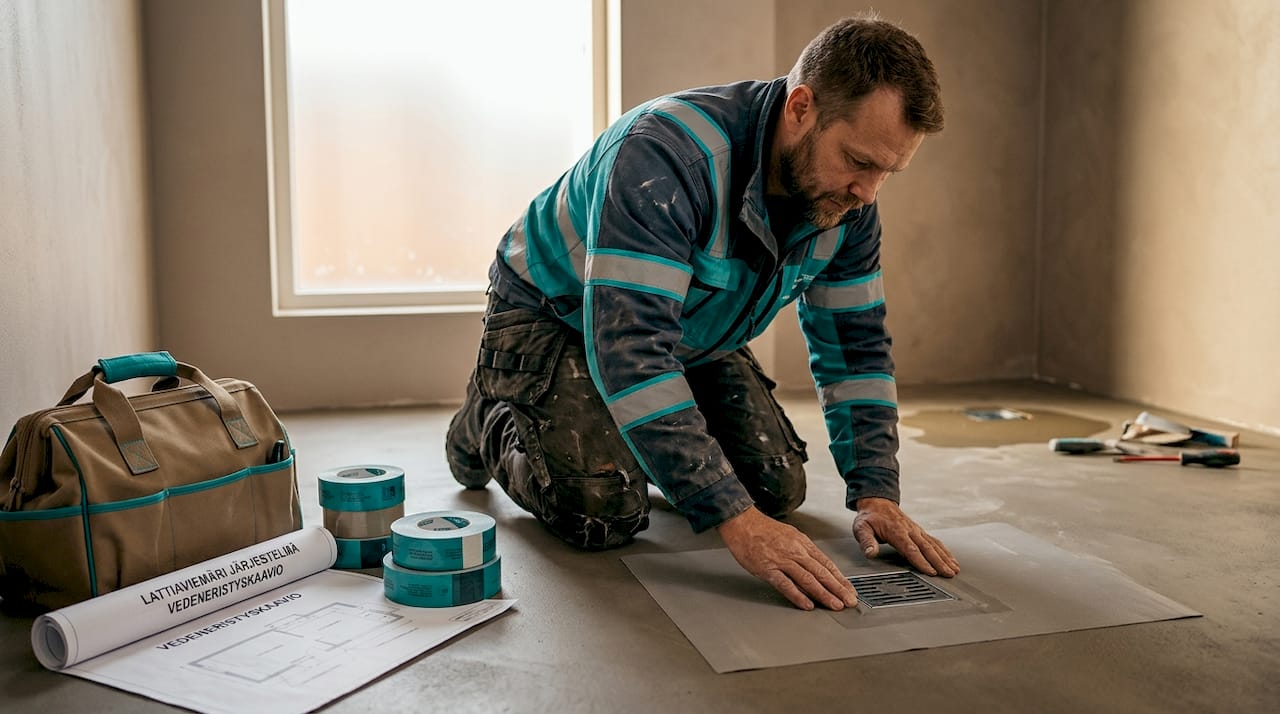
Incorrect waterproofing leads to hairline cracks and costly repairs, even if the surface material itself is high-quality. Waterproofing is not a property of the surface material, but a separate structure beneath it.
Practical implementation checklist for a wet room:
| Phase | Considerations |
|---|---|
| Substrate leveling | Maximum slope deviation 3 mm / 2 m |
| Waterproofing | Product-specific membrane thickness, corners must be reinforced |
| Surface material | Installation adhesive chosen according to material and substrate |
| Grouting | Elastic grout in corners and joints |
| Drying time | At least the time specified by the manufacturer before use |
Professional tip: It is advisable to photograph the wet room waterproofing before installing the surface material. The photo is unequivocal proof in warranty situations and facilitates later repair planning.
Quality Control and Monitoring
Material selection guidelines do not end with installation. The monitoring and quality control phase ensures that the selected materials perform as planned for years to come.
- Testing phase immediately after installation. Check surfaces, seams, and joints before handover. Potential defects are repaired during the warranty period, not years later at one's own expense.
- Provision of maintenance instructions. Every installed material needs written care instructions. The end-user does not know what cleaning agent is suitable for microcement and what will damage the surface.
- Annual inspection. Especially in wet rooms, an annual visual inspection of the condition of seams, waterproofing, and corners prevents small problems from becoming large.
- Life-cycle assessment. Note down the estimated lifespan and planned replacement time of materials at the beginning of the project. This facilitates long-term property management.
"Material selection is now a strategic and ethical decision, not just an aesthetic one." Sustainable interior design
Practical example: a Helsinki restaurant renovated its floor five years ago with a concrete look. Because the waterproofing was done correctly and the concrete surface was treated appropriately, no cracks or moisture problems have appeared on the surface. The maintenance instructions were kept, and annual waxing has kept the surface intact. In a similar project where waterproofing was omitted by cutting corners, the entire floor had to be replaced after three years.
Collecting user experiences from end-users is an undervalued practice. Knowing what works in everyday life and what doesn't concretely improves material choices for the next project.
More practical starting points for materials affecting space planning can be found in Dekoja.net's interior design tips blog.
My Perspective on Material Choices
I have followed the development of material choices for a long time, and one thing has changed clearly: professionals are increasingly talking about patina and the material's aging as aesthetics. I think it's a healthy development.
I remember a project where the client was presented with two options: perfect white marble and slightly uneven, patinated limestone. The white marble surface looked best in pictures. But patina is increasingly seen as a luxury that extends the perceived lifespan of the material compared to flawless surfaces. The client eventually chose limestone, and the space gains more character every year.
Another issue I constantly encounter: the budget is set for the material, and the installation is left too small. The result is an expensive material poorly installed. A better formula is to divide the budget roughly in half between material and labor.
The biggest single mistake I repeatedly see is underestimating waterproofing in wet rooms. It feels like a saving, but the technical management of material selection is most critical here. Repair always costs more than prevention.
A guide to material choices can never be perfect, as every project is different. But when the criteria have been thought through, technical requirements met, and documentation handled, the result is predictable.
— Mikko
Dekoja Helps with Material Choices
Material selection doesn't mean everything is easy. It means knowing where to get help.

Dekoja.net specializes in effect finishes and visually exceptional materials not offered by other Finnish suppliers. Musou Black, non-reflective surfaces, and contrast walls are solutions for restaurants, galleries, and interior designers who want a space to stand out. All products are shipped from a domestic warehouse within 1–3 business days. For B2B clients, Dekoja offers project-specific expert service from start to finish. You can also find more inspiration in Dekoja.net's guide to materials for experiential spaces.
FAQ
Where to start with material selection for a new project?
Start by defining the space's purpose, estimated number of users, and technical stresses in writing. Only then compare materials based on these criteria.
Why is waterproofing so important in wet rooms?
Incorrect waterproofing leads to moisture damage and cracks, even if the surface material itself is high-quality. Waterproofing is a separate structure beneath the surface material, not a property of the surface material.
How to calculate the correct material quantity?
Calculate the required surface area and add 10–15% as a buffer for waste and future repairs. Order everything from the same batch to ensure consistent color shades.
What is the benefit of life-cycle thinking in material selection?
Lifecycle thinking takes into account maintenance and energy costs in addition to the acquisition price, which can be the most significant part of the total cost. Quality and maintainable materials are often more economical in the long run.
What documents regarding material choices should be kept?
Keep the material name, supplier, batch number, installation date, and care instructions. This information is essential for warranty matters, repairs, and planning future renovations.