

Material Technology Trends 2026: A Guide for Professionals
TL;DR:
- Material technology trends in 2026 will focus on bio-based materials and circular economy solutions transitioning from labs to industry. EU regulations, such as ESPR and PEF, will significantly guide material design and environmental impact assessment. Research and innovation areas, such as nanocellulose and MCC, enable the promotion of sustainable development on an industrial scale.
Material technology trends in 2026 are shaped by the growing role of bio-based materials, circular economy solutions, and new process technologies. Nanocellulose-based structural colors, microcrystalline cellulose, and dopant-based recycling methods have moved from laboratories towards industrial scaling. These trends are simultaneously driven by tightening EU regulations, such as the ESPR regulation and the PEF method, and the industry's need to find alternative materials for fossil-based solutions. This guide provides material technology professionals and educators with a concrete overview of where the field is headed and how these trends can be applied in practical projects.
Which new materials will emerge in material technology trends in 2026?
The development of bio-based materials is the clearest trend in material technology for 2026. Wood-based textile fibers, hemp fibers, and cellulose derivatives have moved from niche applications towards broader industrial use. This development is accelerated by both the availability of raw materials and the maturing of processing technology.
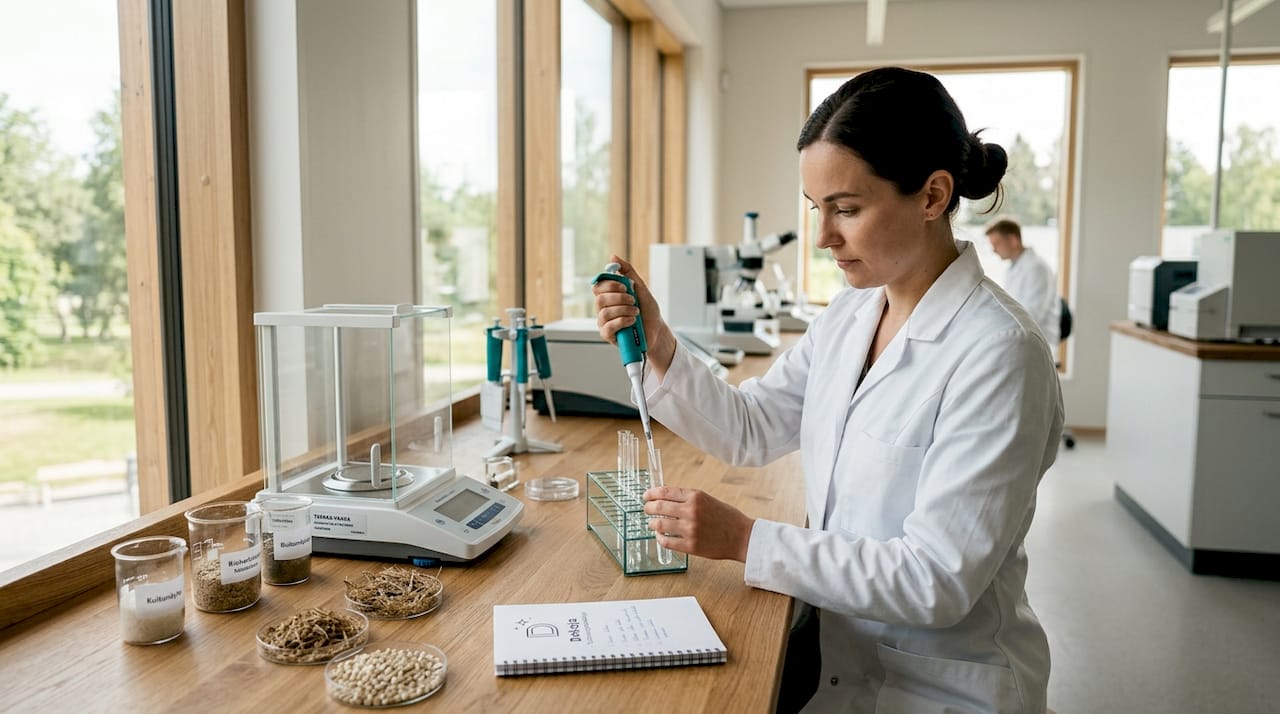
Nanocellulose-based structural colors represent one of the most interesting innovations. In the Shimmering Wood project developed at Aalto University, Noora Yau demonstrated that wood-based nanocellulose enables a shimmering color concept without synthetic pigments. This means that aesthetics and technical performance can be combined in the same material solution without compromises.
Microcrystalline cellulose, known as MCC, is another significant material trend for the future. The AaltoCell™ technology developed at Aalto University allows for a significant scaling of MCC production from its current levels. MCC's current applications are concentrated in the pharmaceutical industry, but the new production technology opens up uses in construction, packaging, and textiles.
A technical breakthrough in textile recycling processes has occurred with dopant-based methods. Research at Aalto University showed that ultra-high molecular weight bacterial cellulose improves the spinnability of recycled cellulosic material. This solves one of the biggest technical problems of recycled textiles: the processing difficulty caused by a decrease in molecular weight.
Key emerging materials and technologies for 2026:
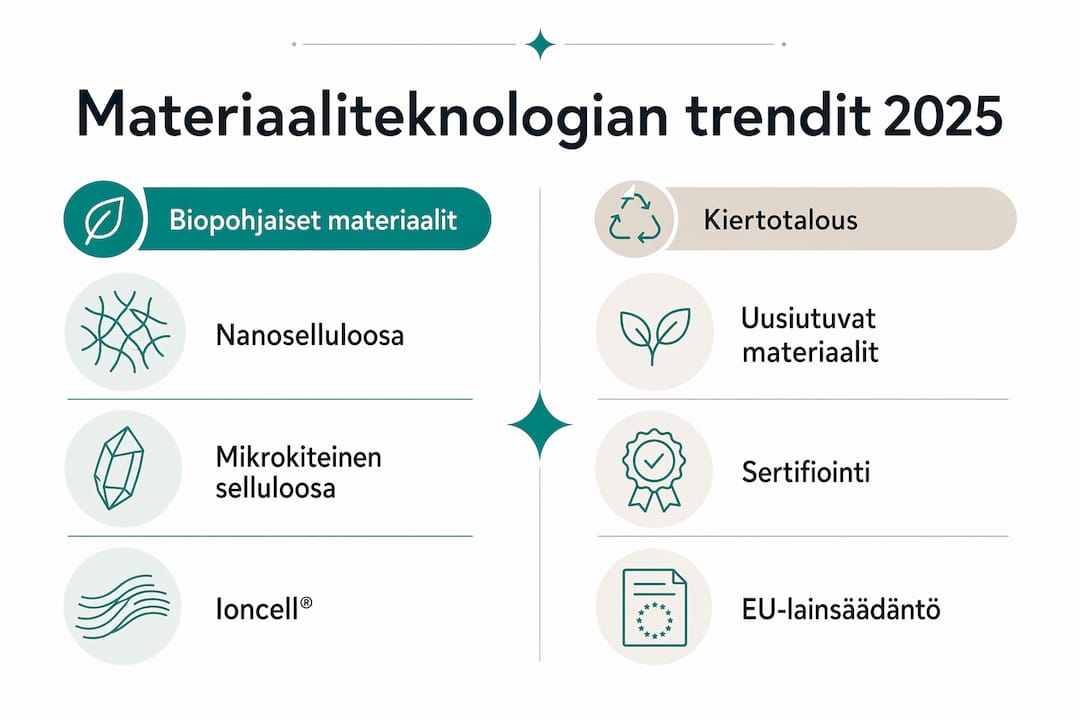
- Nanocellulose in structural colors and coatings, commercialization underway
- Microcrystalline cellulose (MCC) scaled with AaltoCell™ production technology
- Ioncell® fibers as textile fibers made from recycled cellulose
- Hemp fibers and straw-based building materials in carbon sequestration solutions
- Bacterial cellulose as a dopant for processing recycled textiles
Professional tip: Follow Aalto University's Materials Platform publications and the Finnish Natural Resources Research Foundation's dissertation awards. They predict the commercialization phase approximately three to five years before market maturity.
How will the circular economy shape material technology trends in 2026?
The circular economy is no longer just a principle; it has transformed into concrete requirements for material choices through EU legislation. The ESPR regulation, or ecodesign regulation, applies to textiles and construction products, requiring products to be designed with recyclability and renewability in mind. The PEF method, in turn, defines how the environmental impacts of materials are calculated comparably.
A critical question is how the environmental benefits of bio-based fibers are accurately accounted for in PEF calculations. If the method does not correctly identify the carbon sequestration and renewability of bio-based materials, material choices may be directed towards options with poorer environmental impacts. This is a key area of influence for professionals in the field.
Sustainable development in material technology is built on four practical measures:
- Integrating renewability into design from the outset. A material's life cycle is defined at the concept stage, not retrospectively.
- Parallel assessment of bio-based and recycled materials. These do not compete but complement each other in different applications.
- Calculating carbon sequestration potential for building materials. Hemp, straw, and clay sequester carbon for the lifetime of the building.
- Supply chain transparency. ESPR requires documentation of material origin and recyclability.
Finland's greenhouse gas emissions decreased by 7% in 2026 compared to the previous year. However, industrial emissions increased slightly, indicating that material technology choices have a direct link to emission trends and the sector must continue to change.
Bio-based solutions in construction are advancing most rapidly. Hemp fibers, straw, and clay-based materials are key materials for circular economy construction, according to the Testbed Helsinki project. Their implementation requires courage from clients to experiment and systematic monitoring, but the technical foundation already exists.
How do research and innovation affect the future of material technology?
Finnish materials research holds a significant international position, particularly in the field of cellulose-based materials. Aalto University's AaltoCell™ and Ioncell® are examples of how basic research transforms into industrial processes. AaltoCell™ scales MCC production, while Ioncell® enables the spinning of recycled cellulosic materials into high-quality textile fibers.
Noora Yau's prize-winning dissertation on nanocellulose-based structural colors demonstrates how interdisciplinary collaboration between a materials researcher and a designer produces results that neither could achieve alone. The Shimmering Wood project combined wood chemistry, optics, and industrial design into a commercially interesting whole.
“The production of structural color using wood-based materials and nanocellulose requires interdisciplinary collaboration and the standardization of scientific terminology for designers to effectively utilize technical research.” (Finnish Natural Resources Research Foundation, 2025)
The impact of research on education in the field is concrete. When AaltoCell™ or Ioncell® enters textbooks, education must follow quickly. Material technology educators face a challenge: curricula update slowly, but industry is already applying new methods. This means that educators must actively follow research publications and build connections with universities.
Key research innovations that professionals will follow in 2026:
- AaltoCell™: Scaling MCC production from the pharmaceutical industry to broader applications
- Ioncell®: Spinning recycled cellulose into high-quality textile fibers
- Shimmering Wood: Nanocellulose-based structural color for commercial use
- Bacterial cellulose as a dopant: Improving recycling processes at the molecular level
The speed of practical application of research depends on the length of the commercialization pathway. For MCC, it is still several years, while for nanocellulose colors, commercialization is already underway. For a professional, this means that technologies should be followed at different stages of maturity, and their implementation should be planned accordingly.
What are the challenges and opportunities of implementing bio-based materials?
Scaling is the biggest single challenge for bio-based materials. A process that works in the laboratory does not automatically scale to industrial production without significant investments in equipment, process optimization, and quality management. Scalability determines the success of bio-based trend products, not just laboratory experiments.
The roles of designer and client have changed. Clients can no longer expect materials to be fully ready before experimenting with them. Piloting and monitoring are part of the process, and this requires flexibility in contract structures and a willingness from clients to accept uncertainty as part of development work.
| Challenge | Opportunity |
|---|---|
| Scaling production from laboratory to industry | New production technologies like AaltoCell™ shorten scaling time |
| High initial investments in processing equipment | EU funding programs and Horizon projects support the transition |
| Material testing and certification take time | Testbed environments like Testbed Helsinki accelerate piloting |
| Lack of interdisciplinary expertise in organizations | Collaboration models between universities and companies are growing |
| Inaccuracy of PEF calculation in describing bio-based benefits | Industry advocacy for EU method development is ongoing |
The parallel assessment of bio-based and recycled materials is where many projects stumble in practice. Professionals often compare only costs, even though a balanced assessment of environmental impacts is equally important. The correct application of the PEF method requires expertise that is not yet found in all organizations.
Interdisciplinary collaboration is a solution, not an additional cost. Material development where a chemist, designer, and civil engineer work together from the outset yields better results than a sequential process. This is also a practical truth observed in circular economy and material architectural applications.
Professional tip: Build a clear process within your organization for piloting new materials: define the responsible person, budget, and monitoring metrics before starting the experiment. Without this structure, pilots remain isolated and do not lead to implementation.
Key insights
Material technology trends in 2026 are built on bio-based materials, circular economy requirements, and research-driven process innovations, and their implementation requires interdisciplinary collaboration and systematic piloting.
| Point | Details |
|---|---|
| Rise of bio-based materials | Nanocellulose, MCC, and Ioncell® will transition from labs to industrial use by 2026. |
| Circular economy as regulation | The EU's ESPR and PEF will guide material choices concretely, not just in principle. |
| Research into practice | Aalto University's AaltoCell™ and Shimmering Wood demonstrate how basic research transforms into commercial applications. |
| Scaling determines success | Laboratory results are not enough. Industrial scaling requires investments and piloting environments. |
| Interdisciplinarity is a prerequisite | Material development, design, and engineering expertise must be combined from the outset to achieve the best results. |
Material technology trends 2026: what do they mean in practice?
I have been following developments in material technology for a long time, and 2026 feels different from previous years. Previously, trends were often more marketing rhetoric than real change. Now the situation is different. Technologies like AaltoCell™ are truly close to industrial implementation, and EU regulations are forcing organizations to make concrete decisions.
What interests me most is the commercialization of structural colors. Nanocellulose-based color without synthetic pigments is a beautiful concept, but its true value will only be realized when it is available on an industrial scale and at a price that competes with traditional solutions. Shimmering Wood is promising, but the journey is still ongoing.
I am also skeptical about how quickly education in the field will keep up. Curricula update slowly, and there is a risk that graduating professionals will be familiar with technologies that are already outdated. The solution is not merely updating curricula but closer collaboration between universities, research institutions, and companies. This is easier said than done, but it is the only sustainable model.
A practical tip for professionals: don't wait for perfect materials. Pilot, measure, and learn. Organizations that build a systematic piloting process now will have an advantage when the scaling of bio-based materials matures. Those who wait for certainty will be late.
— Mikko
Special Materials in Practical Projects: Dekoja
Material technology trends in 2026 emphasize visual performance and technical precision. Dekoja supplies special materials, such as Musou Black surfaces and anti-reflective effect surfaces, directly from a domestic warehouse to architects, interior designers, and AV professionals. When a project requires a material that stands out technically and visually, Dekoja offers expert support from the beginning to the end of the project. Explore creative material solutions and find applications suitable for demanding spatial design projects. Deliveries within 1-3 business days from Finland. More information at dekoja.net.
FAQ
What are the main trends in material technology in 2026?
The main trends are the scaling of bio-based materials, nanocellulose-based structural colors, and circular economy-driven material selection guided by the EU's ESPR regulation. Microcrystalline cellulose and Ioncell® fibers are key examples of technologies transitioning from laboratories to industrial use.
What is a nanocellulose-based structural color?
A nanocellulose-based structural color is created by the interference of light within the material's nanostructure, instead of using synthetic pigments. Aalto University's Shimmering Wood project is the most well-known example, and its commercialization is underway starting in 2026.
How does the EU's ESPR regulation affect material choices?
The ESPR regulation requires products to be designed with recyclability and renewability in mind from the very beginning. In practice, this means that material suppliers must document the origin, recyclability, and environmental impacts of materials according to the PEF method.
Why is scaling bio-based materials challenging?
Scaling requires significant investments in processing equipment, quality control, and certification. A process that works in the laboratory does not automatically work on an industrial scale, and piloting environments like Testbed Helsinki are crucial for accelerating the transition.
How can material technology teachers stay up to date with trends?
By following Aalto University's research publications, the Finnish Foundation for Natural Resources' dissertation awards, and developments in EU material policy. Close cooperation with research institutions and participation in pilot projects are practical ways to keep teaching current.