

Material Innovations for Designers: A 2026 Guide
TL;DR:
- Innovations in materials include smart, bio-based, and carbon-negative solutions that are shaping space design. Advanced bio- and smart materials developed in Finland enable sustainable, dynamic, and aesthetic spatial solutions. These technologies allow designers to achieve new dimensions in visuals and environmental impact.
Material innovations are developmental steps that combine new technologies and ecological solutions, changing the way designers, architects, and artists build spaces. Finnish research institutions like VTT, companies such as LignoSphere and Carbonaide, and research groups at the University of Turku have all produced concrete breakthroughs in recent years. These new types of materials not only improve environmental responsibility but also open up entirely new visual possibilities for space design. This guide will explain what these developments mean in practice for you who design spaces or create artistic entities.
What do material innovations mean in space design?
In space design, material innovations refer to new materials and manufacturing methods that surpass the performance of traditional solutions in terms of sustainability, aesthetics, or environmental impact. It's not just about material research in laboratories, but about applications that concretely change how a space looks and feels. In Finland, this development is particularly active because the side streams of the forest industry, such as lignin, provide a raw material base that is not available on the same scale elsewhere in the world.
In architecture and interior design, material development is visible in three ways. The first is smart materials that react to the environment. The second is bio-based materials that replace fossil raw materials. The third is carbon-negative solutions that sequester more carbon dioxide than they produce. All three directions directly affect the types of surfaces, structures, and atmospheres that can be created in spaces.
Material technology trends 2026 show that designers are shifting from passive users of materials to active decision-makers in material selection, having a direct impact on the entire lifecycle of a building.
How do smart materials and bio-based innovations change space design?
Smart materials are materials that change their properties under the influence of an external stimulus, such as electricity, heat, or light. The electrochromic smart material developed by the University of Turku reacts in less than 2 seconds and changes color between black, orange, and green with an electric current. This means that a wall surface or window can function as both a visual element and an energy storage at the same time. For the designer, this opens up the possibility of building spaces whose atmosphere changes without physical reconstruction.
Bio-based materials bring another dimension to space design. The lignin-based glues developed by LignoSpher reach a shear strength of over 10 N/mm² and can replace fossil-based epoxies in glulam production. This is significant because it means that wood-surfaced interior elements can be made entirely bio-based without sacrificing performance. Modifying lignin into nanoscale spheres facilitates its integration into traditional adhesive processes, which significantly lowers the threshold for industrial adoption.
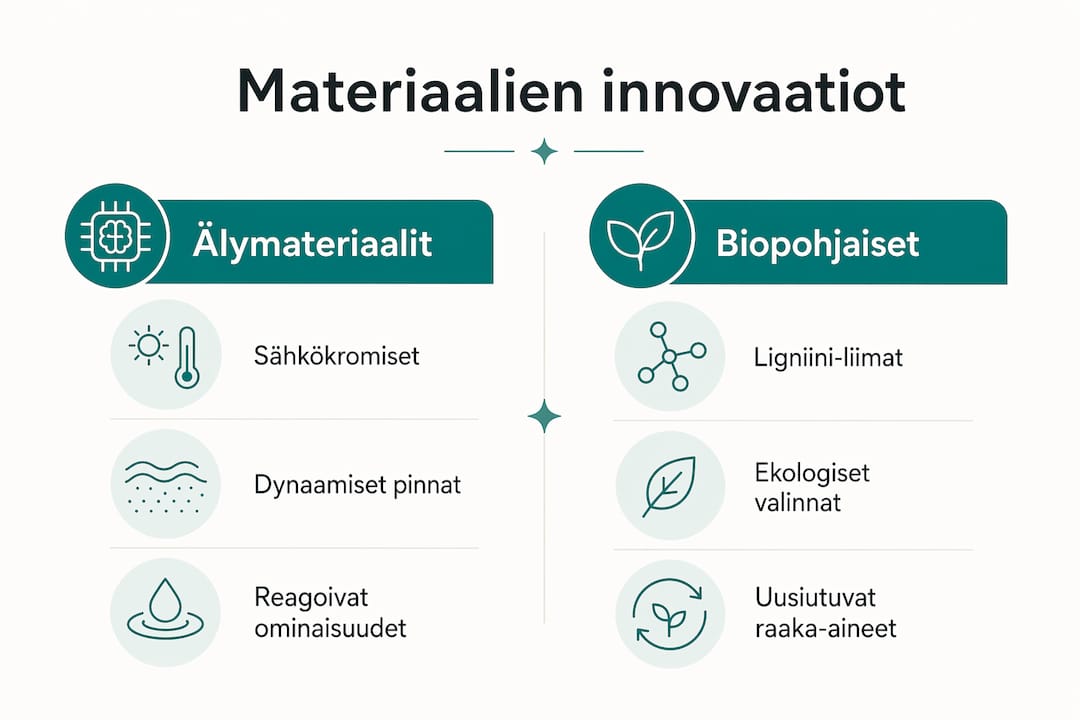
Biomass-based polyester resins offer 76% better tensile strength than traditional fossil-based resins. This performance advantage means that structures and surfaces made from bio-based resins withstand mechanical stress better than previously assumed.
Practical applications in space design are already concrete:
- Electrochromic surfaces enable color-changing walls and windows that can be controlled electrically
- Lignin-based wood products offer an ecological alternative to traditional glued wood surfaces
- Biomass resins are suitable for demanding structures, such as furniture and acoustic panels
- Energy-storing films combine functionality and visual change on the same surface
Professional tip: When evaluating smart materials for your project, always ask the supplier about the requirements for electrical control in advance. Wiring and control systems must be designed into the structure at an early stage, not retroactively.
Low-carbon concrete solutions and their visual possibilities
Carbonaide technology is a Finnish invention that pumps carbon dioxide into concrete during the hardening process. Carbonaide reduces the need for cement by up to 20% and decreases the carbon footprint of concrete by up to 50% compared to traditional concrete. For an architect, this means that a concrete-surfaced building can be significantly lighter environmentally without having to compromise on appearance or structural performance.
Carbonaide aims for ten production units to be realized in the Nordic countries by 2026, which means that the technology is moving from the laboratory to commercial production right now. Inquiries have come from as far as Japan and Mexico, which indicates that international interest is real.
The table below compares Carbonaide concrete and traditional concrete by key design metrics:
| Feature | Traditional concrete | Carbonaide concrete |
|---|---|---|
| Carbon footprint | High | Up to 50% smaller |
| Cement requirement | 100 % | Up to 20% less |
| Visual appearance | Traditional gray | Same or improved surface |
| Availability in Finland | Wide | Growing, commercialization 2026 |
| Suitability for interiors | Yes | Yes |
Visually, Carbonaide concrete does not differ in appearance from traditional concrete, which is important information for a designer. You can use it for similar aesthetic solutions, such as concrete walls, floors, and acoustic elements, but with a smaller environmental impact. This makes it particularly interesting for designing galleries, restaurants, and public spaces where the raw concrete surface is a desired aesthetic choice.
Why is material durability more than just initial appearance?
The true durability of a material is only revealed in the long term, as maintenance intervals become more frequent and surfaces wear. Interior designer Elisabeth emphasizes that material durability requires planning for maintenance intervals and lifecycle already at the design stage. This means that a designer must ask the material supplier not only about price and appearance, but also about the estimated maintenance interval and lifespan in that particular environment.
Traditional laboratory tests are not always sufficient to assess long-term durability. 40 cycles of freeze-thaw stress do not predict decades, meaning that material selection must rely on long-term field tests alongside laboratory results. The Geological Survey of Finland and Tampere University have both emphasized this perspective in their material research.
In life cycle thinking, the exergy method goes beyond traditional models. Exergy assessment combines technical performance and material value, helping to identify when a material should be reused and when it should be recycled. This is particularly useful when designing spaces where materials change or where old building materials are to be repurposed.
Practical checklist for assessing material durability:
- UV exposure: Requirements for indoor and outdoor spaces differ significantly. UV exposure changes preservation and requires different solutions for different applications.
- Moisture stress: Kitchens, bathrooms, and public spaces require different material specifications than dry interior spaces.
- Mechanical wear: Floors, handrails, and door handles are subjected to different stresses than wall surfaces.
- Maintenance interval: Estimate how often the material will require treatment or replacement over a 10-year period.
- Recyclability: Determine whether the material can be dismantled and reused or recycled at the end of the project.
Professional tip: Ask the material supplier for reference sites where the same material has been in use for at least five years. Photos from the time of acquisition and the present day tell more than any technical data sheet.
Creative material solutions in space design require that durability be considered already at the concept stage, not just during implementation.
How does new material technology affect the visual appearance of a space?
The visual appearance of a space is built on the interaction of surfaces, colors, textures, and light. New materials change this equation in two ways: they add dynamic properties to static surfaces and bring the aesthetics of natural materials to technically high-performing solutions. Finnish material innovations combine naturally inspired solutions with high technology, opening up new creative possibilities for designers and artists.
Dynamic surfaces are perhaps the most significant change in space design. Electrochromic materials enable walls and windows that change color or transparency according to control. This means that the same space can function as a bright workspace in the morning and an atmospheric restaurant in the evening without physical changes. In galleries, this opens up the possibility of changing the background color according to the artwork.
The natural aesthetics of bio-based materials bring textures to spaces that cannot be achieved with synthetic materials. Lignin-based surfaces and wood products retain the organic appearance of wood, but their technical performance has significantly improved. This is particularly interesting in restaurants and hotels, where the warmth of natural materials is a desired atmosphere.
Concrete possibilities for space design with new materials:
- Contrast surfaces: Combine a matte concrete surface and an electrochromic element for visual tension
- Acoustic bio-based panels: Wood-based acoustic panels function as both sound absorption and a visual element
- Changing backgrounds: Electrochromic wall surfaces in galleries or exhibition spaces
- Combinations of natural materials: Lignin-based glued wood combined with carbon-negative concrete creates an aesthetically interesting contrast
Aesthetic space design tips 2026 discusses in more detail how these materials work together to create an atmospheric whole.
Key takeaways
Material innovations provide designers and architects with concrete tools to simultaneously enhance the visual appeal, structural durability, and environmental responsibility of a space.
| Point | Details |
|---|---|
| Smart materials in space design | Electrochromic surfaces change color in less than 2 seconds and are suitable for dynamic spaces. |
| Bio-based materials | Lignin-based glues and biomass resins replace fossil alternatives without compromising performance. |
| Carbon-negative concrete | Carbonaide technology reduces the carbon footprint of concrete by up to 50% while maintaining the same visual appearance. |
| Durability assessment | The long-term durability of materials requires field testing and exergy thinking alongside laboratory results. |
| Visual possibilities | New materials enable dynamic, changing spaces without physical reconstruction. |
Material choices I no longer make the same way
I have followed material development for a long time, and one thing has clearly changed: designers still overestimate initial appearance and underestimate how a material will behave years from now. I see this repeatedly in projects where a beautiful surface is chosen without anyone asking what it will look like after three years of heavy use.
Another thing I no longer do is dismiss bio-based materials as an “ecological compromise.” The 76% better tensile strength of biomass resins compared to fossil ones is a performance argument, not just an environmental one. When a material is both more durable and more ecological, the choice is easy.
Electrochromic materials are still undervalued in space design. Most designers think of them as technology, not aesthetics. But when a wall can change color with the mood, it's more than technology. It's a new way of thinking about what a space can be.
Regarding Carbonaide concrete, I recommend actively following its commercialization. The technology is now moving into widespread production, and those architects who are already familiar with it will have an advantage when it becomes widely available.
— Mikko
Dekoja and specialty materials for space design
The visual impact of space design often comes from what others don't use. Dekoja supplies Musou Black and the world's blackest effect surfaces directly from its Finnish warehouse to designers, architects, and artists who want to create spaces that stand out.
Light absorption, non-reflective surfaces, and optical illusions are Dekoja's specialty. If your project requires a contrast wall, a gallery's visual effect surface, or an atmospheric matte surface for a restaurant, Dekoja delivers in 1 to 3 business days from Finland. Explore specialty materials and ask for a B2B offer directly. Our expert will help with the project from start to finish.
FAQ
What are material innovations in design?
Material innovations are new technologies and ecological solutions that improve the performance, durability, or visual properties of materials compared to traditional alternatives. In design, they practically mean smart materials, bio-based products, and carbon-negative solutions.
How do electrochromic materials work in spaces?
Electrochromic materials change color or transparency within 2 seconds when an electric current is applied. In spatial design, they can be used in smart windows, color-changing wall surfaces, and dynamic exhibition spaces.
What is Carbonaide concrete and why does it interest architects?
Carbonaide concrete is a Finnish invention that binds carbon dioxide into concrete during the hardening process, reducing its carbon footprint by up to 50%. Architects are interested in it because its visual appearance is the same as traditional concrete, but its environmental impact is significantly smaller.
How do I assess the true durability of a material?
The true durability of a material is revealed through long-term field testing, not just laboratory values. Ask the supplier for reference sites with at least five years of use and evaluate the material in relation to its actual operating environment, such as UV exposure and moisture stress.
Are bio-based materials suitable for demanding structures?
Yes. Biomass-based polyester resins offer up to 76% better tensile strength than traditional fossil-based resins, making them suitable for demanding structures such as furniture, acoustic panels, and glulam products.