

Create a unique atmosphere: the secrets of material selection
TL;DR:
- Materials impact the customer experience more profoundly than lighting or decorative elements.
- Material choices shape the atmosphere, acoustics, and lasting impression of a space.
- Special materials create a space's personality and set it apart from competitors.
Many restaurant or gallery owners believe that atmosphere is primarily created by lighting or carefully selected decorative elements. The reality is different. The materials from which a space is built affect the customer experience much more deeply than any single lamp or paint color. They engage multiple senses simultaneously: sight, sound, and even touch. This article will explore how material choices build the identity of a restaurant or gallery, manage acoustics, and create a lasting impression that brings customers back.
Table of Contents
- Why materials define the foundation of atmosphere
- The combined effect of lighting and materials on atmosphere
- Acoustic materials: a space where sound and peace meet
- Special materials create the personality of a space
- The surprising truth: atmosphere is created by measuring, not just by feeling
- Space for atmosphere: easily find special materials
- Frequently asked questions about the atmospheric impact of materials
Key Takeaways
| Point | Details |
|---|---|
| Materials create the basic atmosphere | Correctly chosen materials critically impact the perceived warmth and comfort of a space. |
| Lighting and materials work together | Combining suitable materials and light sources enhances the desired atmosphere and visual appeal. |
| Acoustics are the silent key to experience | A good sound environment completes the space's experience and encourages customers to stay longer. |
| Special materials ensure distinctiveness | Unique material choices are memorable and build the space's own narrative. |
Why materials define the foundation of atmosphere
Many consider atmosphere only at a superficial level. Colors are chosen, lights are acquired, and furniture is arranged. However, deeper solutions have the greatest impact on how a space feels.
The effect of materials is multi-sensory. Wood brings warmth and softness, while stone and ceramics communicate durability and timelessness. These are not just visual observations, but sensations that arise from the material's surface structure, weight, and even the sound it produces upon touch. The opacity of wood adds warmth to a space in a way that cannot be replicated by mere paint color.
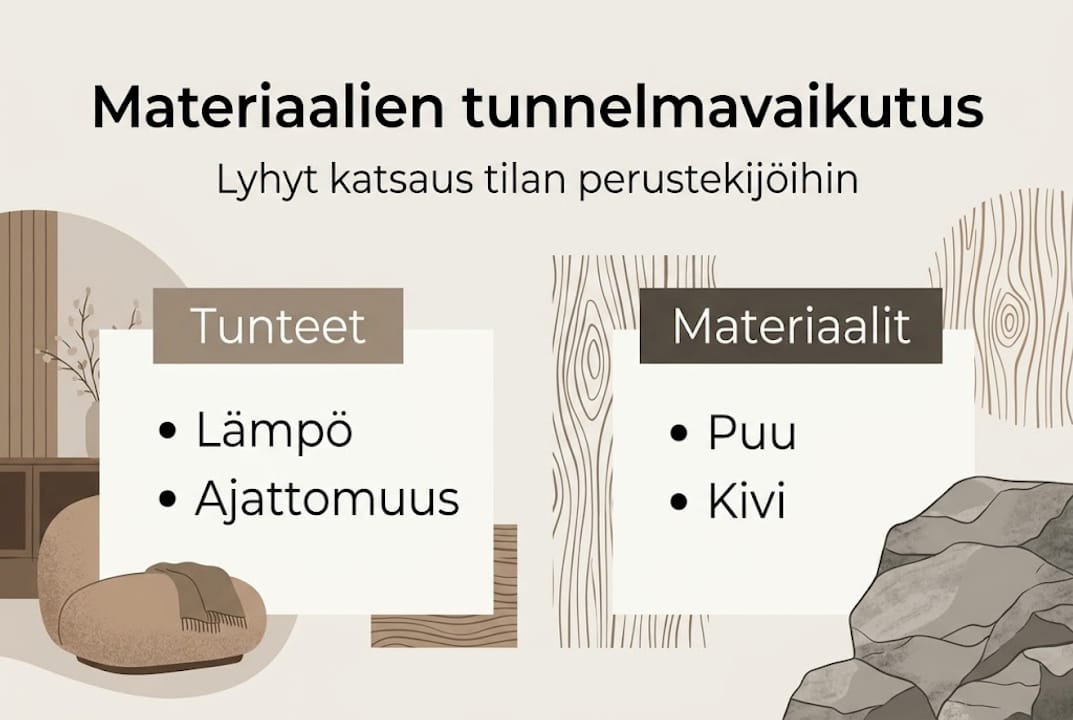
Texture is one of the most underrated factors in spatial design. A rough stone surface reflects light differently than smooth metal. Soft leather absorbs sound, while varnished wood reverberates. These physical properties change the atmosphere of a space virtually without the customer consciously noticing where the experience originates.
Holistic material selection means that every surface—floor, ceiling, wall, and furniture upholstery—functions as part of a unified whole. See more on material design tips with practical examples.
| Material | Sensory Effect | Atmospheric Tone | Typical Application |
|---|---|---|---|
| Wood | Warmth, soft sound | Warm, inviting | Restaurants, cafes |
| Stone | Coolness, resonance | Valuable, timeless | Galleries, fine dining |
| Ceramics | Durability, brightness | Clean, modern | Bars, exhibition spaces |
| Metal | Coldness, reflection | Industrial, precise | Modern spaces, exhibitions |
| Textiles | Soft, sound-absorbing | Cozy, calming | Lounge areas, private rooms |
“Material choice is not just aesthetics. It is a decision about the feeling a customer will take with them when leaving the space.”
Good spatial design begins by identifying the emotion to be evoked. Do you want the customer to feel relaxed or energetic? Intimate or free? Once the goal is clear, material choices follow logically.
In practice, this means, for example, that for a fine dining restaurant, a dark, warm wood is chosen for the flooring instead of cold marble, even if marble is visually striking. Wood dampens footsteps, creates warmth, and elevates the customer's thoughts above everyday life. Marble, on the other hand, echoes and communicates rigidity, which may suit a gallery space but not necessarily an intimate dinner restaurant.
The combined effect of lighting and materials on atmosphere
Once the significance of materials is understood, the next step is their relationship with lighting. These two elements do not work separately but together form what the customer sees and feels.
The color temperature of lighting affects how materials appear. Warm, yellowish light enhances the depth of wood surfaces and makes the space inviting. Cool, bluish light, on the other hand, brings out the textures of metal and stone, creating a modern, even clinical atmosphere. Materials reflect or absorb light in different ways, and this directly impacts how the space is perceived.
In restaurants, colors and materials also have a physiological effect. Red and orange hues combined with warm wooden surfaces stimulate appetite. This is no accident: many successful restaurants deliberately use this combination to create an environment where customers stay longer and order more.
Integrating lighting and materials in practice:
- First, define the materials and their color tones
- Choose the color temperature of the lighting according to the materials (warm wood: 2700-3000K, metal and stone: 3500-4000K)
- Test different lighting intensities at various times of day
- Evaluate how natural light changes the appearance of materials throughout the day
- Adjust the layering of lighting so that different areas of the space have their own atmosphere
Professional tip: Never choose final materials based solely on a store sample. Bring material swatches into the space and view them under the lighting that will be present in the space. A material can look completely different in a showroom than in a restaurant dining room.
| Material Combination | Lighting Recommendation | Atmosphere | Best Suited For |
|---|---|---|---|
| Wood + warm light | 2700-3000K | Warm, cozy | Casual dining, bistro |
| Metal + cool light | 3500-4000K | Modern, precise | Fine dining, gallery |
| Stone + neutral light | 3000-3500K | Timeless, valuable | Wine restaurant, gallery |
| Textile + dimmable | Adjustable | Flexible, relaxed | Lounge, cocktail bar |
Layered lighting is a key tool for controlling how different materials are activated in various situations. For dinner service, general lighting can be dimmed, and individual surfaces highlighted with spotlights. This creates dramatic shadows and emphasizes textures in a way not possible with uniform lighting.
Also, see how material choices for experiential spaces impact the overall experience through practical examples.
Acoustic materials: a space where sound and peace meet
After lighting, colors, and surfaces, an often-forgotten dimension emerges: sound. Acoustics is the factor that can make or break the atmosphere of a restaurant or gallery, yet it too often remains a low priority in design.
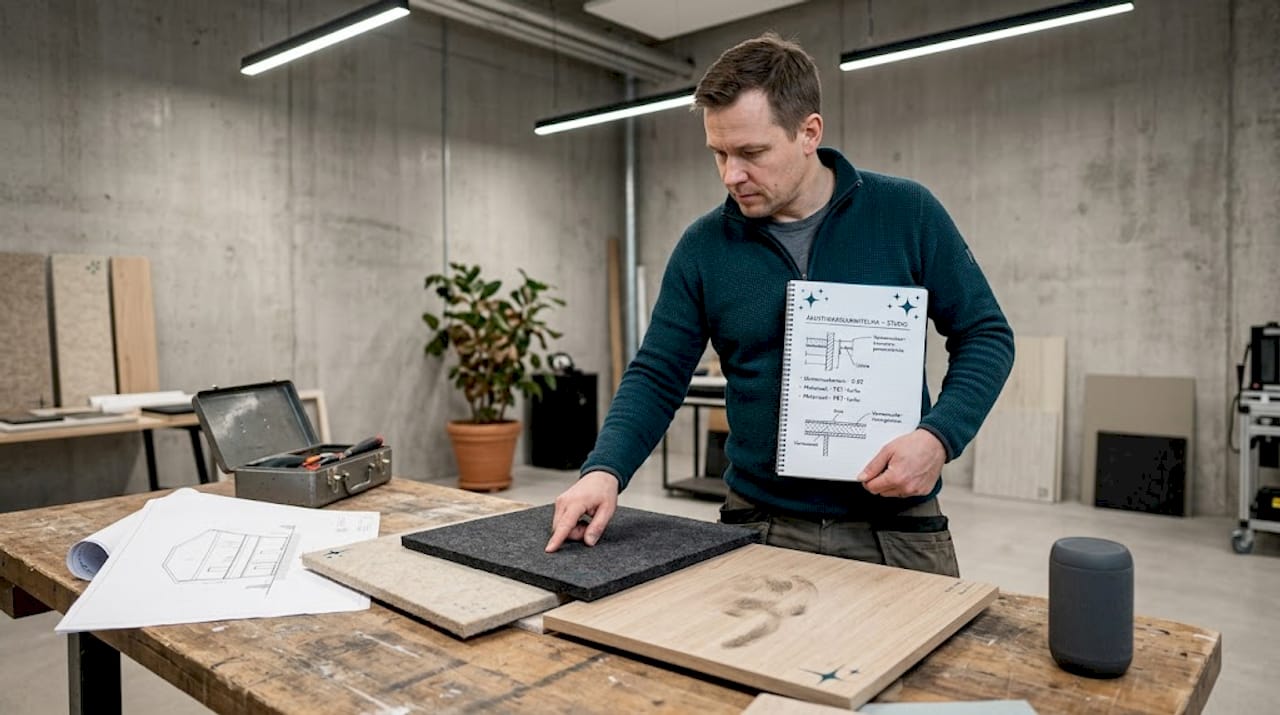
Poor acoustics are a concrete problem. When a restaurant dining room fills with people and all sounds echo off hard surfaces, a noisy environment is created where customers have to raise their voices to be heard. This vicious cycle worsens itself, resulting in a stressful experience that shortens customer visits and harms the restaurant's reputation. Acoustic materials improve the uniformity of the sound field, especially in the 500-1000 Hz frequency range, which corresponds to the main frequency band of human speech.
Effective acoustic solutions in spatial design:
- Soft upholstery and cushions absorb sound and reduce echo
- Acoustic panels on walls or ceilings balance reverberation time
- Heavy curtains absorb sound and also serve as a visual element
- Carpets and soft floor coverings dampen footfall sounds and low frequencies
- Living walls and green elements serve both acoustically and visually
Professional tip: Measure the reverberation time of the space before selecting materials. The reverberation time measured in an empty space is usually much longer than in a full space, but it provides a good starting point. The target reverberation time in a restaurant space is typically 0.6-0.8 seconds. In galleries, a slightly longer echo, up to 1.0-1.2 seconds, can be allowed to create a distinguished, peaceful atmosphere.
Modern acoustic design does not mean that a space looks like a studio covered in acoustic panels. Current solutions are visually striking. Geometric acoustic panels, textured wall coverings, and three-dimensional surface structures can be key visual elements of a space that simultaneously fulfill their acoustic function. This is design at its best: functionality and aesthetics seamlessly combined.
In galleries, acoustics are particularly important. An overly reverberant space disrupts pausing at artworks and diminishes the intensity of the experience. Properly designed acoustics create silence that allows room for thought and the emergence of emotions. See more about acoustics in experiential spaces with practical implementation examples.
Digital 3D modeling tools now enable acoustic simulation before construction. This is a significant advantage, as acoustic problems are expensive to correct afterward. Investing in acoustic design at the beginning of a project pays for itself through improved customer experience and longer visit times.
Special materials create the personality of a space
Once the basic atmosphere and acoustics are in place, it's time to stand out with unique choices. Special materials are the factor that makes a space memorable, not just functional.
An ordinary restaurant or gallery uses ordinary materials. Wood, white paint, gray concrete. These are safe choices, but they are not memorable. Special materials, such as black persimmon wood or sculptural vases, create a unique identity in galleries and restaurants that sets the space apart from everything else.
| Special Material | Visual Impact | Application | Memory Impression |
|---|---|---|---|
| Black persimmon wood | Dramatic, dark | Fine dining, gallery | Very strong |
| Sculptural structures | Three-dimensional, dynamic | Exhibition spaces, bars | Strong |
| Hand-crafted ceramic surfaces | Organic, unique | Restaurants, cafes | Strong |
| Super-black surfaces | Deep, absorbing | Galleries, special spaces | Very strong |
| Stone mosaics | Complex, elaborate | Floors, accents | Strong |
Principles for selecting special materials:
- Choose materials that tell a story about the space's concept
- Boldly combine contrasts: rough and smooth, dark and light, warm and cold
- Use special materials judiciously, not everywhere
- Ensure that special materials meet the practical requirements of the space
“The best space is not where everything is perfect, but where something is so surprising that the customer wants to return to see it again.”
Super-black surfaces are a special case that deserves particular mention. Surfaces that absorb light exceptionally efficiently, such as Musou Black, create optical illusions and contrasts that cannot be achieved with ordinary paints. In a gallery, such a surface can make a work of art the main character in a way impossible by other means. In a restaurant, it can create a dramatic wall element that serves as a visual anchor for the entire space.
Hand-crafted elements are another way to differentiate. When a customer sees that an element in a space is handmade, they understand that the space has been thoughtfully designed. This builds trust and communicates quality. Hand-crafted ceramic surfaces, custom-made light fixtures, or unique wooden sculptures tell their own story without words.
See inspiring material choices from practical projects where special materials have completely transformed the character of a space.
When using special materials, it's important to remember that they are not just decorations. They are part of the core experience. The customer may not be able to articulate why the space feels special, but they will feel it. And that feeling is what makes them recommend the place to their friends.
The surprising truth: atmosphere is created by measuring, not just by feeling
Once the understanding of material selection and atmosphere creation has deepened, it's time to look behind the scenes. In the design industry, there is a strong tradition of talking about "feeling" and "intuition." But the best spaces are not born from mere feeling. They are born from measurement, prototypes, and iteration.
This is an uncomfortable truth for many designers and owners. It's easier to believe that good taste is enough. In practice, however, holistic design combines sustainability, acoustics, lighting, and psychology, and this combination requires a systematic approach.
What does "measuring" mean in practice? It means measuring reverberation time before and after material installation. It means measuring light levels at different points in the space and at different times of day. It means systematically collecting customer feedback and analyzing it in relation to changes made.
Digitalization has brought new tools to this process. 3D modeling software allows for space visualization before construction. Lighting simulations show how different materials behave under various lighting conditions. Acoustic simulations predict reverberation time and the uniformity of the sound field. These tools do not replace professional experience, but they significantly reduce the risk of expensive errors.
Building prototypes is another underestimated tool. Before committing to an expensive material for the entire space, it's worthwhile to build a small prototype or test area. This provides an opportunity to see how the material behaves in a real space, under real lighting, and in real use. Many surprises arise at this stage, and it is much cheaper to make changes in a prototype than in a finished space.
From an entrepreneur's perspective, this approach also means that the atmosphere is never truly finished. The best restaurant or gallery constantly evolves based on customer feedback and new opportunities. The materials of an aesthetic space are not a one-time investment, but an ongoing process.
This doesn't mean the space needs to be renovated every year. It means that small, thoughtful changes – a new accent material, an altered lighting solution, or a new textile element – can keep the space fresh and engaging year after year. Customers notice the changes, even if they don't always know what has been changed. They just feel that the space seems new again.
Space for Ambience: Find Specialty Materials Easily
Now that you know how materials affect ambience, it's easy to take the next step. Material choices are crucial, but finding the right materials can be challenging.
Dekoja.net is the only Finnish specialty materials store that supplies Musou Black and the world's blackest effect surfaces directly from a domestic warehouse. The selection includes super-black surfaces, non-reflective materials, optical illusions and contrast walls, as well as visual effect surfaces for restaurants and galleries. Deliveries take 1-3 business days from Finland, and B2B service is available for projects and design agencies. You get more than just products: an expert who helps with the project from start to finish.
Frequently Asked Questions About the Atmospheric Effect of Materials
How Does Wood Affect the Ambience of a Restaurant or Gallery?
Wood creates warmth and coziness in a space, as its coverage adds warmth in a way that other materials cannot fully replicate. It also absorbs sound, making the space acoustically more pleasant.
What Kind of Lighting Best Highlights Material Surfaces?
Warm light (2700-3000K) brings out wood surfaces and creates a cozy atmosphere, while cool light emphasizes metal and stone, as materials reflect or absorb light differently depending on the color temperature. Always test materials in the lighting that will be in the space.
How Does Acoustics Improve the Customer Experience in a Space?
Good acoustic materials reduce background noise and create a peaceful atmosphere, because acoustic materials improve the uniformity of the sound field, especially in the speech frequency range. This reduces stress and extends the customer's visiting time.
Why Should Specialty Materials Be Considered in Space Design?
Specialty materials, such as black persimmon wood or sculptural vases, create a unique identity that distinguishes the space from competitors and remains in customers' minds. They are an investment that pays for itself in improved customer loyalty and recommendations.