

Opaque Surfaces Explained: A Professional's Guide
TL;DR:
- Opaque surfaces are at the core of design, as their structure influences the atmosphere of a space and light management. Material continuity and light diffusion create visual effects that impact the room's appearance and durability. The correct material choice is based on intended use, maintenance needs, and desired visual impact.
Opaque surfaces explained are not merely a material question. They are at the heart of visual design: how a surface handles light determines the atmosphere, depth, and continuity of a space. Many design professionals choose materials based on surface appearance, forgetting what the material's structure truly does to a space. This guide covers the technical properties of opaque surfaces, key material types, visual effects, and practical applications. The goal is to provide you with the tools to make informed material choices from one project to another.
Table of Contents
- Key Learnings
- Opaque Surfaces Explained: Definition and Materials
- Structure, Light Management, and Spatial Impact
- Opaque vs. Translucent vs. Transparent
- Practical Applications in Interior Design Projects
- Expert View: Opaque Surfaces in Interior Design
- Dekoja Helps with Material and Effect Surface Selections
- FAQ
Key Learnings
| Topic | Information |
|---|---|
| Material structure is key | The level of opacity is determined by the material's internal structure, not just its coating. |
| Continuity is a visual advantage | Through-body materials allow for seamless edges and authentic visual effects. |
| Light management is a design decision | Matte surfaces diffuse light, gloss reflects: both can be consciously used to shape a space. |
| Maintenance requires planning | A durable surface does not mean a maintenance-free surface; upkeep is part of material selection. |
| Comparison guides the right choice | The choice between transparent, translucent, and opaque is based on the intended use and desired effect. |
Opaque Surfaces Explained: Definition and Materials
An opaque surface is simply a surface through which light does not pass at all. Unlike transparent materials such as clear glass or translucent ones like frosted acrylic, opaque materials absorb or reflect all light. This property makes them building blocks for controlling a room's atmosphere, privacy, and visual focal points.
For design professionals, the most common opaque surface materials fall into four main categories:
- Solid surface materials: made from natural minerals and resins, non-porous and hygienic materials that allow for a seamless and easily repairable surface.
- Sintered stone: an extremely dense material, which is 6–20 mm thick and comparable in durability to 30 mm granite. Used in airports and hospitals.
- Opaque acrylic: a material offering complete privacy, suitable for walls, signs, and artworks.
- Matte laminates and coatings: a more affordable option where opacity is achieved through the coating, not the structure.
The key difference between through-body and surface-coated materials is visual continuity. When a solid surface or sintered material is cut, the color and pattern continue to the edge. With a surface-coated panel, a different material is revealed at the cut edge, which is particularly noticeable in edge treatments and corner joints.
Professional tip: The level of a material's opacity should always be tested in real lighting conditions before making a final selection. A spotlight directed from behind a sample piece will reveal whether the material is truly opaque or merely dark.
The table illustrates the main opacity characteristics of different material types:
| Material | Opacity | Edge continuity | Typical Use |
|---|---|---|---|
| Solid surface | Full | Yes | Countertops, sinks, walls |
| Sintered stone | Full | Yes | Flooring, facades, worktops |
| Opaque acrylic | Full | No (cut edge is distinct) | Signs, wall panels, art |
| Surface-coated panel | Full | No | Furniture surfaces, temporary structures |
| Frosted glass | Partial | Not applicable | Interior doors, partitions |
Structure, Light Management, and Spatial Impact
The behavior of opaque surfaces in light is more crucial for design work than mere material knowledge. The surface structure determines how light behaves when it encounters the material: whether it is absorbed, diffused, or reflected back.
Matte opaque materials diffuse light in multiple directions, making the surface appear uniform and soft regardless of the lighting direction. This is an architecturally valuable property: a matte surface does not create glare or reveal structural imperfections as easily as a glossy surface. Less reflective materials are suitable for spaces where atmosphere consistency is a priority.
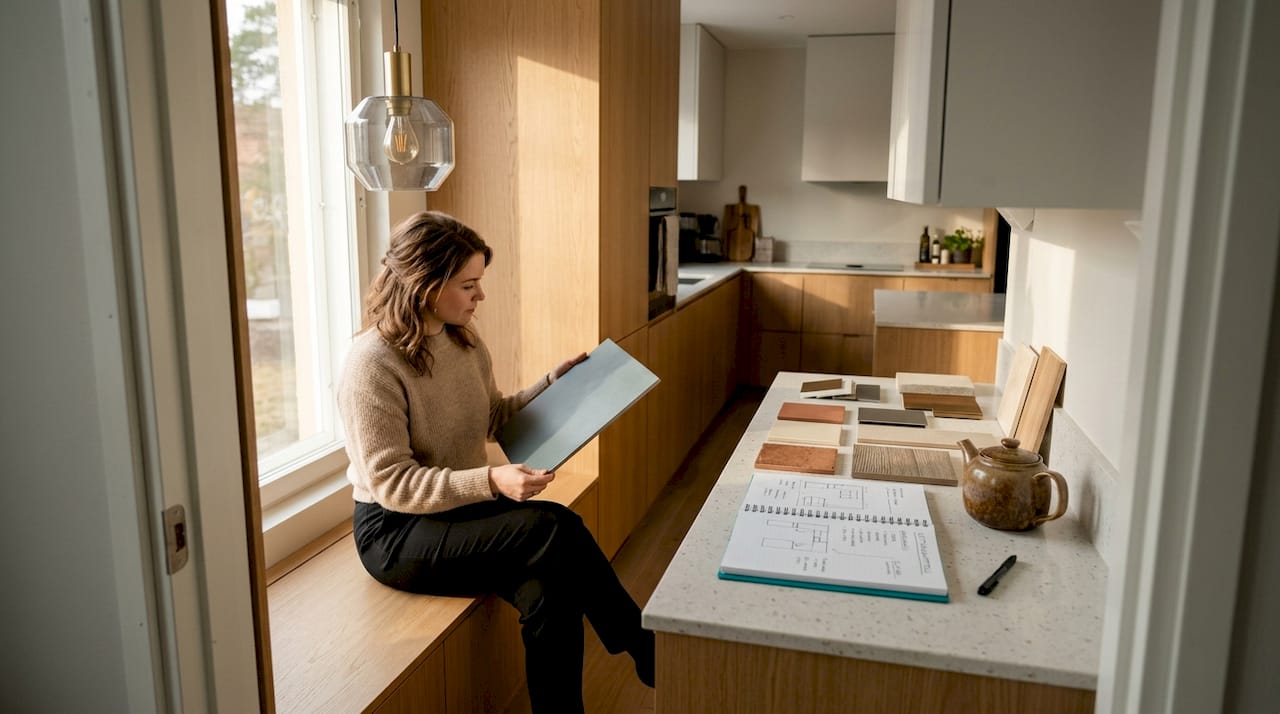
Glossy opaque surfaces, on the other hand, reflect light directionally, creating an illusion of depth and spaciousness. In dark spaces, a glossy opaque surface can multiply the visual impact of a light source.
The waterfall effect, or falling edge treatment, is a good example of why structure is more important than surface appearance. When a worktop continues as a side panel without a visible joint, the material must be through-body: the color and pattern must continue seamlessly from one corner to another. This is not achievable with surface-coated panels.
Coatings add special properties to opaque surfaces. Titanium plate coating techniques such as plasma or flame spraying enable UV protection, wear resistance, and even corrosion protection, which basic opaque materials do not offer. Design professionals should consider this especially in public spaces where surfaces are exposed to heavy wear.
Professional tip: When measuring surface flatness, do not rely solely on visual assessment. Nanometer-level flatness requirements according to standards ASME B89.3.7 and ISO 8512-2 are significant, especially in projects aiming for high-quality visual effects.
Opaque vs. Translucent vs. Transparent
Comparing the three levels of permeability is a practical tool in interior design. Less often is it considered what an individual choice means for the entire space.
Transparent materials like clear glass or cast acrylic allow light to pass through almost unchanged. They create a sense of openness and lightness. In public spaces, however, they can cause a lack of privacy or glare problems.
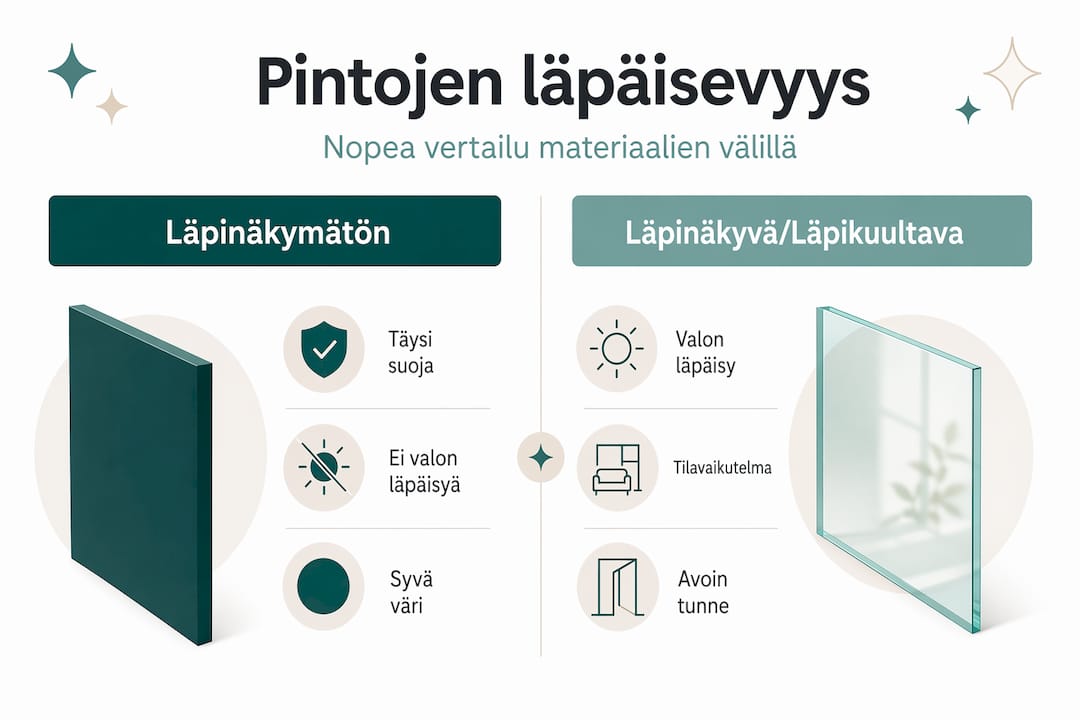
Translucent materials scatter light but allow some to pass through. They are particularly suitable for partition solutions where both a visual separation and natural light are needed. In practice, their visual manageability is the most challenging: lighting behind them radically changes the surface's appearance.
Opaque surfaces offer complete control. They are visual breakpoints that define, guide, and draw the eye. This makes them an essential part of spatial design where clear contrasts are desired or the intensity of the atmosphere is to be deepened. Material choice in relation to intended use strongly directs the design solution.
From the perspective of durability and maintenance:
- Transparent surfaces reveal dirt quickly but are easy to clean
- Translucent surfaces can hide dirt but are more susceptible to surface damage
- Opaque surfaces withstand heavy use, but limescale and surface wear require regular maintenance
From a cost perspective, opaque solid surface and sintered materials are an investment that pays for itself in long-term use. Translucent glass structures, however, increase the project budget due to structural requirements. The decision is not only aesthetic but always financial.
Practical Applications in Interior Design Projects
Choosing the right opaque material depends on three variables: the desired visual effect, wear and tear, and the level of finish. Here is a concrete framework for material selection in various applications.
-
Accent Walls and Focal Elements: Dark, opaque surfaces are used in accent walls to create depth and define space. Super black matte finishes absorb almost all light, making the space three-dimensional. The impact of materials on space planning is a documented topic worth exploring before a major project.
-
Waterfall Countertops and Corner Joints: As mentioned earlier, through-body sintered stone or solid surface material is the only option when seamless continuity is desired. With a surface-coated panel, the result is always a compromise.
-
Effect Surfaces for Restaurants and Galleries: The explanation of surface transparency is central to restaurant design. A completely opaque acoustic panel can be coated in matte black, serving as both a sound absorber and a visual element.
-
Bathroom and Wet Rooms: Solid surface materials are ideal for wet rooms: they don't absorb water, tolerate moisture, and scratches can be buffed out. The seamless surface also reduces the risk of bacterial growth.
-
Public Spaces and High-Traffic Environments: Sintered stone surfaces have a documented history of use in airports and hospitals. Materials without transparency are suitable for these applications because they withstand mechanical stress and are easy to maintain.
Professional tip: Seamless finishing of opaque surfaces requires that joints are designed according to the material's properties. Use the correct resin or sealant, whose shade matches the material as closely as possible. A color deviation in a 2–3 mm wide seam is often more noticeable than imperfect geometry.
From a maintenance perspective, opaque surfaces require quick drying in moist areas and a regular cleaning routine. Durability does not automatically mean maintenance-free. This is information that should also be shared with the end-client at the end of the project.
Expert View: Opaque Surfaces in Interior Design
I have followed discussions about material choices for years, and one of the most recurring mistakes is this: an opaque surface is perceived only as a neutral background, not as an active design element. That is a big mistake.
In the best projects I have seen, opaque surfaces do two things at the same time. They block out what is not wanted to be seen and direct the gaze to where it is desired. A completely black, matte surface combined with a single spotlight is aesthetically more powerful than tens of thousands of euros worth of designer furniture in vague lighting.
Another thing that often goes unnoticed is the material's behavior over its lifecycle. I have seen projects where a surface-coated panel was chosen for cost reasons instead of a through-body material. Five years later, the edges are worn, the color has faded, and the material looks cheap. The right material choice is not an additional cost; it is a saving.
The future trend, in my opinion, is clear: very low light reflection and color absorption will become more common in spatial design. Surfaces that, instead of catching the eye, expand it. Aesthetic space design is already the direction in which the best professionals are moving.
— Mikko
Dekoja Helps with Material and Effect Surface Selections
When the theory of opaque surfaces transforms into a concrete project, material selection becomes significantly faster with expert support.

Dekoja is the only domestic specialty materials store that delivers Musou Black and the world's blackest effect surfaces directly from a Finnish warehouse. The selection includes super black matte finishes, non-reflective fabrics, and studio materials used in restaurants, galleries, and architectural projects to create visual effects. Delivery time is 1–3 business days, and B2B customers are offered project-specific material consultation from start to finish. If your project requires an opaque surface that does more than just cover, contact Dekoja.
FAQ
What makes a surface opaque?
Opacity arises when a material completely blocks the passage of light. This is due either to the material's dense structure, pigments, or a coating that absorbs or reflects all light.
How does an opaque surface differ from a translucent one?
A translucent surface allows some light to pass through, scattering it, while an opaque surface does not allow any light to pass through. In practice, this means an opaque surface offers complete privacy and tighter visual control.
Which opaque surface materials are most durable for public use?
Sintered stone and solid surface materials are the most durable options. Sintered stone is comparable in durability to thick granite with a thinner structure, and it is used in airports and hospitals.
Is an opaque surface always easier to maintain than a transparent one?
Not necessarily. Opaque surfaces can temporarily hide dirt, but limescale, for example, is also a problem for them and requires a regular cleaning routine.
Can an opaque surface create a sense of depth in a small space?
Yes. Combining dark, matte, opaque surfaces with spotlights creates an illusion of depth. This is a particularly effective technique in restaurants and galleries, where the ambiance of the space is a primary design goal.