

Using effect paints: easily create impressive spatial experiences
TL;DR:
- Effect paints are popular interior design products that create multi-layered and textured surfaces in restaurants and creative spaces. They are used to build different atmospheres and brand identities cost-effectively, offering a significant competitive advantage. Good planning, testing, and the right tools ensure a successful outcome and a sustainable way to stand out in the market.
Many believe that effect paints belong only in striking art galleries or individual showroom projects. The reality is different. Effect paints are already used in thousands of restaurants, bars, cafes, and event venues across Finland and Europe, providing measurable benefits in terms of customer experience, brand identity, and social media shares. This article will cover what effect paints actually are, how they differ from regular paints, how they are used in practice, and how to ensure your project succeeds the first time.
Table of Contents
- What are effect paints and why are professionals interested in them?
- Effect paints vs. traditional paints: what changes in the space?
- Most popular applications of effect paints in restaurants and creative spaces
- Key points for successful effect painting
- Why are the possibilities of effect painting still underestimated?
- Elevate the look of your space with effect paints
- Frequently asked questions about using effect paints
Key Takeaways
| Point | Information |
|---|---|
| Effect paints create experiences | With effect paints, you can elevate the atmosphere of a space to a new level and stay in customers' minds. |
| Stand out from competitors | With the right effect, a restaurant or event venue can build its own strong brand image. |
| Practical implementation is key | A successful outcome requires a good plan and the selection of suitable materials. |
| Suitable for many spaces | Effect paints are suitable for walls, furniture, and small details in restaurants and creative spaces. |
What are effect paints and why are professionals interested in them?
Effect paints are surface treatment products that imitate or create various textures, depths, and visual illusions. They can produce the impression of concrete, marble, velvet, metal, or lime directly on walls, ceilings, or furniture. The end result is completely different from what is achieved with ordinary paint.
Ordinary paint covers a surface evenly. Effect paint builds the surface. It brings out layering, patterns, and details that the eye automatically follows. This is precisely the feature that makes them so interesting in restaurant and space design.
The use of effect paints has become widespread in the construction and interior design industry to create innovative space solutions, and growth continues. There is a clear reason for this: customers are looking for experiences, not just places. A restaurant or space with distinctive walls stands out. It gets shared on social media. It forms the core of the brand.
“Effect paints are innovative surface design that customers expect. They are memorable.”
The main types of effect paints can be divided as follows:
- Concrete effect paints create a rough, industrial surface that works in both modern and raw industrial styles.
- Metallic effect paints give walls or furniture a metallic sheen, from golden copper to steel.
- Lime paints and marbleizing paints produce a soft, timeless surface suitable for classic and luxurious spaces.
- Velvet paints create a deep, soft, and glare-free surface that absorbs light exceptionally well.
- Pearlescent and color-changing effect paints produce lively surfaces whose color tone changes with the viewing angle.
- Super-black and light-absorbing paints, such as Musou Black, eliminate reflections and create optical illusions that other paints cannot replicate.
Professional tip: Always try a small surface sample in the chosen space before making a final decision. Lighting dramatically changes effect paint, and the same product can look completely different in natural light and spotlighting.
Restaurants and event venues are particularly interested in effect paints because they offer a way to build a visual identity without massive space renovation. A single wall surface can change the entire atmosphere of a space. This is a cost-effective solution compared to, for example, structural changes or expensive coating systems.
Now that you understand the background of the topic, let's specify next how effect paints compare to other paint types in practice.
Effect paints vs. traditional paints: what changes in the space?
The clearest difference emerges when you look at the same space twice: first with evenly painted walls and then with effect painting. A smooth surface is neutral and controlled. An effect surface is lively and changing.
Effect paints help with differentiation, which is key to success in the competitive interior design market. This is not just a marketing claim. In the case of restaurants, the space itself is part of the product. When a customer chooses where to go for dinner, they often choose a place that offers a memorable atmosphere.
| Feature | Ordinary paint | Effect paint |
|---|---|---|
| Visual appeal | Smooth, monochromatic | Textured, multi-layered |
| Applications | General walls, ceiling | Themed surfaces, accents, brand areas |
| Price range | More affordable | Slightly higher, but better value |
| Durability | Variable | Often better in quality products |
| Brand identity | Does not support distinctiveness | Builds a personalized look for the space |
| Impact of lighting | Minimal | Significant, effect lives with light |

The table shows that it's not just about aesthetics. The added value obtained with effect paint is not achieved merely by changing the color. It requires a plan and careful execution.
When choosing effect paint for your space, the process should be broken down into clear steps:
- Space objective. What do you want the customer to feel or experience in the space? Do you want to create a calming atmosphere or a strong visual experience?
- Desired effect. Choose the effect type according to the objective: raw industrial concrete, warm metal, timeless lime, or graphic contrast.
- Material and substrate selection. Consider the moisture, wear, and surface material of the space. In kitchens and bars, durability is critical.
- Paint application technique. Different effect paints require different tools: brushes, rollers, spatulas, or special techniques like spraying or layering.
Test panels are a practical tool that should not be overlooked. An A4-sized test area at minimum provides a realistic view of what the final surface will look like in the actual space and under real lighting conditions. This small step saves time, money, and disappointment.
Once you understand the differences and benefits, let's next explore practical situations where effect paints should be applied.
Most popular applications of effect paints in restaurants and creative spaces
In restaurants, effect paints bring the most added value to spaces where customers spend time and where photography is natural. This primarily means dining areas, bar counters, entrances, and so-called social media walls, which are designed for sharing on social media.
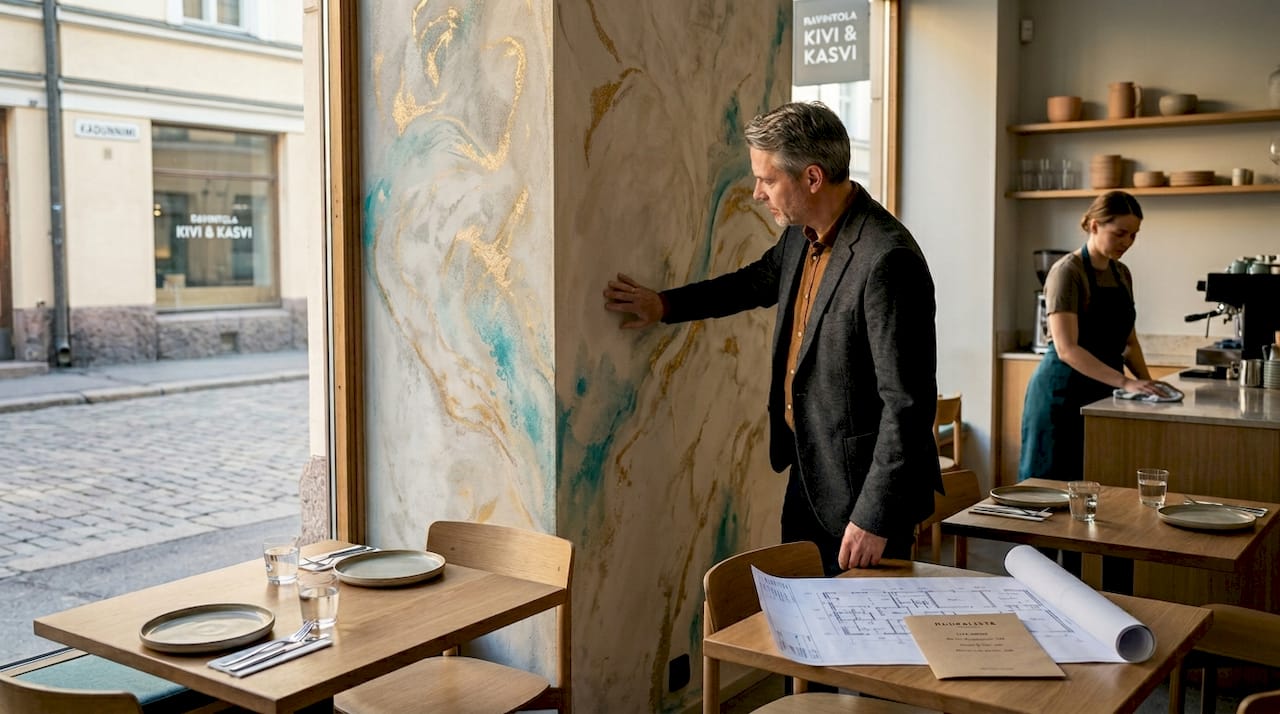
Properly chosen effect paint supports enhancing the customer experience and versatile use of the space, especially when the effect painting considers lighting changes at different times of day.
| Effect Type | Application Area | Atmosphere |
|---|---|---|
| Concrete effect | Restaurant accent wall, bar counter area | Industrial, modern, masculine |
| Metallic effect (gold, copper) | Private rooms, bars, lounge areas | Warm, luxurious, intimate |
| Pearlescent effect | Illuminated stage area, retail display windows | Modern, changing, energetic |
| Lime paint | Restaurant dining area, hotel lobby | Soft, coastal, breathable |
| Super-black surfaces (Musou Black) | Photo corners, galleries, exhibition spaces | Dramatic, optical, dazzling |
Practical ideas for which effect paints are particularly suitable:
- Restaurant wall surfaces where metallic or lime plaster style paint emphasizes architecture and creates atmosphere.
- A bar counter accent wall with a concrete effect, making the bar area a visual focal point.
- Staircases and transition areas where effect paint guides movement and creates a sense of anticipation before entering the main space.
- Private cabinets and group rooms, where metallic effect paint creates an exclusive atmosphere.
- Background surfaces in galleries and stage areas, where super-black or light-absorbing paints eliminate reflections and make artworks dominant.
Professional tip: Use effect paints especially in areas where lighting changes during the day. When transitioning from a morning coffee shop to a dinner atmosphere, the effect surface lives and changes with the light. This dynamic feature makes the space distinctive around the clock.
Trend tip: Combine several effect surfaces in the same space thoughtfully. For example, a concrete wall and metallic details work together when the color palette is cohesive. However, do not overdo it, as the power of the effects will then diminish.
Now that you know about applications, let's briefly delve into how to ensure successful effect painting.
Key points for successful effect painting
The most common mistake in effect painting is starting the project without a clear plan. One picks a paint they fell in love with online, orders it, and only during the painting process realizes that the result doesn't meet expectations. Planning is the only way to avoid this.
Systematic planning in the use of effect paints improves both the quality of the final result and the customer experience. This applies to both small cafe renovations and large space design projects.
The steps for successful effect painting are:
- Preparation phase. Clean the surface thoroughly. Patch cracks and unevenness. Check if the substrate is suitable for the chosen effect paint. This stage most significantly determines the quality of the final result.
- Testing. Always make a test panel in the chosen space. Use the same lighting as in the actual use situation. Allow the test panel to dry completely before evaluation.
- Choosing the right tool. A concrete effect requires a spatula or a sponge roller. A metallic effect often requires a brush-like application. Velvet paints are often applied with a short-pile roller. The wrong tool gives the wrong result.
- Finishing. Most effect paints require a protective treatment in public spaces. Lacquer or wax protects the surface from wear and tear and facilitates cleaning. Do not skip this step in customer areas.
Maintenance is something many only realize later. In public spaces, wall surfaces receive more bumps, touches, and stains than at home. Choose an effect paint designed to withstand wear, or use a sufficiently hard protective lacquer.
Professional tip: Use a skilled painting contractor for large projects or demanding effects. Metallic effects and multi-layered concrete effects, in particular, require experience to achieve the correct final result. Poorly executed effect paint looks cheap and is difficult to fix.
Also, ensure that the new surface supports the space's brand. Effect paint is not an end in itself. It is a tool for building a cohesive visual entity. If a restaurant's brand is warm and cozy, a cold steel effect might convey the wrong atmosphere. The surface and service either speak the same language or they don't.
Once the basics, differences, and pitfalls have been mapped out, the perspective section will consider why many still underestimate the business value of effect painting.
Why are the possibilities of effect painting still underestimated?
Here's a fact that's surprising: most restaurant and space design projects budget as little as possible for surface treatments. The logic is understandable when looking at raw investment figures. Equipment, furniture, systems, and personnel take up the bulk of the budget. Walls are left for last.
This is a fundamental mistake.
Customers don't touch the equipment. They don't see the systems. They see the walls. They sense the atmosphere of the space within the first few seconds, and that first impression guides their entire experience, which they then share.
“Customers return for the experience, not just the product.”
Every euro invested in effect painting is one of the best-performing investments in a restaurant or creative space renovation. Research shows that visually striking spaces receive significantly more social media shares than neutral spaces. A bold effect paint can practically double the likelihood of a customer taking a photo and sharing it on Instagram or another channel. This is free marketing that reaches the right target audience.
Another underestimated perspective is competitive differentiation. When every restaurant uses the same neutral surfaces and the same furniture series, a unique visual identity becomes invaluable. Creative space design is not a luxury; it is a business strategy.
A third reason for underestimation is technical uncertainty. Effect paints are perceived as difficult or risky. There is a fear that the end result will not meet expectations. The answer to this is simple: a good product, a proper plan, and testing before implementation eliminate almost all risk. Expert support along the way does the rest.
The boldest have already acted. The best spaces in Helsinki, Tampere, and Turku are those where someone dared to choose an effect surface instead of a plain wall. These spaces fill up, they are shared, and they are written about. A competitor who follows suit a year later is already behind.
Elevate the look of your space with effect paints
Are you ready to make your space memorable? Dekoja.net is the only Finnish specialty materials store that delivers Musou Black and the world's blackest effect surfaces directly from a domestic warehouse. We have solutions for restaurants, interior designers, architects, and builders of creative spaces.
Our selection includes effect paints from concrete surfaces to metallic sheens and super-black absorption materials. Trendy interior materials and expert advice are available to you immediately. We deliver your order in 1 to 3 business days from Finland, and our B2B service covers the entire project from start to finish. Contact us, tell us your space's objective, and we will help you choose the right solution.
Frequently asked questions about using effect paints
Can effect paint also be used over old paint?
Yes, but the substrate must be clean and matte to ensure adhesion. A glossy or uneven base will significantly impair the final result.
Are all effect paints suitable for public spaces?
Not all effect paints are suitable for heavy wear, so choose according to the surface and space. In restaurants and cafes, it is important to select a product that withstands cleaning and mechanical wear. The need for protective lacquering must be determined on a product-by-product basis, as the benefits of restaurant interiors only come from durable solutions.
How much does the use of effect paints increase costs compared to regular paints?
Effect paints are generally slightly more expensive, but their impressive visual impact quickly brings a return on investment. Standing out in interior design is key to success in a competitive market, and effect paint is one of the most cost-effective ways to achieve this.
What do concrete effect or metal effect paints mean, for example?
Concrete effect creates a rough, vibrant surface resembling concrete, while metal effect paint gives a metallic sheen and depth to the wall. Neither requires actual concrete or metal; instead, special materials can be applied directly to a regular wall surface using the correct technique.