

AV Project Planning Guide: Impressive Results for Your Space
TL;DR:
- Even a single weak link in an AV system can spoil the atmosphere of a space. A carefully designed AV solution combines functionality, atmosphere, and technical quality, serving well into the future. The right materials, such as super black surfaces, significantly improve image contrast and quality.
Even a single weak link in an AV system is enough to spoil the atmosphere. A carefully designed restaurant interior or gallery can feel cheap if the sound distorts, the lighting doesn't support the displays, or the projector's reflection gets lost on bright wall surfaces. This guide covers the stages of AV project planning from start to finish: from setting goals to material selection, installation, and quality assurance. The approach combines functionality, atmosphere, and technical quality so that the end result serves both the space and its users long into the future.
Table of Contents
- Starting Points for AV Project Planning
- Preparation and AV Plan Creation
- Selection and Implementation of AV Solutions
- Review, Commissioning, and Quality Assurance
- Perspective: Why the Success of AV Projects Determines the Atmosphere of Commercial Spaces
- Make Your Next Project Impressive – Our Solutions at Your Disposal
- Frequently Asked Questions about AV Project Planning
Key Takeaways
| Point | Details |
|---|---|
| Importance of Planning | Good AV planning improves the functionality, atmosphere, and customer experience of a space. |
| Correct Materials | Gray projection screens and super black bezels enhance visual quality. |
| Safety First | Building regulations, such as fire safety and acoustics, must be considered in an AV project. |
| Thorough Testing | All AV solutions should be tested before commissioning to ensure a successful outcome. |
Starting Points for AV Project Planning
A successful AV project is not born from just the right equipment. It is born from clear goals that guide every choice, from materials to installation. Before a single cable is pulled, it is worth pausing and asking: what should this space achieve?
Four Key Objectives
Every professional AV project is built on four pillars:
- Experientiality. The space should evoke emotions and leave a lasting impression. This means a visually consistent whole, where lighting, sound, and visual content work together.
- Functionality. Technical solutions must serve practical needs. The display must be readable in daylight, the sound system must cover the space evenly, and control must be intuitive.
- Energy Efficiency. In commercial spaces, equipment can be on for tens of hours a week. Energy-efficient choices significantly reduce operating costs in the long run.
- Brand Support. AV integration in restaurants covers acoustics, lighting, background music, and digital displays, all of which support the brand and customer experience.
Four Main Areas of Planning
In practice, an AV project is divided into four technical areas that must work together:
- Acoustics. Absorption, diffusion, and reverberation time affect how clear the sound appears in a space.
- Lighting. Layered lighting improves the functionality of a space and creates different moods within the same space.
- Digital Displays. Resolution, brightness (nits value), and viewing angle determine the conditions under which a display performs best.
- Sound Systems. Speaker type, placement, and amplifier power affect sound evenness and clarity.
Environment Defines Requirements
Different spaces require different approaches. In a restaurant, natural ambient sound and clear visual brand communication are most important. In a gallery, image accuracy and light control take precedence. In a retail space or lobby, durability, ease of use, and maintainability are emphasized. The importance of visualization in architecture has been widely documented: visualization during the planning phase helps avoid costly mistakes.
The Role of Super Black Materials
Super black surfaces are an underutilized tool in AV design. When the area around a projector or display is dark and non-reflective, the contrast ratio dramatically improves. This means a sharper image, better color reproduction, and a professional visual impression without needing to upgrade the equipment.
| Environment | Most Important AV Area | Recommended Surface Material |
|---|---|---|
| Restaurant | Acoustics and mood lighting | Dark, absorbent wall surface |
| Gallery | Visual accuracy, light control | Super black surfaces, matte |
| Retail space or lobby | Durability, maintainability | Neutral, easy to clean |
| Home theater | Contrast ratio, sound insulation | Black velvet or absorption material |
Preparation and AV Plan Creation
Once the design principles are clear, the next step is to build a concrete AV plan. This doesn't just mean a list of equipment, but a comprehensive document that guides the entire project's progress.
Seven Steps for the Initial Phase of an AV Project
- Needs Assessment. Discuss with the client what happens in the space, who uses it, and when. A restaurant's happy hour requires a different solution than an office meeting room.
- Prioritization of Goals. Prioritize goals. If the budget is limited, what is most important: sound quality, image brightness, or installation neatness?
- Budget Allocation. Determine a realistic budget that covers equipment, materials, installation, testing, and potential training.
- Team Assembly. Include the client, architect or interior designer, AV specialist, and the contractor responsible for electrical and construction work.
- Preliminary Material Selection. Outline what types of surfaces, acoustic elements, and cable routes are suitable for the space. Super black surfaces or absorption material can be integrated into the interior design at this stage.
- Scheduling. Coordinate AV installation with other construction phases. Cable routes must be laid before surface structures are closed.
- Regulation Check. Building regulations cover noise limits and fire safety requirements, which also apply to AV installations.
Professional Tip: Invite an AV designer to join during the project planning phase, not just before installation. Late involvement often leads to compromises that degrade the final outcome and increase costs.
Comparison of Key Materials and Solutions
| Material or Solution | Application | Benefit |
|---|---|---|
| Super black absorption surfaces | Projector wall, display frame | Improves contrast, eliminates reflections |
| Acoustic panels | Ceiling, back wall | Reduces reverberation, clarifies speech |
| Velvet borders | Projection screen, display frame | Prevents light leakage, improves image framing |
| Digital displays (high nits) | Lobby areas, restaurants | Works well in bright conditions |
| Fire-retardant cables | All AV installations | Meets regulations, reduces fire risk |
Lighting design tips for restaurants provide concrete guidance on how layered lighting supports AV solutions in restaurant and service spaces.
Importance of Documentation
All choices must be clearly documented. A good design document includes a floor plan with cable equipment locations, an equipment list with technical specifications, a material list, and an installation schedule. Documentation also facilitates future maintenance and potential updates.
Selection and Implementation of AV Solutions
After selecting the solutions, it's time to move on to implementation. At this stage, every detail affects the outcome: projector placement, speaker type, wall surface color, and material reflectivity.
Projection Screen or Fixed Display?
This is one of the most common questions in AV projects. The choice depends on the space's purpose, ambient lighting levels, and budget.
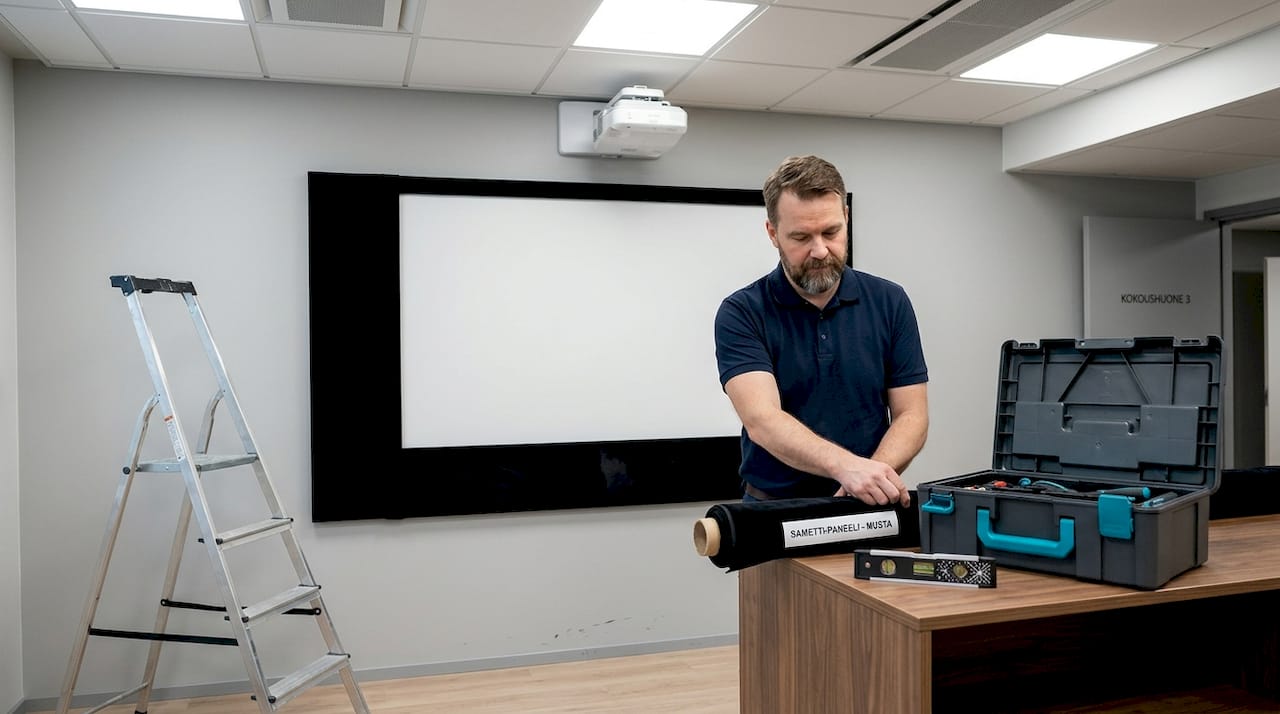
- Gray projection screens (gain value 0.8) improve contrast, especially in spaces where ambient lighting cannot be fully dimmed. Black 8 cm velvet borders prevent light leakage from the edges of the screen, making the image more sharply defined.
- Fixed LED displays are suitable for spaces where brightness is paramount. Lobbies, retail stores, and restaurants with abundant natural light benefit from high-brightness displays.
- Projectors remain a cost-effective solution for large image sizes in spaces where lighting is controllable.
Leveraging Super Black Materials
Super black surfaces are not just about aesthetics. They are a technical solution that measurably improves image quality. When light projected from a projector does not bounce back from around a black wall, the image contrast ratio can improve significantly without equipment upgrades. This is especially important in spaces where complete darkness cannot be achieved.
Integrating AV Equipment into Interior Design
Professional AV installation is invisible. Equipment should blend into the space, not stand out.
- Speakers are recessed into the ceiling or wall, or models that match the interior's color and form are chosen.
- Cables are routed within structures or covered with moldings.
- Display frames and projector screen borders are selected from the same color palette as the rest of the interior.
- Super black absorption surfaces can be used as a background curtain or framing material, serving both visually and technically.
Professional Tip: Plan the placement of AV equipment first, then build the interior around it. If you do the opposite, you will often end up with compromises that degrade both technical performance and visual outcome.
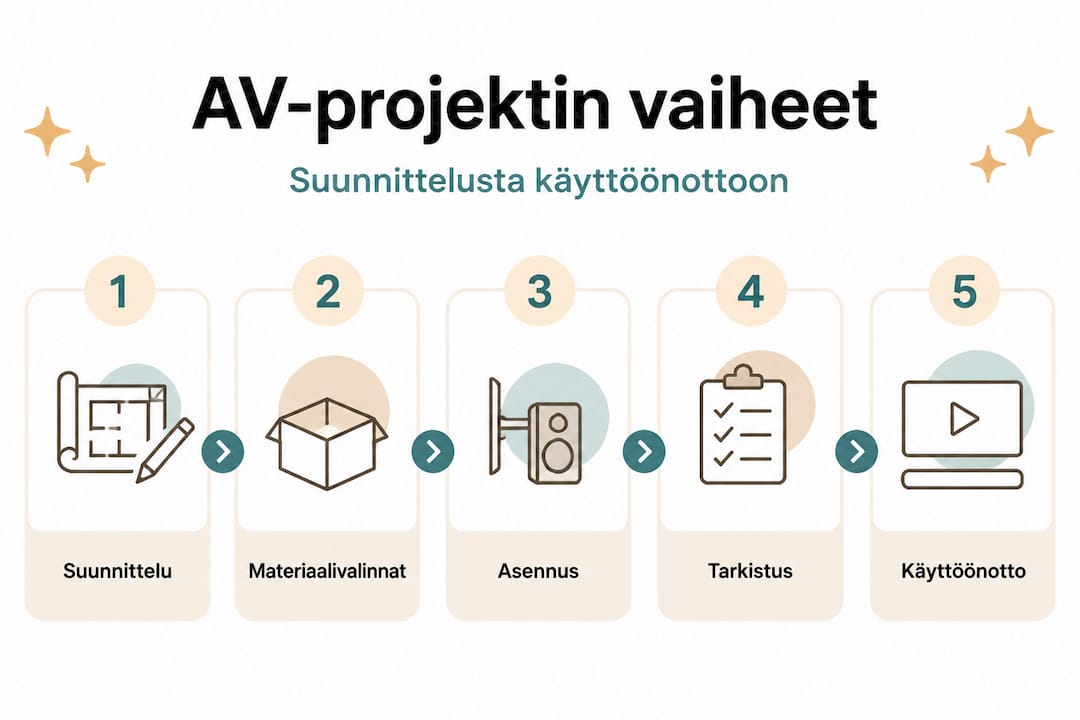
Installation Workflow
| Phase | Action | Notes |
|---|---|---|
| 1. Cabling | Electrical and signal cables before surfaces | Check cable types and fire ratings |
| 2. Mounting points | Mounts for projector, displays, and speakers | Structural capacity, suspension loads |
| 3. Surface materials | Acoustic and absorption surfaces | Super black surfaces before equipment installation |
| 4. Equipment installation | Displays, projectors, speakers | Calibration and adjustment during installation |
| 5. Control systems | AV controller, lighting control | Testing after each phase |
Highlighting light in restaurant interiors offers practical examples of how combining lighting and AV solutions produces the best results in restaurant and service spaces.
Compatibility and System Integration
Modern AV systems are often connected to building automation: lighting, blinds, and temperature control. This means that compatibility between different systems must be checked already in the planning phase. Standard protocols, such as HDMI 2.1, HDBaseT, and the Dante audio system, significantly facilitate integration.
Review, Commissioning, and Quality Assurance
Once the installation is complete, the most critical phase of the project begins: testing and quality assurance. At this stage, it is ensured that every component functions as designed and that the space meets all technical and safety requirements.
Commissioning Step-by-Step
- Image Quality Check. Measure brightness, contrast ratio, and color reproduction under standard conditions. Compare results to the goals set during the planning phase. If a gray projection screen is used, ensure that the reflection points are correctly calibrated.
- Acoustic Testing. Measure reverberation time (RT60) and compare it to calculations from the design phase. Ensure that speech intelligibility (STI value) is sufficient for the space's intended use.
- Lighting Adjustability. Test all lighting scenarios: full power, half power, mood lighting, and darkness. Ensure that AV content is readable in all situations.
- Control System Functionality. Test all control commands: power on/off, signal routing, volume, and lighting control. Check that the user interface is intuitive even for inexperienced users.
- Safety Check. Building regulations set clear requirements for noise limits and fire safety. Ensure that AV equipment and its cabling comply with fire safety regulations, and that the maximum volume of the sound system does not exceed the permissible noise level.
- Commissioning Documentation. Record all measurement results, device settings, and calibration values. This facilitates troubleshooting in the future.
- User Training. Review the control system's operation with all relevant personnel. Provide clear operating instructions in written form and, if possible, as a video.
“The best AV system is one that works so smoothly that no one notices it. Only when it doesn't work is it visible to everyone.”
Maintenance Tip for Future Use
Regular maintenance is an often-overlooked part of an AV project's lifecycle. Dusty speakers, loose cables, and outdated software slowly but surely degrade performance. The recommended maintenance interval for commercial spaces is six months. During a service visit, the physical condition is checked, equipment is cleaned, mounts are inspected, and software is updated.
Most Common Mistakes During Commissioning
- Only one scenario is tested, not all use cases.
- The volume is forgotten to be calibrated to the correct level for the space's operating conditions.
- User training is brief or skipped entirely.
- Documentation is neglected, making the next service visit more difficult.
When each of these steps is handled carefully, the project concludes with a clear and functional whole for the client, ready for immediate use.
Perspective: Why the Success of AV Projects Determines the Atmosphere of Commercial Spaces
We have seen numerous projects where the interior design was visually perfect, but the AV solution lagged behind. The result is always the same: the space feels incomplete, even if all other elements are in place. The importance of AV design is consistently underestimated, and the reason is simple: it is invisible when it works.
This is precisely the illusion that leads to poor decisions. When AV is invisible, the client may think that not much investment is needed. But when it fails, it is the only thing everyone notices. Distorted sound in a restaurant or a projector screen full of reflections in a gallery space ruins the experience faster than any bad chair or wrong wall color.
Super-black materials are a good example of an investment where the benefit is indirect but measurable. Layered lighting and AV projects work best when the absorption properties of surfaces have been considered already in the design phase. A small investment in the right surface material produces a greater visual impact than a hardware upgrade.
Another often overlooked aspect is the value of an expert team. Many clients try to save money by involving an AV expert only at the last stage or by replacing a professional with a cheaper solution. The result is compromises, re-installations, and ultimately higher costs. Thorough planning with an expert team from the beginning significantly reduces the risk of errors and produces a result that stands the test of time.
The boldest projects stand out from their competitors precisely in the details that others did not invest in: a velvet-black frame that makes the projected image sharper, an acoustic element that also serves as a work of art, or lighting control that seamlessly transitions the atmosphere between dining and drink rounds. These are not luxuries. They are competitive advantages.
Make Your Next Project Impactful – Our Solutions at Your Disposal
AV project design is a whole where every choice affects the outcome. The right materials, the right team, and the right design process make the difference between a functional and an impactful result.
Dekoja.net supplies Finland's most comprehensive selection of super-black materials and special AV design solutions directly from a domestic warehouse. The selection includes Musou Black paint, non-reflective fabrics, absorption surfaces, and visual effect materials for restaurants, galleries, and studio spaces. Deliveries within 1-3 business days. B2B service for projects and design agencies. Contact us and tell us about your project. We help with planning and implementation from start to finish.
Frequently Asked Questions About AV Project Design
What are the benefits of a grey projection screen or velvet borders in an AV project?
A grey projection screen (0.8 gain) improves contrast, especially in bright spaces, and black velvet borders prevent light leakage, ensuring a sharp image and significantly enhancing the visual quality of the space.
What are the most important design areas for an AV project in restaurants?
AV integration in restaurants covers acoustics, lighting, background music, and digital displays, which together support the brand and create a memorable customer experience.
What fire safety considerations should be taken into account in an AV project?
Building codes require that AV equipment, cables, and materials do not compromise the fire safety of the space. Cable fire ratings and equipment placement must always be checked before commissioning.
How is an AV project ensured to be high-quality and functional?
The final result is ensured through systematic testing: image quality, acoustics, and lighting adjustability are measured and checked, after which users receive clear guidance on how to operate the equipment.
Why invest in super-black materials for AV projects?
Super-black surfaces absorb reflected light, improving contrast ratio and resulting in a visually clearer and more professional outcome, especially in demanding interior design and AV environments.