

Crucial Materials for AV Professionals in Space Design
TL;DR:
- In spatial design, acoustic materials affect both the sound environment and the visual ambiance, not just appearance. Modern slatted panels, AR films, and sustainable, modular solutions combine acoustic performance and longevity. Physical and digital acoustics complement each other, and careful material selection and design prevent errors and ensure a functional outcome.
In spatial design, visuals grab attention, but the essential materials for AV professionals cover much more than what meets the eye. The right acoustic panel, anti-reflective film, or room-within-a-room structure determines whether a space truly functions or just looks good in pictures. This article explores the materials and solutions that influence both the sound environment and the visual ambiance. Each section is written specifically for interior and spatial designers working on professional AV projects.
Table of Contents
- Key Takeaways
- Acoustic Materials in AV Spaces
- Display Surfaces and AR Films
- Sustainable Material Choices in AV Projects
- Physical and Digital Acoustics Combined
- My Perspective on Material Choices
- Dekoja Helps with Your AV Projects
- FAQ
Key Takeaways
| Item | Details |
|---|---|
| Acoustics is also a visual choice | Modern slatted panels combine an NRC 0.85 absorption rating with a decorative appearance in the same product. |
| Anti-reflective films improve readability | AR films reduce reflection to less than 0.3 percent, which is critical in bright spaces and outdoor displays. |
| Durability is a design principle | Sustainable material selection means maintainability and longevity, not just ecological origin. |
| Physical and digital solutions complement each other | Dirac Live ART helps with low frequencies, but physical absorbers are needed for high frequencies. |
| Technical values of screen fabric are decisive | TS, OF, and RS are more important than the fabric's color or appearance alone. |
Acoustic Materials in AV Spaces
Interior designers emphasize the importance of acoustics as part of the overall atmosphere of a space. It is no longer just a technical detail, but part of the visual identity. A good AV space works both for the ears and the eyes.
Slatted Panels: Combining Technology and Aesthetics
Modern slatted panels are constructed from MDF slats, real wood veneer, and 9 mm recycled polyester felt. They achieve an NRC value of 0.85, meaning 85 percent of sound is absorbed and not reflected back into the room. Thickness typically ranges between 18 and 22 mm, and installation can be done by gluing or screwing directly to the wall structure.
The NRC value is the most important single metric when selecting an acoustic panel. With a value below 0.5, the panel is primarily an aesthetic element. With a value above 0.75, it makes a measurable difference to the room's reverberation time and speech intelligibility.
Color and surface choices directly affect the room's atmosphere. Ecophon Texona offers 14 color shades with a textile-like surface, so the acoustic panel does not look like a technical component but part of the interior design. This is precisely the feature that spatial designers now demand: functionality must not appear as an applied solution.
| Feature | Value or Option |
|---|---|
| NRC absorption value | 0.85 |
| Thickness | 18 or 22 mm |
| Surface options | Wood veneer, textile, painted MDF |
| Installation method | Gluing or screwing |
| Recycled polyester felt | 9 mm backing material |
Pro tip: Do not install all panels on the same wall. Dispersed placement on multiple surfaces, including the ceiling, balances the room's acoustics more effectively than one large panel wall.
Installation options also have practical significance: gluing is suitable for permanent structures, but screw-on panels can be replaced or moved if necessary. In long-term AV space design, adaptability is a competitive advantage.
Display Surfaces and AR Films
Outdoor spaces and bright indoor environments place entirely different demands on displays than dimly lit studios. This is where AV tools and materials often go wrong: a display is chosen, but its surface treatment is forgotten.
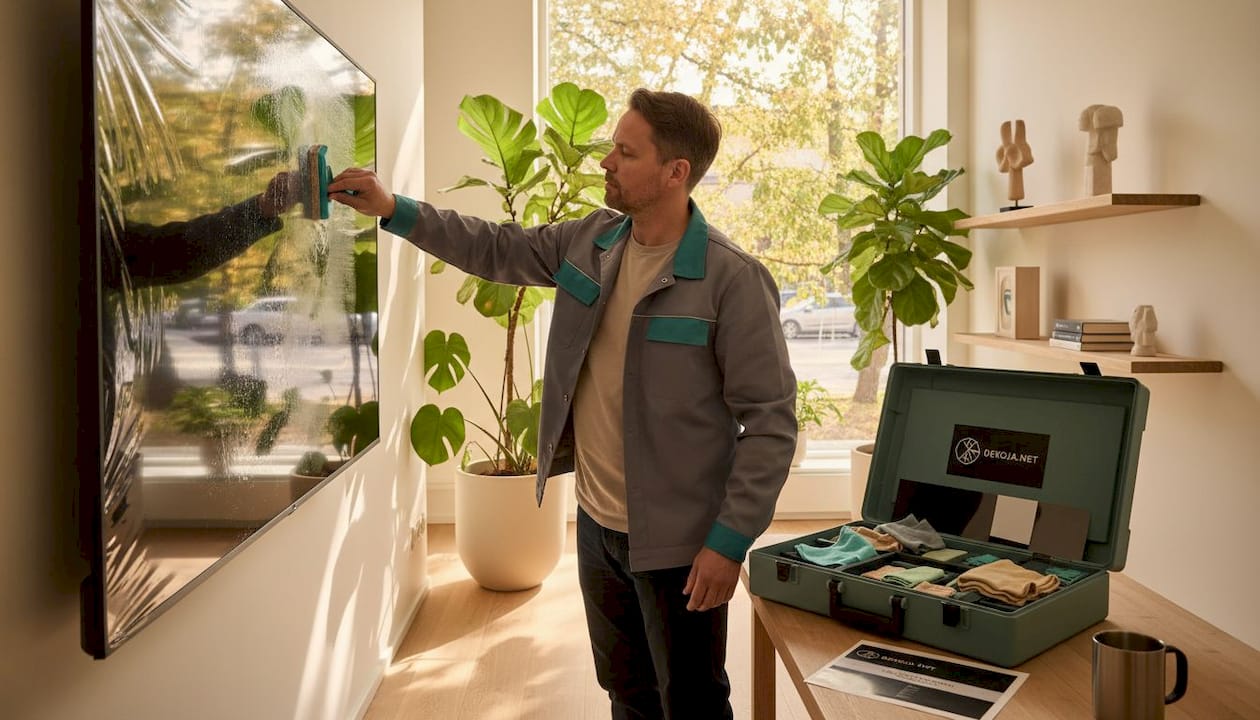
Anti-reflective films are a key solution. AR films reduce reflection to less than 0.3 percent, dramatically improving display readability in direct sunlight. This is crucial in museums, restaurants, and outdoor events, for example.
Key technical considerations when selecting display materials:
- Brightness. Laminated displays can achieve up to 2000 nits, which is 4 to 5 times brighter than standard indoor displays.
- Lamination technique. Optical lamination removes the air gap between the display glass and the panel, eliminating ghosting effects.
- Surface hardness. AR-treated tempered glass withstands mechanical wear and cleaning better than plastic protective films.
- Light transmission. High-quality AR film maintains color accuracy and does not significantly cool or warm colors.
- Maintenance-free. A permanently laminated surface does not collect dust in air gaps, extending maintenance intervals in public spaces.
The same principle applies to screen fabric selection. The technical values of screen fabric, such as solar energy transmittance (TS), openness (OF), and reflectance (RS), are more critical than mere color. An aluminized backing improves heat load management and is particularly useful in south-facing spaces where direct sunlight is an issue.
Pro tip: Always ask the supplier for samples of two or three different AR film types and test them in direct sunlight before making a final decision. The technical data sheet doesn't tell the whole story.
Sustainable Material Choices in AV Projects
Sustainable design begins with selecting materials with their entire lifecycle in mind. In AV space design, this specifically means materials that withstand wear, are maintainable, and can be updated if necessary without dismantling the entire space.
Important materials for AV professionals from a sustainable design perspective include, in particular:
- Removable upholstery and replaceable surfaces. Permanently glued upholstery ages quickly. Removable upholstery allows for color or material updates without structural changes.
- Modular acoustic elements. Screw-on panels can be moved or swapped to another space. This extends the material's lifespan and reduces waste.
- Absorbers made from recycled material. Polyester felt made from recycled materials performs acoustically as well as that made from virgin fibers, but has a smaller carbon footprint.
- Durable surface treatments. Water-based finishes are easier to renew locally without needing to sand the entire surface, compared to oil-based lacquers.
Sustainable material selection does not mean choosing the most expensive product or the one with the most ecological label. It means the designer understands how the material will behave five or ten years from now.
Pro tip: Always ask the supplier for maintenance instructions and availability of spare parts before making a purchase decision. If spare parts are not available in five years, the material is not truly long-lasting.
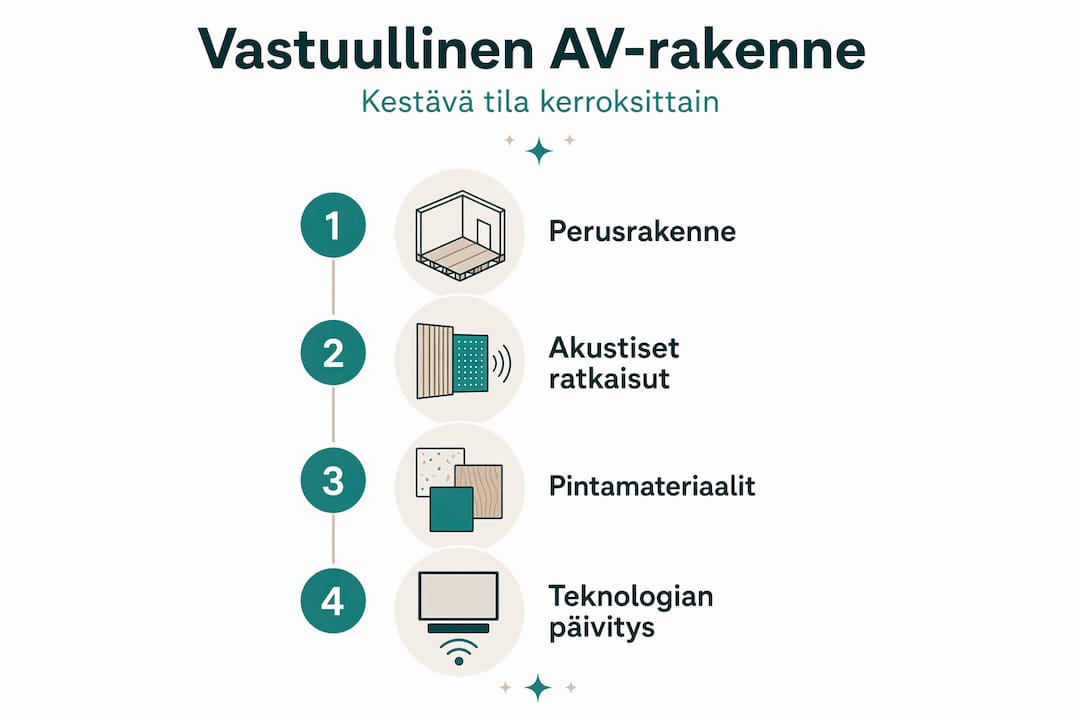
In practice, a long-lasting AV space is built in layers. The structure is permanent, but the surfaces and acoustic elements are replaceable. This approach serves both the budget and the environment, as the space can be updated without a full renovation.
Material choices for experiential spaces also guide how a space is perceived over time in projects aimed at professionals. A material that patinas gracefully tells a story. A material that wears poorly makes a space look old prematurely.
Physical and Digital Acoustics Combined
Advanced AV space design no longer chooses between physical or digital acoustic treatment. They operate in different frequency ranges and complement each other.
The room-within-a-room structure is the most effective way to isolate a space from external noise. The concept is based on mechanical vibration isolation: the inner structure rests on separate spring elements and is not in direct contact with the building's frame. In studios and home theaters, this eliminates footfall noise and structural noise that would otherwise travel through the building.
The layers of physical treatment proceed in a logical order:
- Isolation. A room-within-a-room or floating floor prevents vibrations from transferring to structures.
- Absorption. Basstrap or mineral wool wedges in room corners attenuate low-frequency standing waves.
- Diffusion. Irregular surfaces such as QRD diffusers scatter mid-frequencies and prevent unwanted echo.
- Absorbent surface materials. Acoustic panels like slatted panels handle high frequencies and improve speech intelligibility.
Digital room correction comes into play after this, not before. Dirac Live ART is one of the most effective active correction solutions for low frequencies. It can smooth out low-frequency irregularities in a space that would be difficult to address with physical absorbers. However, at higher frequencies, digital correction does not replace physical materials.
“Digital correction is like post-production in image processing. It enhances the end result, but it doesn't completely fix a poorly lit photo. Physical acoustics is the lighting.”
This order is also important for budgeting. Digital correction software is an tempting shortcut, but it does not replace fundamental material solutions. Work done in the correct order saves money and produces a better outcome.
Combining acoustics and lighting is one of the total solutions that spatial designers value most. When acoustic panels are selected based on both their absorption value and visual impact, the space functions as a whole, not just a technical assembly.
My Perspective on Material Choices
I've repeatedly seen the same mistake: a spatial designer first chooses visual materials and adds acoustics afterwards. The result is a space where acoustic panels look like applied solutions, because that's what they are.
The best result is achieved when acoustics, lighting, and visual materials are designed concurrently from the outset. I have found that a slatted panel chosen first for its NRC value and then for its surface material integrates seamlessly into the space. It's not a compromise; it's good design.
Another aspect often underestimated: blackness and light absorption. Super dark surfaces are not just an aesthetic choice. They eliminate unwanted reflections from projector screens and display surroundings more effectively than any other material. I have seen its impact in several projects: the right black surface does more than six meters of acoustic panel in the wrong place.
As a professional, I recommend that every AV spatial designer try a non-reflective surface material around a projector or display at least once before making a decision. The difference is visually noticeable.
— Mikko
Dekoja Helps with Your AV Projects
Dekoja is a Finnish supplier of specialized materials, serving architects, interior designers, and AV professionals in projects where ordinary solutions are not enough. The selection includes Musou Black, the world's blackest effect surfaces, non-reflective surface materials, and other specialized materials suitable for AV design, from domestic stock.
Deliveries from Finland within 1 to 3 business days. Tailored service for B2B customers at every stage of the project. If you don't know which material suits your project, Dekoja will help with the selection from start to finish.
Explore material choices and find solutions that others don't offer.
FAQ
What is NRC value and why is it important?
NRC, or Noise Reduction Coefficient, describes a material's sound absorption capability on a scale between 0 and 1. A value of 0.85 means the material absorbs 85 percent of sound, which is a typical level for high-quality acoustic panels.
What does AR film mean in the context of display materials?
AR film is an anti-reflective surface treatment that reduces display reflection to less than 0.3 percent. It significantly improves image readability in bright spaces and outdoor displays.
Is physical acoustics replaced by digital room correction?
Not entirely. Dirac Live ART and similar solutions are effective at low frequencies, but higher frequencies require physical absorbers and diffusers.
Which screen fabric values determine the choice?
The most important values are solar energy transmittance (TS), fabric openness (OF), and reflectance (RS). They determine how the fabric behaves in lighting conditions, and mere color does not convey this.
Why are super dark surfaces useful in AV spaces?
Non-reflective black surfaces eliminate unwanted reflections from around a projector or display. This improves image contrast and perceived sharpness without additional equipment.