

Staircase lighting design: A guide for professionals
In brief:
- Step lighting combines safety and aesthetics through the right light, placement, and color temperature.
- Choose suitable solutions based on material, such as warm lights for wood surfaces or cooler lights for concrete.
Designing step lighting is a process that combines safety and aesthetics through the right type of lighting, placement, and color temperature. From a professional perspective, it's not just about installing luminaires, but about accentuating the architecture of the space and guiding the user with thoughtful lighting. This guide covers the key parameters of step lighting design: types of light sources, optimal placement, recommended Kelvin and lumen values, and the role of smart lighting systems. The tools used include LED strips, recessed luminaires, and Casambi-type control systems.
What step lighting solutions are available?
Step lighting solutions are divided into four main types: LED strips, recessed spot lights, solar-powered lights, and linear LED profiles. Each has its own application and impact on the atmosphere of the space.
LED strips are the most flexible option. They are suitable for both indoor and outdoor use and can be cut to length. Strips are most commonly used under or to the side of the step's underside, creating indirect, soft light.
Recessed spot lights provide a clean finish because the luminaire is flush with the step surface or wall. They are particularly suitable for concrete and stone stairs where the surface can withstand milling. Installation requires more planning, but the result is refined.
Solar-powered lights are a cost-effective installation solution for outdoor stairs. They do not require wiring, which significantly speeds up installation. The drawback is their dependence on sunlight, which makes them unreliable during Finnish winters.
Linear LED profiles are a solution favored by architects. The profile is installed at the edge of the step or wall, and a diffuser spreads the light evenly. The result is a continuous line of light without visible dots.
Material-specific recommendations
The choice of material directly guides the appropriate lighting type. Warm lights are suitable for wood surfaces, accentuating the wood grain. Cooler linear lights are suitable for concrete and metal, highlighting the surface texture and modern look. For stone stairs, recessed spot lights work best, as they withstand mechanical stress and moisture.
- Wood: LED strips or linear profiles, color temperature 2,700–3,000 K
- Concrete: recessed spot lights or linear profiles, color temperature 3,000–4,000 K
- Metal: linear LED profiles, color temperature 3,000–4,000 K
- Stone: recessed IP65-rated spot lights, color temperature 2,700–3,500 K
- Glass: linear LED profiles or recessed spot lights, color temperature 4,000–5,000 K
How to position step lights correctly?
Light placement determines both safety and aesthetics. Incorrect placement creates distracting shadows or glares directly into the eyes of the user.
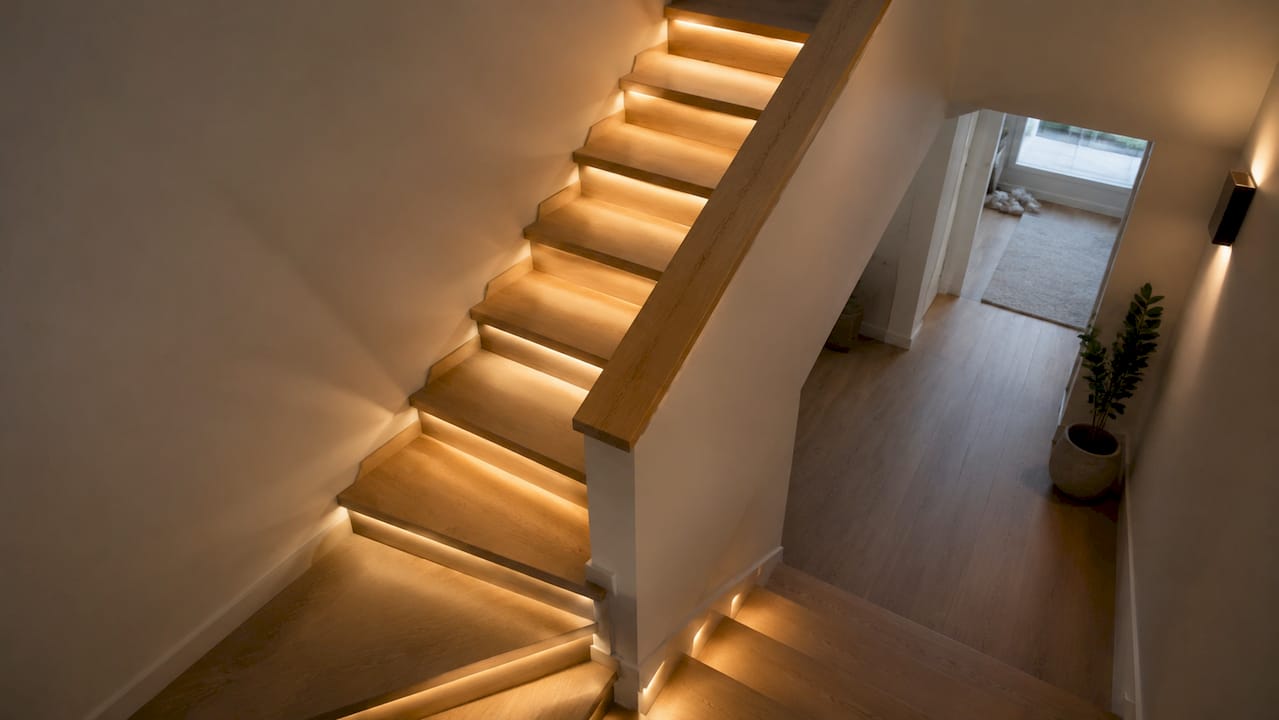
The basic principle is simple: luminaires are placed 1.2–1.8 meters apart on stairs to maintain even lighting along the entire path. In practice, this means a luminaire on every second or third step, depending on the height of the step and the power of the light source. Even lighting prevents eye adaptation variations, which are one of the most common causes of falls on stairs.
Layered lighting on stairs
Layered lighting combines indirect LED light and accent lights. Indirect light creates general illumination and eliminates harsh shadows. Accent lighting highlights individual steps or architectural details. The combination makes stairs both a safe passage and a visually interesting element of the space.
Wall lights or an LED strip running along the handrail complement step lighting. They increase the overall light intensity without the need to increase the power of individual step lights. This solution works particularly well with high staircases where mere step lights would leave the upper part dim.
Glare prevention
Glare is the most common mistake in step lighting. Diffusers on LED profiles spread light evenly and prevent individual LED dots from being visible. Without a diffuser, the strip looks cheap and can cause glare for the user.
The following placement principles effectively prevent glare:
- Install the LED strip or profile under the underside of the step so that the light source is not directly visible from the direction of travel.
- Always use a diffuser or a frosted cover over the strip.
- Direct recessed spot lights towards the step surface, not towards the user's eyes.
- Dim the lighting at night to 20–30 percent of daytime intensity.
- Test placement with temporary light sources before final installation.
Pro tip: Place yourself at the bottom of the stairs and look up before confirming the installation. If you can see the LED dots directly, move the profile or add a diffuser. This simple test saves costly corrections.
What color temperature and brightness work best on steps?
Color temperature and brightness determine how the stairs feel in use. Incorrect values can make the space either clinical or dangerously dim.
The recommended color temperature for step lighting is 2,700–3,000 K. This range creates a warm, inviting atmosphere suitable for living spaces, restaurants, and hotel stairs. Cooler color temperatures above 4,000 K are suitable for office spaces or modern public buildings where the sharpness of the architecture is to be emphasized.
In terms of brightness, the optimal level is 20–100 lumens per light source. This is sufficient for safe visibility without glare. For comparison: a typical office luminaire produces 300–500 lumens per square meter, so step lighting is intentionally subtle and atmospheric.
Color temperature according to material
| Surface material | Recommended color temperature | Effect |
|---|---|---|
| Wood | 2,700–3,000 K | Accentuates grain, creates warmth |
| Concrete | 3,000–4,000 K | Accentuates texture, modern look |
| Metal | 3,000–4,000 K | Sharp, industrial feel |
| Stone | 2,700–3,500 K | Natural, organic impression |
| Glass | 4,000–5,000 K | Emphasizes transparency |
Adjusting brightness and color temperature prevents over-illumination and improves the user experience, especially at night. A dimmable system is therefore almost always a better choice than a fixed-power one.
How is a step lighting plan implemented in practice?
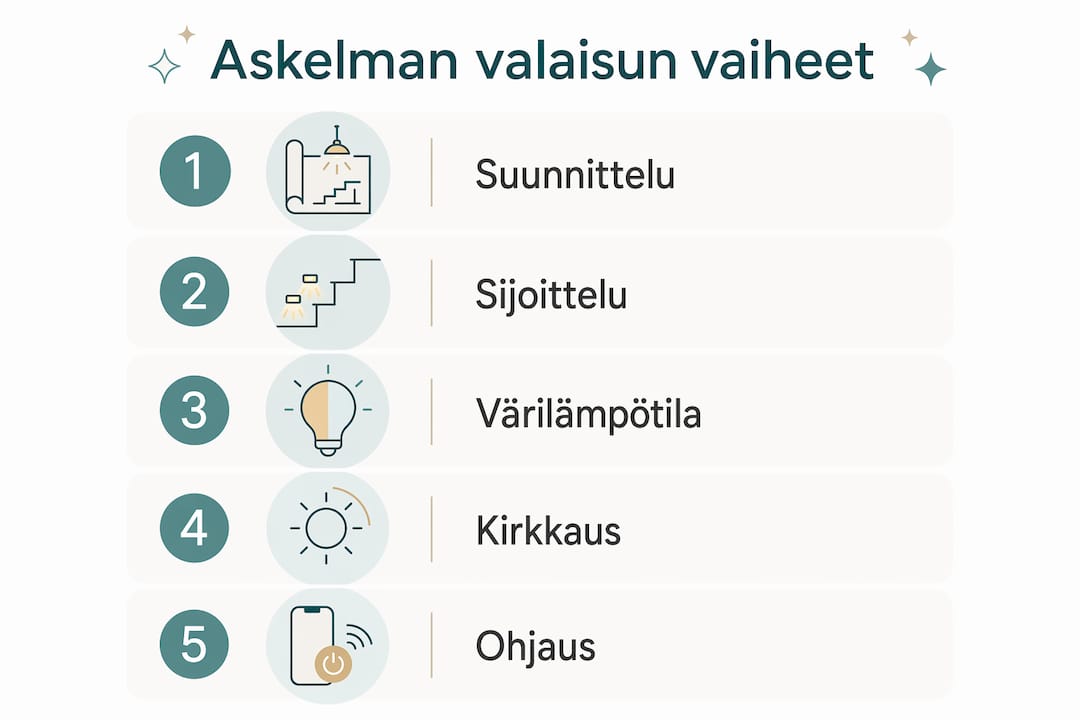
Implementation proceeds in a logical order: first planning, then testing, and finally installation. This order saves time and money.
-
Survey the space. Measure the length of the stairs, the number of steps, and the available power supply. Determine whether it is an indoor or outdoor location and choose the IP rating accordingly. Outdoor locations require at least IP65 rating.
-
Select lighting type and products. LED strips, recessed luminaires, or linear profiles are chosen based on the material and desired atmosphere. For outdoor use, for example, weather-resistant LED modules are available from several manufacturers.
-
Temporarily test placement. Test the placement of lights with temporary light sources before final installation. This reveals potential shadows, glare points, and uneven lighting before cables are run into the walls.
-
Install wiring and luminaires. Run cables discreetly within the step structure or in channels. Use LED profiles with diffusers for a finished look.
-
Connect the control system. Smart lighting systems such as Casambi enable lighting adjustment based on presence and daylight. This reduces energy consumption and improves user comfort automatically.
-
Adjust and document. Set final dimming profiles and save settings. Documentation facilitates maintenance and possible changes later.
Pro tip: Do not underestimate the importance of the control system. Stair lighting that automatically dims at night and brightens in the morning is both energy-efficient and user-friendly. A Casambi-based system is easy to integrate into existing building automation.
Smart lighting systems also bring the control of light and shadow to a new level. When lighting reacts to movement, the stairs activate only as the user approaches. This creates a dramatic visual effect and saves energy simultaneously.
Key takeaways
Step lighting design is best achieved when color temperature, brightness, placement, and control system are chosen together according to the surface material and intended use.
| Point | Details |
|---|---|
| Color Temperature | Use 2,700–3,000 K for residential spaces and restaurants, cooler for public spaces. |
| Brightness | 20–100 lumens per light source is sufficient for safe visibility without glare. |
| Placement | Install lights 1.2–1.8 meters apart and always test placement temporarily before installation. |
| Glare Prevention | Use LED profiles with diffusers and install the light source so it's not directly visible from the direction of travel. |
| Smart Control | A Casambi-type system automatically adjusts lighting based on presence and daylight. |
Step lighting design requires more than a good product
I have seen hundreds of staircases where the lighting is technically correct but visually unsuccessful. The most common reason is that the designer chose the product first and only considered placement during the installation phase. The order should be reversed.
The best step lighting starts with reading the space. How do the stairs relate to the surrounding space? Is it a private home, a restaurant, or a public building? These questions determine the choice of color temperature, brightness, and control system before any products are ordered.
Another aspect that is constantly underestimated is the importance of contrast. The difference in illuminance between the edge of the step and the surface is what makes the stairs safe. Mere uniform general lighting is not enough. Accent lighting is needed to clearly highlight the edge of each step. This is particularly important for dark stairs, where discerning the edge is otherwise difficult.
Smart lighting is a trend that is already a practice in the best projects. Casambi-based control is no longer a luxury; it is a standard in demanding locations. The system pays for itself in energy savings and user satisfaction within a few years.
One last piece of advice: don't be afraid of black. Dark surfaces and contrasts make the light more striking. When the step surface is dark and the light is precisely directed at the edge, the result is dramatic and architecturally strong. This is a principle that Dekoja utilizes in its own projects.
— Mikko
Dekoja and step lighting design
Dekoja specializes in solutions where the relationship between light and surface is at the core of the design. Dark effect surfaces, non-reflective materials, and contrast walls make step lighting a visually impressive whole.

Dekoja.net serves interior designers and architects in projects where ordinary is not enough. The selection includes Musou Black surfaces and other special materials that make light the main character. Our experts assist with material selection and design from start to finish. Deliveries leave our domestic warehouse within 1–3 business days. Explore our solutions in the Dekoja.net online store and request a quote for your B2B project.
Frequently asked questions
What is the best color temperature for step lighting?
The recommended color temperature is 2,700–3,000 K, which creates a warm and inviting atmosphere. Cooler values of 3,000–4,000 K are suitable for modern public spaces and concrete surfaces.
How many lumens does a step light source need?
Sufficient brightness is 20–100 lumens per light source. This ensures safe visibility without glare.
How densely should luminaires be placed on stairs?
Luminaires are placed 1.2–1.8 meters apart, which practically corresponds to every second or third step. Even spacing prevents the formation of shadows.
How is glare prevented in step lighting?
Use LED profiles with diffusers and install the light source under the underside of the step so that it is not directly visible from the direction of travel. Dim the lighting at night to 20–30 percent of daytime intensity.
Is it worth getting smart control for step lighting?
Yes. A Casambi-type smart control automatically adjusts the lighting according to presence and daylight, which reduces energy consumption and improves user comfort without manual adjustment.