

Absorption in spatial design – Visual impact and materials
Creating a unique space requires much more than just choosing a color. The absorption capacity of materials determines how light, sound and heat behave in a space and profoundly affects its atmosphere. Absorption in interior design offers designers and architects the opportunity to control the contrast and visual dynamics of a space more precisely. This article provides practical tips and material examples that will help you make bold material choices and emphasize the distinctiveness of spaces.
Table of contents
- What does absorption mean in interior design?
- Different absorption properties of materials
- Absorption process: how light is absorbed
- Musou Black and exceptional light absorption
- Benefits and risks of absorption in design
Key Summary Information
| Perspective | Detail |
|---|---|
| Absorption properties of materials | Materials are central to the atmosphere and functionality of an interior, and it is important to know about their ability to absorb sound, light and heat. |
| Light absorption and effects | A dark color, like Musou Black, can absorb up to 99.4% of visible light, allowing you to create special effects in a space. |
| Benefits of absorption in acoustics | Properly selected materials improve the acoustic quality and energy efficiency of a space, but can also lead to excessive sound attenuation. |
| Testing in practice | It is important to test materials in different environments before making a final decision to understand their behavior in different conditions. |
What does absorption mean in interior design?
Absorption in interior design refers to the ability of materials to absorb light, sound, or other forms of energy, which significantly affects the visual and experiential nature of a space. The absorption ability of materials profoundly shapes the colors, light, and atmosphere of a space.
The importance of absorption in interior design can be divided into several key aspects:
- Light absorption : Materials can absorb light in different ways, which affects the illumination of a space
- Sound absorption : The ability of materials to absorb sound
- Heat absorption : Thermal behavior of materials
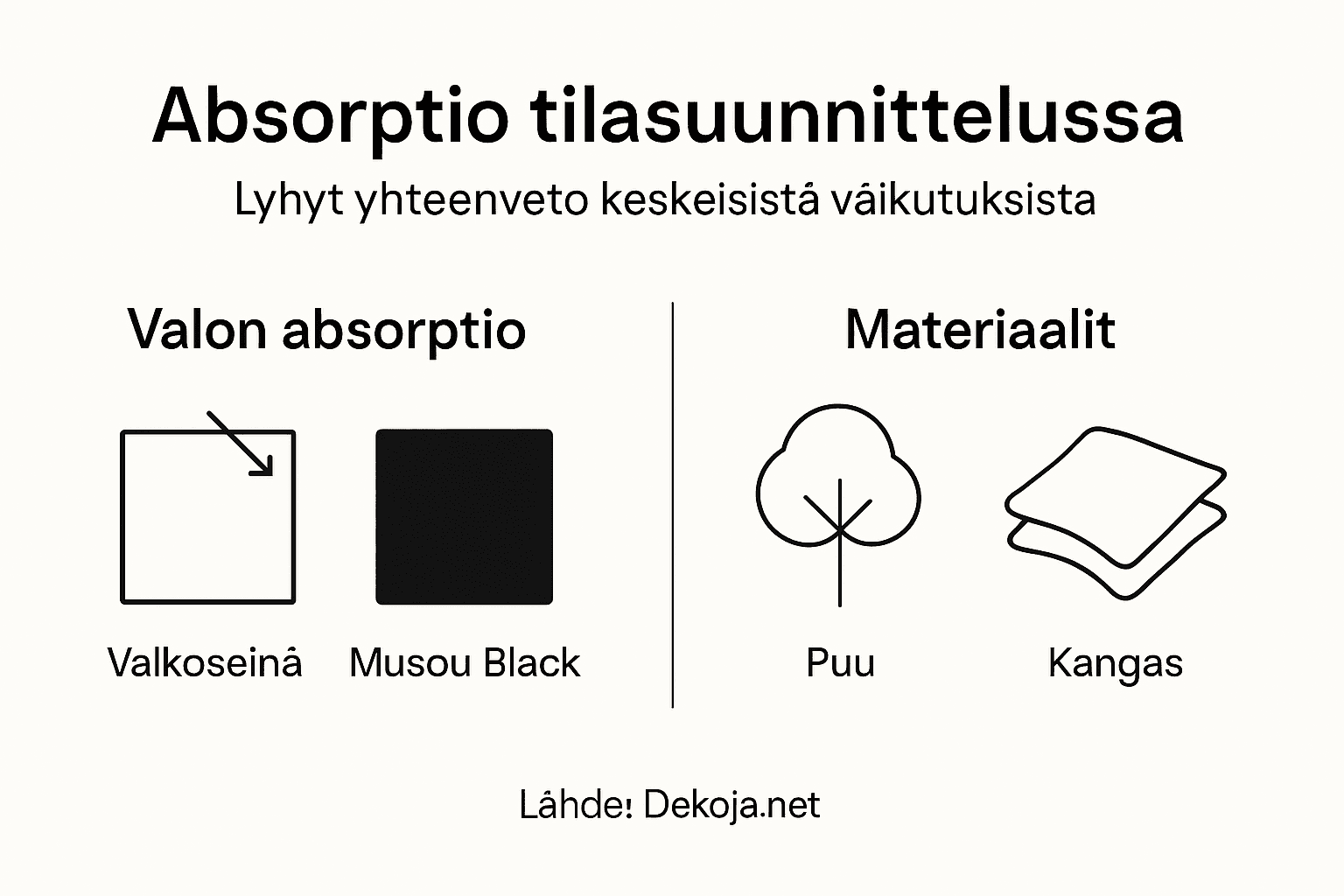
In practical terms, absorption means that while a white wall reflects almost all of the light, a dark or deep black surface absorbs almost all of the light. This means that the material not only changes the direction of the light, but practically “swallows” it.
In spatial design, absorption plays a significant role, especially in creating atmosphere and visual experience. Materials that effectively absorb light can create depth, contrast and dramatization in a space.
Pro tip: Choose materials that absorb light the way you want and create just the right mood for the space.
Different absorption properties of materials
Absorption properties are a key property of materials that determine their behavior with respect to different forms of energy. The materials used in interior fabrics have a significant impact on the absorption and atmosphere of a space.
Materials have different absorption properties depending on their:
- By fiber type (natural fibers vs. synthetic fibers)
- Thickness
- About the structure
- Surface structure
- Density
Natural fibers, such as wool and cotton, behave differently than synthetic fibers. For example, long-pile materials absorb sound more effectively than thin or smooth surfaces.
In practice, absorption properties are affected by three key factors:
- For acoustics
- For thermal insulation
- For visual appearance
In-depth knowledge of materials helps create spaces where absorption properties are optimized to achieve the desired atmosphere and functionality.

The following table summarizes the absorption properties of common interior materials from different perspectives:
| Material | Light absorption | Sound absorption | Thermal insulation |
|---|---|---|---|
| Villa | Moderate | Excellent | Good |
| Cotton | Low | Good | Moderate |
| Polyester | Low | Weak | Weak |
| Wooden surfaces | Moderate | Moderate | Moderate |
| Musou Black | Extremely large | Weak | Weak |
Pro tip: Compare the absorption properties of different materials before making a final choice and test the behavior of the materials in different lighting and sound environments.
Absorption Process: How Light is Absorbed
Light absorption is a complex physical phenomenon in which the propagation of light energy stops when it hits a material. In light absorption, an interaction process occurs between energetic atoms, in which the light energy is converted into other forms of energy.
Key factors affecting absorption:
- Wavelength of light
- Chemical composition of the material
- Properties of the electronic structure of atoms
- Material thickness
- Light incidence angle
The energy of the light is transferred to the atoms or molecules of the material, causing the following reactions to occur:
- Change in electron vibrational state
- Conversion of energy into heat
- Stopping the propagation of light
Complete absorption refers to a situation where all the light energy is absorbed by the material without reflection or transmission. This depends on the chemical structure of the material and the properties of the electrons.
Pro tip: Test the absorption properties of materials using different color temperatures and light angles to evaluate their behavior.
Musou Black and exceptional light absorption
Musou Black is a material revolution in light absorption that challenges traditional notions of color and light behavior. The world's blackest paint is capable of absorbing up to 99.4% of visible light, making it a unique spatial design tool.
The exceptional absorption properties of Musou Black are based on several factors:
- Extreme complexity of microstructure
- Utilizing nanotechnology in pigments
- Special molecular structure
- Absolute light dispersion
- Minimal reflectivity
While regular black reflects 5-10% of light, Musou Black takes absorption to a whole new level. In practice, this means that the material not only absorbs light, but also makes it almost invisible.
In the visual design of a space, Musou Black enables:
- Unprecedented depth perception
- Perfect contrast
- Dramatic lighting control
Pro tip: Try Musou Black on a small test area first to understand how it changes the visual dynamics of the space.
Benefits and risks of absorption in design
The benefits of absorption in spatial design are manifold, but they also come with key risks that the designer must be aware of. The effects of absorption on acoustics are one of the most significant aspects of the functionality of a space.
The main benefits of absorption:
- Sound attenuation
- Improving the acoustic quality of the space
- Adding visual depth
- Contrast control
- Improving energy efficiency
Risks that should be considered when planning absorption:
- Material durability
- Maintenance requirements
- Changes in colors and surfaces over time
- Cost-effectiveness
- Installation complexity
The properties of the materials require careful assessment, as maximizing absorption capacity must not be at the expense of other properties. The intended use of the space and the design goals guide the utilization of absorption.
The table below illustrates the implications of the benefits and risks of absorption in spatial planning:
| Perspective | Benefit | Possible risk |
|---|---|---|
| Acoustics | Damped noise | Excessive attenuation of sounds |
| Visuality | Deeper atmosphere | Darkness of the premises |
| Energy efficiency | Less waste | Material costs |
Pro tip: Test the absorption properties of materials in a real environment before making a final choice and evaluate their effects holistically.
Utilize absorption and Musou Black for perfect spatial design
Absorption is a key challenge in spatial design when the goal is to create spaces where light, sound and heat work seamlessly together with the atmosphere. Are you aiming for in-depth lighting control, sound attenuation and maximizing visual contrast?
Musou Black offers this opportunity as it exceptionally absorbs up to 99.4 percent of visible light, creating a dramatic and clean space without reflections. When light absorption, material selection and space are skillfully combined, experiences that will be remembered can be created.
Take a step towards modern space design and discover how Dekoja.net can help you utilize absorption effectively. Discover the world-famous Musou Black and other innovative solutions that will take your restaurant, home theater or exhibition to the next level. Book an appointment for an expert consultation and start your space's complete transformation right away.
Frequently asked questions
What is absorption in spatial design?
Absorption in spatial design refers to the ability of materials to absorb light, sound, or other forms of energy, which affects the visual and experiential nature of the space.
How do the absorption properties of materials affect acoustics?
Materials that effectively absorb sound, such as long-pile fabrics, improve the acoustic quality of a space and reduce noise.
What effect does light absorption have on the atmosphere of a space?
Light absorption can create depth, contrast, and dramatization in a space, thus significantly affecting its mood and visual appearance.
How does Musou Black differ from other black colors in terms of light absorption?
Musou Black is capable of absorbing up to 99.4% of visible light, making it unique compared to traditional black colors, which always reflect some light.
Recommendation
- Emphasizing lighting in interior design: Create an impressive result – Dekoja.net
- Emphasizing lighting in interior design: Create an impressive result – Dekoja.net
- Emphasizing lighting in interior design: Create an impressive result – Dekoja.net
- Emphasizing lighting in interior design: Create an impressive result – Dekoja.net
- Architecture Feasibility Study | 3D City Planner