

Lighting Best Practices: Enhance Spaces and Ambiance
TL;DR:
- Lighting is the most crucial design decision for a space's functionality and ambiance.
- Layered lighting allows for versatile uses and proactive problem-solving.
- Energy-efficient LED solutions and the right material choices improve sustainability and impact.
Choosing the right lighting defines the experience and functionality of a space more than any other single design decision. In restaurants, galleries, and spatial design projects, lighting is not a final touch but the foundational structure of the entire concept. Yet, it too often gets compromised due to budget and schedule constraints. This article reviews the criteria, practices, and material choices that enable a professional to create lighting that works both technically and visually. The result is a space where customers feel comfortable and the brand is visible.
Table of Contents
- How to Identify the Criteria for Successful Lighting
- Best Practices for Layered Lighting in Practice
- Innovative Materials and Lighting Solutions for Interior Design
- Common Challenges and Their Solutions in Space Lighting
- What's Often Forgotten in Lighting Best Practices – An Expert's Perspective
- Master Lighting Solutions – Learn More About Dekoja
- Frequently Asked Questions About Lighting Best Practices
Key Takeaways
| Point | Details |
|---|---|
| Layered lighting | Utilizing different levels of lighting enables a versatile and functional space. |
| Right materials and technologies | Innovative and energy-efficient materials support both ambiance and sustainability. |
| Design starting point | The needs of users and the space are at the core of a successful lighting project. |
| Challenges are solvable | Most lighting challenges can be resolved with careful planning and skilled execution. |
How to Identify the Criteria for Successful Lighting
Before selecting a single fixture, you need to know what is required of the lighting. Successful lighting doesn't happen by chance, but from clear objectives. The three key objectives are functionality, ambiance, and adaptability. Functionality means the space is safe and practical to use. Ambiance refers to how the space feels. Adaptability means the lighting can adjust to different situations throughout the day.
Layered lighting is the professional's most important tool for achieving these goals. Layering means illuminating the space with several distinct levels that function both independently and together. The four basic layers are general lighting, accent lighting, ambient lighting, and task lighting. Each layer serves its own purpose, and their combination creates a balanced whole.
Light quality is another critical factor. Color temperature is measured on the Kelvin scale: below 3000 K is warm and suitable for restaurants and lounge areas, 3000 K to 4000 K is neutral and works in offices and retail, above 4000 K is cool and suitable for laboratories and technical spaces. Color rendering is expressed by the CRI (Color Rendering Index) value, and for professional settings, a CRI of at least 90 is recommended so that materials and food appear natural.
Adjustability is a criterion often underestimated. Dimmable lighting is not a luxury but a basic tool for professionals. In a restaurant, lunch and dinner times require completely different lighting levels. In a gallery, highlighting an individual artwork requires the ability to lower the light in the rest of the space.
User needs must be mapped out before starting the design. Who uses the space, when, and how? Elderly users need more light than young people. Those doing detailed work need bright, glare-free lighting. Customers who are relaxing need soft, warm light. Layered lighting is a key best practice in lighting design, and it always begins with understanding the user profile.
Professional tip: Create a separate document for the lighting plan, where each layer has its own objective, lux level, and adjustment range. This simplifies both implementation and subsequent modifications.
Best Practices for Layered Lighting in Practice
Once you know the required criteria, the next step is practical implementation: how to achieve layering in different spaces.
General lighting creates an even base for the entire space. It should not be too bright or too dim. In a restaurant, general lighting acts as a background, keeping the space safe and navigable. In a gallery, general lighting should be sufficiently neutral so as not to compete with the artworks. In practice, general lighting is often implemented with recessed LED panels or indirect lighting that reflects off the ceiling or walls.
Accent lighting highlights details and focal points. In a restaurant, this might mean a pendant lamp above a table or a spotlight illuminating a bar. In a gallery, accent lighting is the primary light source for an artwork. Direction is crucial in accent lighting: incorrectly directed accent lighting creates disturbing shadows or glares at the viewer. Adjustable track lights are a flexible solution because their direction can be changed without an electrician.
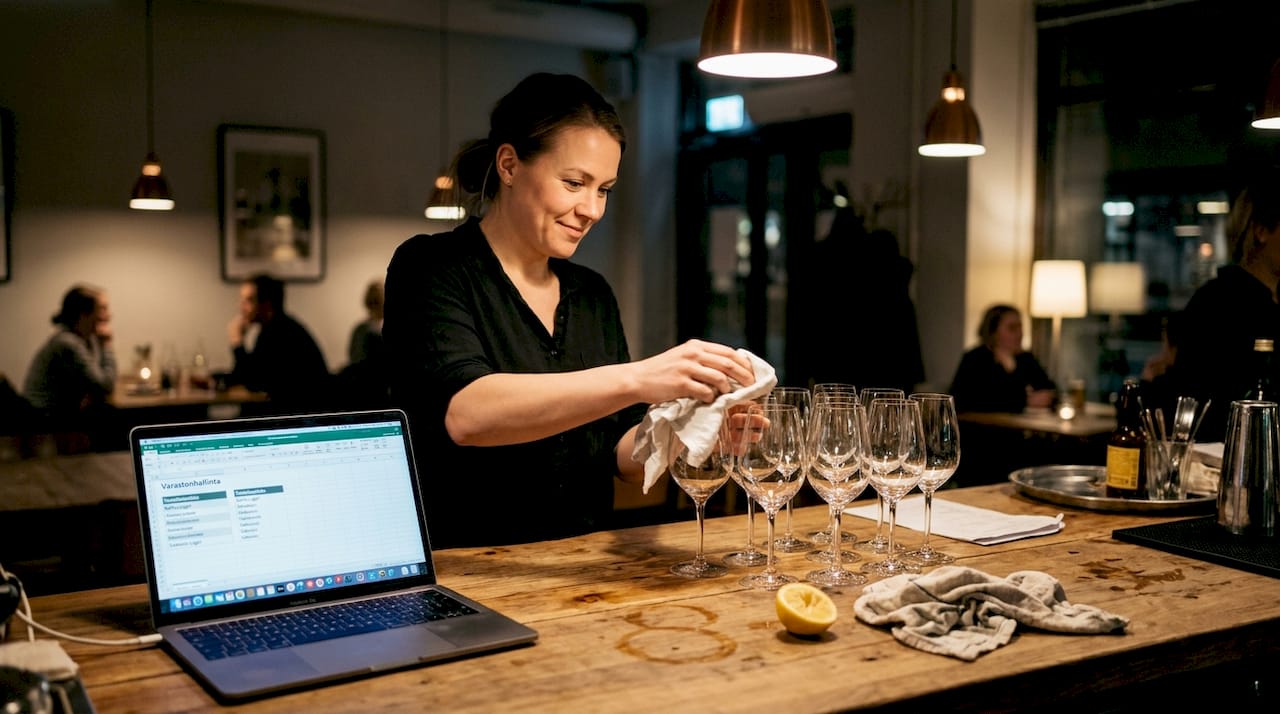
Layered lighting (general, accent, ambient, and task lighting) is essential in all professional settings. Ambient lighting is the layer that makes a space memorable. It can be an LED strip under a bar counter, grazing light accentuating a wall surface, or candle-like warm accent light. Ambient lighting is also the layer where the brand's personality is best expressed.
Task lighting supports ergonomics and precision. In the kitchen, bar, and checkout counter, bright, glare-free light is needed, which doesn't tire the eyes during a long shift. Task lighting is always designed from the user's perspective: from what angle the light comes, whether there are shadows, and whether the lux level is sufficient.
| Lighting Layer | Typical Lux Level | Application |
|---|---|---|
| General lighting | 100 – 300 lux | Entire space |
| Accent lighting | 300 – 1000 lux | Details, artworks |
| Ambient lighting | 30 – 100 lux | Creating ambiance |
| Task lighting | 500 – 1000 lux | Kitchen, office |
In practical implementation, it's worth remembering the following:
- Design each layer on its own electrical circuit for independent control.
- Use compatible LED loads with dimmers to avoid flickering.
- Test the lighting before final installation in a prototype room or model section.
- Document all adjustment values so the space can be restored to its original state.
Lighting design tips for restaurants offer more concrete examples of how layering works in demanding professional settings.
Professional tip: Don't design lighting solely in daylight. Visit the space in the evening light and check how the different layers work together. The eye detects problems better in a real-use situation than from a plan.
Innovative Materials and Lighting Solutions for Interior Design
The implementation of good lighting also requires the right materials and techniques, which is why it is worth comparing alternatives.
LED technology is currently the clearest choice for professional settings. It consumes 70-80 percent less energy than traditional incandescent bulbs and typically lasts 25,000-50,000 hours. LED technology also allows for precise color temperature selection and CCT (Correlated Color Temperature) adjustment, enabling the same luminaire to produce both warm and cool light as needed. LED solutions for spatial design have developed rapidly, and current products are suitable for almost all professional applications.
Fiber optics are a special solution that enables lighting in places where traditional cabling is not suitable. Fiber optics transmit light from the source to the target without electricity in the fiber itself, making it safe for lighting wet areas and objects near water. In galleries, fiber optics are a popular solution for illuminating sensitive artworks because they do not produce UV radiation or heat.
Organic light surfaces, such as OLED (Organic Light Emitting Diode) panels, are the latest newcomer to professional interior design. OLED produces a uniform, glare-free light from a thin surface without point light sources. This enables entirely new surface solutions: lighting can be part of a wall, ceiling, or furniture. OLED is still more expensive than LED, but prices are falling rapidly.
Utilizing layered lighting requires innovative solutions, and material selection is part of this overall picture. The reflective properties of a surface affect how light behaves in a space. Matte surfaces diffuse light softly, glossy surfaces create sharp reflections, and super black surfaces absorb light almost completely.
| Feature | LED | Fiber Optic | OLED |
|---|---|---|---|
| Energy Efficiency | Excellent | Good | Good |
| Lifespan | 25,000 – 50,000 h | 50,000 h | 10,000 – 40,000 h |
| UV Radiation | Minimal | None | None |
| Cost | Affordable | Moderate | High |
| Suitability for moisture | Good (IP rating) | Excellent | Limited |
Material and technology choices also affect how light is accentuated in interior design. When a wall surface is designed correctly, light behaves predictably, and the desired visual effect is reproducible.
- LED: best choice for a combination of energy efficiency and longevity.
- Fiber optic: ideal for lighting wet areas and sensitive objects.
- OLED: suitable for premium applications where uniform and glare-free light is a priority.
- Traditional halogens: only in special cases where color rendering is critical and energy efficiency is not a priority.
Common Challenges and Their Solutions in Space Lighting
Although best practices are known, many professionals still face everyday challenges in lighting design.
Uneven lighting is the most common problem. It arises when a space has bright spots and dark areas without a planned transition. The solution is layering and careful luminaire placement. General lighting should cover the entire space evenly before accent or ambient lighting is added. Dimmers are essential because they allow for balancing different layers according to the situation.
Blinding luminaires are another common mistake. Glare occurs when a light source is directly in the viewer's field of vision or reflects off a glossy surface. Correct aiming is the first solution: an accent light should never point directly into a customer's eyes. Shades and indirect lighting are another solution that softens the light and eliminates the source of glare.
- Check the aim of each luminaire relative to the customer's sitting height.
- Use matte or satin-finished reflectors instead of glossy ones.
- Add shades or louver grilles to glaring spotlights.
- Utilize indirect lighting in areas where customers spend a long time.
- Test the lighting by sitting in the customer's place yourself.
Incorrect color temperature ruins an otherwise successful space. Too cool light in a restaurant makes food unappetizing and the space cold. Too warm light in an office is tiring and reduces concentration. Always choose the color temperature according to the space's purpose and brand. Restaurants: 2700 – 3000 K. Galleries: 3000 – 3500 K for neutral works, 2700 K for warm ones. Offices: 3500 – 4000 K.
Layering is crucial in preventing problems in spatial design. When each lighting layer is designed separately and can be adjusted independently, most everyday problems can be solved without structural changes. Layering is both a preventative measure and a remedial tool.
Energy efficiency is a long-term challenge that directly affects the overall cost of a project. LED technology is the clearest solution, but control systems are also an important part of the whole. Occupancy sensors, daylight sensors, and time schedules can reduce energy consumption by 30-50 percent without compromising user experience. The challenges of restaurant lighting often lie precisely in these practical details, which can be resolved with good advance planning.
What's Often Forgotten in Lighting Best Practices – An Expert's Perspective
Technical criteria and the principles of layering are important, but experience shows that one thing is constantly overlooked: the visibility of the brand and individuality in lighting.
In many projects, lighting is designed technically correctly but visually neutrally. The result is a space that works but isn't memorable. Customers don't remember what the lighting looked like, but they remember how the space felt. That feeling arises precisely from the details that technical criteria don't measure.
Trends and new technologies easily obscure what truly determines the customer experience. An OLED panel is impressive, but if it doesn't support the story of the space, it's merely a technical achievement. Communicative and emotional elements, such as the dramaturgy of color temperature throughout the evening or accentuating a particular surface with brand color, make the space unique.
The benefits of layered lighting are undeniable, but they are only realized when layering serves the space's story and not just technical requirements. The best lighting design is one that makes the brand visible without the customer consciously noticing the lighting.
Master Lighting Solutions – Learn More About Dekoja
Now that you know what makes lighting successful, you can leverage expert services and materials to support your projects. Dekoja.net offers professionals specialized materials that complement lighting design in a new way.

Super black surfaces, non-reflective materials, and optical effect surfaces change how light behaves in a space. When a wall or ceiling absorbs light almost completely, the effectiveness of accent lighting multiplies, and contrasts deepen. This is a solution not found in a typical building supply store. Dekoja.net's services cover both products and project-specific expert assistance from start to finish. Deliveries in 1-3 business days directly from our domestic warehouse.
Frequently Asked Questions About Lighting Best Practices
Why is layered lighting the most important principle in lighting design?
Layered lighting optimizes the functionality of a space and enables a pleasant atmosphere for all purposes. It is the only way a single space can serve multiple different needs throughout the day.
What are the most common mistakes in space and restaurant lighting?
The most common mistakes are uneven light distribution, incorrect color temperature, and blinding luminaires, which can be avoided with careful planning. Layering is crucial for preventing problems in spatial design.
What benefits does LED lighting bring to professional premises?
LED lighting is energy-efficient, long-lasting, and allows for a wide range of lighting effects in various spaces. It reduces energy consumption by up to 80% compared to traditional solutions.
How are different user groups taken into account in lighting design?
Lighting design begins with identifying user needs and the purpose of the space, tailoring solutions to each specific project. Different user groups require different lux levels and color temperatures to achieve an optimal experience.